More

Featuring fresh takes and real-time analysis from HuffPost's signature lineup of contributors
Michael Judge

GET UPDATES FROM Michael Judge
 

The Problem With Tarantino: He Has Nothing to Say

Posted: 08/31/09 05:41 PM ET

Last Thursday, the Post published Johann Hari's critique of Quentin Tarantino's latest film, Inglorious Basterds, in which Hari argued that the director's "terrible moral emptiness" is "wrecking his films." While I share the critical thrust of Hari's accusation--that is, that Tarantino's churning out opulently-made vacuities, the impeccable style-credentials of which appear to be the only reasons for their existence--I could hardly disagree more that what Tarantino's work lacks is a necessary leavening of "moral sensibility" or "responsible ethics"; simply put, Tarantino hasn't got (and, in fact, may never have had) any ideas, an element far less dispensable to a work of art than the vaguely-defined and coercive parameters of morality.

In any given sociocultural gestalt, in any place or at any time, "morality" is at best a byword for the social legislation of acceptable behavior; at worst, it becomes the brutalizing thrust of the authoritarian regime, the terrorist tactics of abortion-clinic bombers and concentration camp directors, the exclusionary measure of xenophobes and economic protectionists. To say that a film, or that any work of art, fails to contain a "moral sensibility" is simply to adjudge the degree to which it falls within the bounds of respectability and politesse established in its epoch and locality; this is the stuff of such reactionaries-in-hiding as Lionel Trilling, whose insistence on "moral education" in his supremely popular and supremely banal 1950 treatise The Liberal Imagination is little more than a middle-class anachronism's attempt to force the concepts of "seriousness" and "respectability" into an uneasy marriage vis-à-vis literature and its critique.

When film is primarily concerned with the edification of its (presumably White, moderate, and at least middle-class) audience and the delivery of some resounding (and resoundingly obvious) moral message, we can expect little more than the hideous banalities and half-baked piety of Paul Haggis' Crash (2004), that turgid bit of empty preaching which briefly made racial tension the Hollywood cause celèbre of its epoch and prompted numerous astonishingly insincere and naïve dialogues about whether or not we, as a nation, had "really dealt with racism"; this is, of course, the sort of question that only the White bourgeoisie can ask with a straight face, and the tendency of that cohort to adopt pet causes for exactly as long as those causes serve to distinguish oneself as a "caring individual," a "charitable capitalist," one who "understands those less fortunate"--in short, to serve as a mode of postmodern identity capital in the terms delineated by Frederic Jameson, to create a public profile for oneself on the architectonic level of a sort of ür-Facebook--is one of its many sickening and venal qualities. Movies centered around the hamfisted repetition of some moralizing truism or vague Unitarian Universalist cliché ("Family is important ... in the end, you get what you give ... we're all just brothers and sisters ... yawn") are doomed to the stifling mediocrity and mouthpiece-for-power-structure status that the visionaries of the French New Wave referred to by that marvelously poisonous epithet, "the tradition of quality."

Here, then, is Hari's principle error, and it's instructive to compare Tarantino's ostensibly "amoral" or "immoral" depiction of violence with an auteur, Stanley Kubrick, mentioned alongside Tarantino in the implication that his stylizations and understandings of the violent gesture are somehow "more moral" and therefore better. Unfortunately for the moralist argument, there is perhaps no modern film more equivocal and ambivalent about the nature of violence and the uses to which it may be put than Kubrick's A Clockwork Orange (1971): this vicious and surreal satire of the changing nature of political power pillories precisely the notion of morality as a behavioral code divorce from regime change and economic exchange and examines the mechanisms by which a given era's moral conception changes to fit the purposes of its sociopolitical power-brokers.

Protagonist Alex DeLarge (Malcolm McDowell's legendarily bravura performance) is, as the contemporary press for the film put it, principally interested in "rape, ultra-violence, and Beethoven"; he and his less "politic, cautious, and meticulous" band of Droogs roam the streets of an apocalyptic London torturing and abusing whatever human objects of fancy stray across their anarchic path. When a power struggle erupts between Alex and the gang, the once-loyal Droogies betray him by leaving him battered and unconscious, and thus easy prey for the police who have as yet failed to pin anything on him, after his murder of an eccentric spinster. (Note here that Alex is not necessarily taken in because this crime exceeds his former deeds, because it constitutes a more serious violation of the moral code--it's quite simply the result of infighting and politicking.) Upon his capture, he submits to experimental psychotherapy that sears into his neurons an indelible association between violence (and, quite by accident, Beethoven's 9th symphony) and feelings of nausea, asphyxiation, and imminent death that makes it quite literally impossible for him to resume his former hellion's regimen; when, in turn, this therapy drives him to attempt suicide, the Minister of the Interior who championed its implementation has the therapy reversed and brings Alex into his inner circle as a poster-child for the lenience and understanding of his administration.

Aside from the fact that Kubrick's film is remarkable qua film in virtually every aspect, one of its most striking features is the absolute lack of ethical outrage with which Alex is treated and the social critique associated with that treatment: his behavior is only "wrong" (that is to say, "illegal") at the outset because it conflicts with the public face of a British parliament that promised to eradicate crime in the streets, and that same behavior, unmodified and reinstituted with a vengeance, is only "right" at the film's conclusion because it serves as proof that the same parliament will refuse to resort to coercive, torturous means to achieve that goal (shades of our own beloved Bush and Cheney here, who instituted torture to combat the inhumanity of torture). Morality as a static and abiding proposition has less than nothing to do with Kubrick's sardonic vision; morality as one more arrow in the quiver of political manipulations, everything.

Tarantino's Inglorious Basterds is certainly no more a violation of moral taboos than was A Clockwork Orange at the time of its release (it was rated X for two years in the United States and thereafter only available in censored form for over a decade; in the UK, the uncut film was nearly impossible to see until the late '90s, and Kubrick had his life threatened and was accused of inspiring copycat crimes): the problem is that Tarantino's violence, and by extension Tarantino, haven't got anything to say. Hari's article is correct to note that Basterds, like most of the director's oeuvre, consists of film-history references and stylistic tropes divorced from any sense of meaning apart from their self-contained connoisseur cachet, but he would be hard-pressed to argue that the better films from which Tarantino draws his stylistic gestures--'60s and '70s American exploitation flicks, vintage film noir, the surreal expressionist horror of Italian gialli, among others--are more "morally concerned" or "ethically responsible."

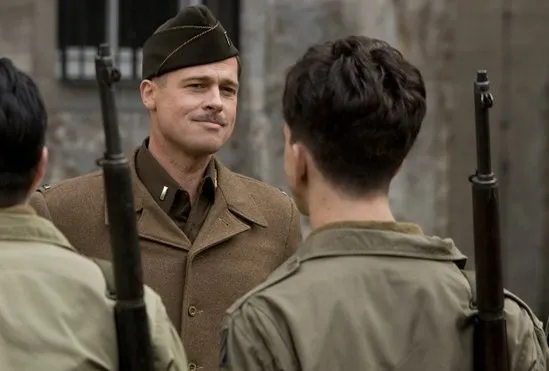
Very few bodies of cinematic work, for example, can lay claim to a more paranoid, cynical, and resolutely amoral understanding of world-processes than the golden-era films noirs, and the crucial difference between The Third Man, Out of the Past, or Touch of Evil and Tarantino's borrowings from suchlike films thus lies in his omission of there being any idea behind his depictions and techniques. If anything, Basterds in its worst moments swings perilously close to a jingoistic moralist's anti-Nazi revenge fantasy: the final sequence in which Lt. Aldo Raine (Brad Pitt) carves a Swastika into the forehead of defecting Nazi intelligence agent and "Jew hunter" Hans Landa (Christoph Waltz) is the moralizing S&M fantasy of a naïve historian who, despite all evidence to the contrary, still believes that Nazism was somehow to be viewed as exceptional among the numerous political power systems founded upon exploitation, ostracism, fear, and murder (these including our own). Much more remarkably absent from Basterds is any notable level of intellectual or conceptual engagement--rarely has a movie about such a cataclysmic event had so incredibly little to say about its subject.

On the technical and stylistic level, it can't be denied that Tarantino still manages the occasional sparkling passage: Landa's virtually monologic opening exchange with a French farmer whom he suspects of harboring Jews is a taut, swift piece of scripting, and the excellent Michael Fassbender is pitch-perfect as the witty, debonair proto-Bond Lt. Archie Hicox. Ultimately, however, these interludes consist mostly of the skillful deployment of cliché, reference, and cultural archetype, and with nothing resembling an idea lurking beneath their impressive surfaces, one wonders why a self-professed student of film history like Tarantino considers them, or any of his work, necessary.


  • Comments
  • 34
  • Pending Comments
  • 0
  • View FAQ
Comments are closed for this entry
View All
Recency  | 
Popularity
Page: 1 2  Next ›  Last »  (2 total)
05:22 PM on 09/02/2009
A complaint that a guy who makes violent films has nothing to say is oxymoronic. So what violent filmmaker has anything to say? And are violent filmmakers even worth critiquing?
02:29 PM on 09/02/2009
The problem with Tarantino is the people writing the critiques.

This one here is a self proclaimed review of a review of his movie. That alone is pretty lame, but then it acts as if it is appraising the appraisal of the holy grail, "that guy is wrong, but it still isn't nearly as holy as I expect it to be!" being the conclusion.

Where did the propensity to line Tarantino's movies up along side the greatest films of all time come from? This movie is exactly in line with his previous works. It's pretty obvious that Tarantino makes movies that he will like and that is where it ends.

It's no surprise that a critic like this wouldn't like it. I highly doubt this critic likes more than one in every thousand movies he sees.
photo
JDM73
male, 38, writer/draughtsman/ex-musician
06:22 PM on 09/01/2009
I never cared much for Quentin Tarantino's work, but I utterly dismissed it when I saw him critiquing Robert Altman's "McCabe and Mrs. Miller" like a spoiled, petulant eight-year-old child. Twisting his hands together, smacking his lips, rolling his eyes. "Now, I don't like the audio...and I don't like the hazy camerawork...and I don't like the way the characters talk over each other." Guess what, Quentin? I couldn't care less what you like or don't like about one of the greatest films ever made. How could Altman have improved on "McCabe", in your humble opinion? Maybe some of the characters should have been werewolves or vampires? Or go-go dancers with black belts in karate?
photo
JaneaneTheAcerbicGoblin
Where's Mr. Darcy?
11:02 PM on 09/01/2009
I never cared much for Tarantino's work either, but I never heard him diss McCabe and Mrs. Miller, which is my favorite Robert Altman film, and one of his very best and most unique films. Maybe Tarantino is jealous of a real artist like Altman.

Thanks for letting me (and the Huffington Post) know about that. Tarantino just sunk some more in my eyes.
photo
JDM73
male, 38, writer/draughtsman/ex-musician
11:50 PM on 09/01/2009
I think Youtube is where I ran across it. I was looking for the "McCabe" trailer and here was this clip of Quentin Tarantino twitching and fidgeting around in his chair, yakking as if he thought his criticism meant anything. I turned it off after about a minute.
03:10 PM on 09/01/2009
Eitehr I am very imaginative or most everyone seems to have missed what to me is Tarantino's main point: It is asking the question which should resonate deeply in a world of Dick Cheney justified torture, which is essentially- it is okay to be brutal and cruel if in service to some "good" cause?
That this author and so many others seem to have missed the point speaks to Tarantino having bungled his message, but to say he has nothing to say, is not fair.
It cannot be a coincidence that the most brutal, violent acts are committed by "our heroes"- the Americans, baseball bats, summary executions, scalping, finger probes of bullet wounds even in those on "our side."
It cannot be a coincidence that the film within the film features "their hero" gunning down our guys. I thin he means for us to wince as their audience cheers their hero's shooting down of our boys. all within a movie in we cheer on the butchering and battering of "them."
To me, the film was too long, badly acted in spots and not entirely satisfying....but it seemed most definitely to be trying to say something.
02:20 PM on 09/02/2009
If that is what he is trying to say I think its irresponsible. The fact is that in the real world we know that torture doesn't work and that we were able to defeat the Nazis and japanese Bushido warriors without using it. Setting up make believe situations where the bad guys are destroyed by brutal violence and torture (e.g. 24) just encourages the sadists and fear mongers in our government who want to extend state power and further erode what this country is supposed to stand for.
09:06 AM on 09/03/2009
I am not sure he IS saying it is okay, so much as asking the audience to think about it. I don't think he is definitely comig down in favor of evil in service to a good cause, just pointing out that whatever side you are on- you think it is okay to do whatever you do to win.
01:29 PM on 09/01/2009
"rarely has a movie about such a cataclysmic event had so incredibly little to say about its subject."

One wonders what film you went to see. Tarantino's been making his own grindhouse b-movies for a while now, and somehow he's fooled some into thinking they are about to see KATYN or SCHINDLER"S LIST---with a title like INGLOURIOUS BASTERDS I guess I see the source of confusion.

This film ends up being very much about our collective intake of WW2 films, and, playing with the genre, is a not "nearly" a fantasy but a full-fledged wish-fulfillment yarn. "Once upon a time" has meaning one shouldn't ignore.

I do find it funny that Tarantino's fantasies are called "immoral"; one should hope so!
02:12 PM on 09/01/2009
I took the "Once Upon a Time" graphic just a cheap riff on the spaghetti western that the scenes and music immediately following were based on. QT's films - to me - seem like they're just threaded together pieces of b-films. Mike Myers playing the stock Brit officer seen in hundreds of British war films... Aldo Rayne being a take on all the b films of Aldo Ray and they like. When the Nazi screams "I have a BINGO!" he seemed to be channeling Col. Klink...

QT has nothing to say. His films violence is comic book and not shocking at all.

I was actually thrilled by IB. I found it a simple war movie crowd pleaser. Nothing more.

It's a handsome movie and there's some nice comments about German and French film making while at the same time nodding to British and American war films. It's amazing that people are looking into deeper meanings with the film. It's paper thin and entertaining. Anyone shocked or moved really need to get out of the house more.
12:09 PM on 09/01/2009
Bravo!

Excalibur wielding of the Fiery Pen, or scalpelquill :-)

Oh, agree about Terantino as well :-)
photo
HUFFPOST SUPER USER
americancolonyinhell
11:52 AM on 09/01/2009
Brilliant response to Hariri's [sic] essay. I'm not sure, however, that Hariri would agree that you read him right. Morality of the sort that you decry in your essay, I would agree, is a kind of public threat all its own. This has been a central issue in Western culture since the advent of modernism in the late 19th century.

Decency is another matter altogether; lowbrow nihilism yet another. Low culture swamping high another still. How much is too much? Personally, I've tired of the rudeness, indecency, stupidity, infantilism, scatology, and complacency of contemporary culture.. This might even be a defining feature of postmodernism [whose lingo, Mr. Judge, you seem to have mastered]: that nowadays the righteous outrage at bourgeous [sic] moral complacency that fueled modernism for nearly a hundred years has curdled into mere license to offend.
11:21 AM on 09/01/2009
Your piece is bang on and beautifully written! As one blogger here has put it, "I am not against violent films, I just can't stand bad films."
photo
HUFFPOST SUPER USER
TreadingWater
I'm proud to say I'm a "Liberal." JFK 1960
10:44 AM on 09/01/2009
Although "Basterds" was violent, it wasn't even close to the misogynistic torture porn that substitutes for movie making in movies like Saw.
12:16 PM on 09/01/2009
So does that make 'Basterds' good, because it was ridiculously violent but LESS violent than another bad film? We have very low standards today.
photo
HUFFPOST SUPER USER
TreadingWater
I'm proud to say I'm a "Liberal." JFK 1960
05:35 PM on 09/01/2009
I didn't find the violence in Basterds that prevalent. It was long and talky just like all of QT's movies, with violence as punctuation.
10:30 AM on 09/01/2009
Well, Mr. Judge, Mr. Tarintino may not have a lot to say, but most certainly the same can not be said of you. "...political power pillories precisely..."; try saying that one 3 times, fast!

To me, Mr. Tarintino's films are his attempt to recreate the thrills he has experienced over the years as a lover of film--not as an academic appraiser--but as a fan—a real FAN---of films. Mr. Tarintino seeks not to fashion cryptic, deeply felt revelations of the human condition....he seeks to create an experience that so many indie-art house flicks rarely manage: enjoyment, escape, entertainment---and all without giant robots, quick-cuts of cgi, threadbare plots or Megan Fox. On that count, I would argue he usually succeeds.

Perhaps he has "nothing to say" in the process...but I'm not sure that's a problem if he never claimed to say anything? It's only a failure if there was something attempted...think of all the maudlin sentiment that turns up in MOST popular tripe and the most overwrought, pretentious indie flicks…THOSE films are failures…they try and they fail. The rest of this is all academic. Arguing whether Tarintino is a lesser artist than Kubrick is like arguing whether Batman can beat-up Superman.

In all your 1,500 words, all you have managed to tell me is that Tarintino films are not your cup of tea....is there anything else about you I should know?
12:17 PM on 09/01/2009
without giant robots, quick-cuts of cgi, threadbare plots or Megan Fox.

No, he has heads exploding (to which we are supposed to laugh), made-up history, threadbare plots, and other "actresses" who are really models.
01:36 PM on 09/01/2009
I get it...It's not your bag. You're not alone. So what? Congratulations? You win? What?

I don't agree with you. I don't agree with the author of this post. PERIOD.
photo
HUFFPOST SUPER USER
RedDogBear
10:09 AM on 09/01/2009
This was a great article. It captured the way I feel about Inglorious Bastards and Tarantino in general perfectly.
10:09 PM on 08/31/2009
I put "Pulp Fiction" up there among the best films ever made but the
decline of Tarentino since this masterwork make me think, he was
just lucky with this film and he had the luxury of a "try out" with "Reservoir
Dog"(in my opinion).

I stopped watching Q's films after Kill Bill, I found all his film after Pulp Fiction
embarrassing. The way he explores violence is childish and sterile.

I am not against violent films, I just can't stand bad films. There have been
many great and violent films :"Collateral","The Godfather","Saving Private Ryan",
"Scarface","Apocalypse Now" and they were great because we learnt something
from it or we felt touched but maybe because I am not into video-gaming, I
can't just get it but I can leave with that :)
photo
HUFFPOST SUPER USER
Frank Smith
11:02 PM on 08/31/2009
I really liked Jackie Brown, which isn't especially violent for a crime film. Death Proof is very entertaining. Kill Bill ran out of steam after Vol. 1.
10:05 PM on 08/31/2009
Oh, finally. Someone gets it right! Spot on, Michael Judge.
HUFFPOST SUPER USER
Winning09
06:37 PM on 08/31/2009
Uh, isn't Tarantino a guy who LOVES B-movies?

His movies are about movies.
04:35 AM on 09/01/2009
Yup. He's just a very good gleeful mashup artist. I'm not even sure he'd mind being called that.
06:33 PM on 08/31/2009
Boy I guess what you take into a Tarantino is what you take out of it. This guy not much in and not much out. Check out this link review: http://www.focusfree.blogspot.com for someone who has posted 7 installments of a review and is still going. Lots and lots to see in this movie. That is, if you take in lots and lots in your head.