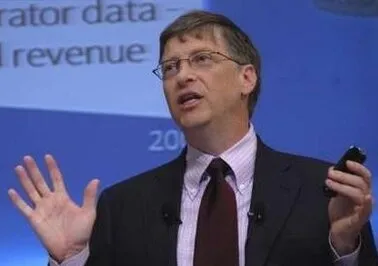
Bill Gates retires as a full-time employee of Microsoft, the company he founded, this week -- ending the most successful capitalist career of all time. He is going to devote the rest of his active years to philanthropy. He is already the world's biggest philanthropist. And even before he begins this new chapter, he is arguably the most successful in terms of the impact the Bill and Melinda Gates Foundation has had. (Bias alert: As editor of Slate, I was a Microsoft employee for seven years. My wife, Patty Stonesifer, is CEO of the Bill and Melinda Gates Foundation, although she is leaving that post in September. I have good reason to be grateful to Bill Gates.)
Despite his move from capitalism to philanthropy, Gates believes that some of the world's problems -- especially the problems of the world's poorest countries -- are too big to be solved by philanthropy. Only capitalism can address them successfully. But -- as he argued in a speech at Davos in January -- capitalism is much better at serving the needs of the the prosperous than the needs of the poor. He goes on to argue that capitalism needs to be, and can be, reformed to solve this problem. He called this new system "creative capitalism."
The notion that capitalism, which is all about self-interest, can be amended somehow to be more about helping others -- and still be capitalist -- struck many (me included, at least at first) as hopelessly Pollyannaish and a little bizarre. Not only is Bill Gates the most successful capitalist of all time, but amending capitalism to serve the poor has not until recently been on his agenda. Gates' approach has been to take capitalism for all that it is worth, squeeze every penny out of it, and then take the money and give it all away. This is a much more traditional strategy, employed by the Rockefellers, Henry Ford, Andrew Carnegie and other giants of industry who became giants of philanthropy.
It's hard to remember how quickly Gates' reputation as a philanthropist -- and the reality behind it -- have blossomed. A couple of years after Slate started publication in 1996, we instituted a feature called the Slate 60. Now an established and respected circulation-boosting gimmick, the Slate 60 is an annual list that ranks people on the basis of how much they give away. It derives from an idea of Ted Turner's, who told Maureen Dowd, who wrote a column about it. Turner said that very rich people weren't giving away as much money as they might otherwise because they were afraid of falling off or moving down the Forbes 400. A replacement list based on giving money away was supposed to solve that problem.
The first year of the list, Bill Gates was number ten. He was asked constantly about why he wasn't giving more of it away, and he always insisted that he would do this as soon as he had the time to do it as intelligently as he tried to "do" software. The next year he came in first, and he has remained there or close most years since.
So why isn't his approach -- make the money, then give it away; "to every thing there is a season," and so on -- the right approach? That is one question raised by creative capitalism. There are others. Wouldn't the small-d democratic approach be: make the money and then tax part of it away? When corporations start giving money away or devoting it to good works, aren't they cheating their shareholders? (That was Milton Friedman's position, you won't be surprised to hear.)
To explore these questions, I'm producing a book. And "producing" is the right word. This is a literary experiment as well. The book will be derived from a private website and a public blog in which economists and others debate whether "creative capitalism" is meaningless, dangerous, useless, maybe useful, very useful, or brilliant. Anyone interested is welcome to join in at creativecapitalismblog.com. As the project progresses other contributions to the book will be published on this site and perhaps elsewhere -- all in the spirit of web collaboration. The book will be out by the end of the year.
And in the spirit of capitalism, contributors will be paid. The amount you get will be a proportion of the advance based on the number of your words that end up in the final product (as edited by me). We hope that this will create the right balance of incentives between writing long and writing deep. No guarantees, but we expect the payout to end up around a dollar or two per word. And if you're thinking that's not much, coming from Bill Gates -- Gates has nothing officially to do with this project. Nor does the Gates Foundation (unless you count glancing at printouts left by accident on the kitchen counter as "official"). The money comes from the bounty of Messrs Simon and Schuster.
Want to reply to a comment? Hint: Click "Reply" at the bottom of the comment; after being approved your comment will appear directly underneath the comment you replied to
Wiki hard-copy publishing, interesting.
I may have to throw in my 2 cents about capitalism at heart being less a theory than a forse of nature-you can have theories ABOUT it, but it exists separate from those theories and rears its head in all sorts of other economic systems. And because of that you don't have good or bad capitalism, you have better or worse versions of it, kinder or meaner practitioners or it, greed or philanthropy by its practitioners. But capitalism, like survival of the fittest, is amoral and there whether you like it or not.
I agree that capitalism is more like fire, a natural force, than a "system," that people agree to. Capitalism existed in the USSR, it was exercised freely by party hacks who could afford foreign health care or dachas. Like fire, we can use it in constructive or destructive ways, and that's worth arguing about.
Capitalism as encouraged by Bush is not an "level playing field" but rather is rigged to benefit specific clients, such as big pharmaceutical companies and big oil. There are no "level playing fields" but it is the business of good government to regulate capitalism so it produces socially useful results while remaining free enough to generate and abundance of products and services.
Requires honestly applied intelligence, this administration fails both criteria.
It's amazing how much of the discussion of capitalism is uninformed, especially about the failure of the alternative "socialism" proposed and rejected in the 20th century.
Marxism was always an unscientific theory, gasped by millions who needed social change or national liberation. Just one small illustration. The Marxian definition of value is the effort that "workers" put into a product. Marx says that capitalists steal this value when they profit. This concept was actually invented by the Catholic Church, which has a teaching about what a "fair price" would be, based on the same definition of value.
This is medieval Thomistic thinking, stolen by Karl Marx for his third-rate ideas.
Marxism may have been useful to some in overturning obsolete economic structures, but it failed as a viable system . Ask Russia and China.
The kind of "free market" capitalism proposed by the Bush idiots is just a cover for corruption, and that's in the process of failing.
It's clear that the capitalist core of our economy needs to be responsibly regulated and inserted into a national economic model. The Bush cowboys always deride the idea of a national plan, and now the Chinese, who have one, are publicly heaping scorn on the Bush robber-ocracy.
The Europeans are ahead of us, with responsibly applied capitalism unburdened by the huge wasteful war machine that drains us and helps us create death around the globe.
We have a lot of work to do, but prattling economic nonsense will get us nowhere.
Capitalism is, among many things, a legal way of stealing. Those who prosper the most do so entirely on the backs of others and the inherently "criminal" manipulation of markets in a manner contrary to the public good. Its basic premise has been reduced to a seductive fiction by its practice in the service of unenlightened but ever so powerful self-interests.
you want the truth? you cant handle the truth.
learn about the true nature of capitalism.
all the gory details in a paper I wrote called "fractional reserve banking as economic
parasitism"
http://econpapers.repec.org/paper/wpawuwpma/0203005.htm
endorsed by two phd economists. printed in nexus
magazine, 60k world circulation. #1 top downloaded
economics paper. used by economics
teacher in australia as standard classroom material.
more info on request.
recent supporting material:
The Shock Doctrine: Naomi Klein on the Rise of Disaster Capitalism
http://www.democracynow.org/article.pl?sid=07/09/17/1411235
Confessions of an Economic Hit Man: How the U.S. Uses Globalization to Cheat Poor Countries Out of Trillions
http://www.democracynow.org/article.pl?sid=04/11/09/1526251
John Perkins on "The Secret History of the American Empire: Economic Hit Men, Jackals, and the Truth about Global Corruption"
http://www.democracynow.org/article.pl?sid=07/06/05/149254
Video, senator/pres candidate Dennis Kucinich
at last years 2005 Monetary Reform Conference
http://www.monetary.org/video/kucinich/win_broadband.wmv
Money as Debt, video by Grignon
http://video.google.com/videoplay?docid=-9050474362583451279
The rise or fall of government-country resides upon the growth or decline of the economy. By this standard the economy of a rising government-country provides the citizentry at all levels of the organization virtually unlimited opportunities to develop competence as owner, employee or public bureaucrat. Taxation is directed to individuals and organizations most able to pay. The Country protects businesses from unfair foreign or monopolistic competition. Decisions are built upon valid and reliable working knowledge available.
By the same standard in a failing organization, the legal barriers hinders economic growth or productivity. What economic activity that does exist becomes concentrated in the hands of the few. Foreign influence and monopolistic competition beccome the coin of the realm. Opportunity for the many dries up. The competent and highly skilled are forced into retirement or disguised under-employment. Taxation is thrown on those least capable to pay. Business is at the mercy of predatory targeted competition by foreign and monopolistic economic organizations that force distressed selling, reorganization or bankruptcy. Decision making is the result of unreliable, intentionally skewed knowledge intended to hide the grim truth from the citizens.
In this "Free Trade" world those governments that apply sound business principles and practices to their economy and protect their industries and technologies against unfair encroachment: such governments administer growing and developing countries of increasing wealth, plenty and competence for all their citizens.
Those governments that ignore such obvious safeguards and rules of civilized capitalism lead their citizens towards decline.
To say that the wealthy got there through some economic model, capitalism, is untrue. Before the "person" status of corporations, few managed to acquire such immense wealth as seen by the Exxon owners-Rockefellers, media baroness-Patty Hearst, railroad barons-Vanderbilts,etc. In the course of business, when doing public harm these barons/baronesses were held liable for their damages and as such their wealth was kept to what they could reasonably afford to look after. Unlike today. With the "person" status, corporations can bribe officials legally and have their speech(bribe) protected as free speech. We working stiffs do not have that opportunity. It is not an even playing field. If the laws are followed by all alike, people and corporations, then you won't see the tremendous inequities we see now; if GE were a country they'd be ranked somewhere around 23rd in GDP. There's nothing wrong with self-interest. There's something wrong when the Supreme Court rules that the wealthy, under disguise of corporations, can be held less liable than regular folk. Just look at the Exxon Valdez ruling this last week. The damages award was cut in half by the Supreme Court. Why is the SCOTUS wiping away a jury's ruling? That's the kind of junk I'm talking about.
capitaliism without social responsibility is fascism. the day when increased productivity became the currency of the stockholder and not the employee, was a sad day indeed.
What does it profit a man to gain the world if he loses his soul?
Or if you don't give a rat's long pointy tail about your soul, what does it benefit you to gain the world if you ruin it in the process?
I am not talking about global warming. I am talking about visiting hardship on your neighbor for your own profit, which is what corporations will do if not guided by principle over profit. And boy are they busy doing it right now. The destruction of America's middle class is all but complete, they now being the less poor of the poor.
No amount of altruism will rectify this. To put the philosophical shoe on the other foot, if government took all of your work product and left you less than enough to live on, you would overthrow the government. And so an overindulged government is the metaphor for capitalist altruism. They took your work product and are spending it in the way they see fit, rather than trusting you to do what is right.
And boy is that a load. Poor people are generous to a fault and the rich give nothing by comparison to the day to day charity of the people. So don't concern yourself on how to make capitalism more charity friendly, just make Bill pay his workers more money.
I wouldn't mind paying more taxes if I thought the government spent it well. They waste so much of our tax dollars. I would rather give to charity then the government. Just finished reading "Atlas Shrugged". What would happen if the rich got tired of supporting the poor? I have two questions- What percentage of a rich person's income should go to the government and at what income is someone rich?
Georgia..Atlas Shrugged is great reading..but..written by a nutjob who hated philantropy of any kind, Ms. Rand believed in personal responsibility (I do too...very strongly)..but...I make exceptions for starving children, wounded soldiers, abused women..the list goes on.
Like the other poster..I too, would not ;mind taxes..."if"..they actually went toward infrastucure, again..hungry children..and NOT into the coffers of multi-national agri-business (ADM, MON)...and big OIl...explain to me again..how Exxon can still get subsidies..
PEOPLE could make compassionate capitalism work..sadly..first, we have to find the hubris and greed gene (I believe Cheney is patient Zero...)...and make it a "bad" thing..not something to which to aspire.
I make a living in what should be a perfect capitalist biz..i.e., stockmarket..but..I think people should INVEST..not trade... I'd get rid of all cap gains taxes..IF YOU HELD YOUR INVESTMENT OVER 5 YEARS..if you day trade...sorry honey...I'm taking 50% of your gains... what say we start there?
Capitalism is toast. We need a new economic model that preserves entrepreneurship but adds ecology and the common wealth as a limiting principle. We must erase the principal axiom of Capitalism--growth--and put in its place an axiom of balance and sustainability.
And then what?
Axiom in place.
Entrepre.... free enterprise is the vehicle.
Sustainability and ecology are the principles of the new model.
What do we do about return on investment?
Money makes money.
Without control of the money supply through a strong monetary system that is aimed at those goals, the global financial powers will thwart any threats to its way of being, and its existence.
So, how do you get control of the money supply of this nation, and turn it towards a priority use that is compatible with your principles and your axiom, as good as they are.
Thomas Jefferson kind of warned us in a pretty straightforward way.
"If the American people ever allow private banks to control the issue of their currency, first by inflation and then by deflation, the banks and corporations that will grow up around them will deprive the people of all property until their children will wake up homeless on the continent their fathers conquered."
Sound familiar?
The answer lies in how the rich distribute their money. Cindy McCain's foundation gives lots to their kid's private school. Harvard is rolling over in its grave with bequests. Barbara Bush gave money for Katrina victims, but some percentage had to be spent on educational software her son produced. Opera and art museums and places willing to name a wing for donors do well.
Our government borrows money for the benefit of the very rich, who are free to spend it on yachts and Norwegian currency and houses in Hong Kong and Italy. This won't help the middle class pay off our country's debt.
Since neither our government or the rich can be trusted with all those trillions, I think either me or the Netherlands should manage it.
You're right about that "distribution" of the money thing.
Seems to work like - those who do the distributing are the ones that have the most of it to use.
Funny that way.
And when they're doing the distributing, it matters not whether it is used against the economic interest and well being of the people of America.
The money system is used to get the highest return.
To the people with the money.
All of the puny financial underpinning that exists in this country is based on the deposits of the commercial banks. All the investment banks are about broke, counterparty wise.
So, our commercial bank depositors are bankrolling their party.
Part of which is the fact that, as you mentioned, our government MUST borrow money from these people, who don't have it, but who have the power to create it out of nothing but the trust that the government will pay it back. With interest. Or, in other words, about three times over.
Seems a kind of roundabout way for those guys who do the distributing to get their invisible hand into the pockets of the taxpayers of this country, who must pay that money back.
What's wrong with this picture?
The government of this country is controlled by the cabal of the private banking industry who use the money system to exercise its power.
The Chicago Plan.
A quiet revolution.
By the pen.
I hope you include Barbara Garson's comment, which goes (roughly): Capitalism is the theory that the worst people, guided by the basest instincts, will somehow produce good.
A partnership between a business and a union is a good way to share the profit pie. In exchange for an honest days labor and an effort to increase the profit of the business. In exchange, the business gives a negotiated wage to his worker,, union members. This is also a fine way to break the glass ceiling for our Female population.
The stagflation started long ago when unions were busted by our leaders and the department of labor.
Each and every time a business faces a union vote they threaten to fire everybody or go out of business. They then must decide to either break the law or become a union shop or go under. Most become a union shop and discover that these people that are suddenly getting a decent wage for a decent days labor are much more company oriented and will ing to make a great effort to help their business. These business' are quite often very surprised. In many cases they have a pool of trained employees that are available on call.
The fear and smear used by our Taliban party has also been used to defeat the union movement.
The union movement created the middle class. The union movement will bring back the middle class.
By electing progressive candidates that support our citizens right to unionize and ignoring the fear passed down from the CEO and his little people that do his bidding.
I thought foundations were creative capitalism?A good way not to pay taxes and great jobs for your freinds and families.
My first reaction to the idea of creative capitalism (crapitalism) was also that the notion is pollyanna-ish. Philanthropy and capitalism are mutually exclusive ideas, at first glance. In thinking a little about it, in order for creative capitalism to work, mutual benefit must be derived from the company and from the people who receive the charity from that company. I think this is doable, and ultimately sustainable, but that it requires a concerted, coordinated effort to get it going. In essence, a company is "investing" in individuals, making them viable, productive members of society, and, if possible, the company itself. If this strategy becomes commonplace, the effect is one of firm and serious uplift for the entire economy, and the fortunes of the business sector in general. It's a good idea and it can be done.
The traditional "Gates method" is too altruistic to catch on with the corporate world, apparently. Their capitalistic self-interest is too great for it to be significantly sustainable. And, in my opinion, the main reason Bill Gates started up his foundation is because he simply has too much money, amazingly, more than he, or we, can fathom--not because deep, deep down, he's an altruist at heart. He was drowning in it, being entombed under the weight of it. Best to just get rid of a lot of it. Ted Turner, on the other hand, *is* an altruist at heart.
LOL. I hope the term "Crapitalism" catches on. Michael? Are you paying attention to the comments as well as your website? I guess I should qualify my statement, as the use of the term would be fitting only if the collaboratively written book comes to the conclusion Creative Capitalism, as espoused by Gates, would mostly be smoke and mirrors.
I was with you until you started to 'guessing' Gates' and Turner's motivations to give. Who cares? They give, don't they? I agree that we shouldn't simply rely on the wealthy to be charitable, but let's not pick them apart if they do! We wouldn't want to discourage them. :P
Researchers have found that it is possible to guess many -- if...
MOSCOW — Russia's first lady Svetlana Medvedev took...
HAPPY FOURTH OF JULY! The American flag has been painted on bathing...
After a long flight, the first family touched down in...
The first lady's garb is a great way to gauge what's hot for summer style. Michelle...
I wish Hunter S. Thompson had lived to see this. As Hunter said, "When the going gets weird, the...
Anyone who is in any way surprised by Sarah Palin's announcement today that she will...
Michelle Obama traded the traditional red, white, and blue for Saturday's 4th of...
Alaska's Republican Sen. Lisa Murkowski issued a surprisingly harsh statement late on Friday, ripping...
Dickipedia is HuffPost Comedy's...
The Cruise family is down under at the moment, and Sunday Tom, Katie and Suri went to the stage production...
I'm liveblogging the latest Iran election fallout. Email me with any news or thoughts, or follow me...
During his interview with ABC's This Week on Sunday, Vice President Joe Biden made...
It's been amusing to observe, in the past few days, Sarah Palin hit the media...
A long weekend, parties, crazy hats, fireworks, and fun...
JOHANNESBURG — Namibia's annual commercial seal hunt will go on...
Posted June 26, 2008 | 09:46 PM (EST)