
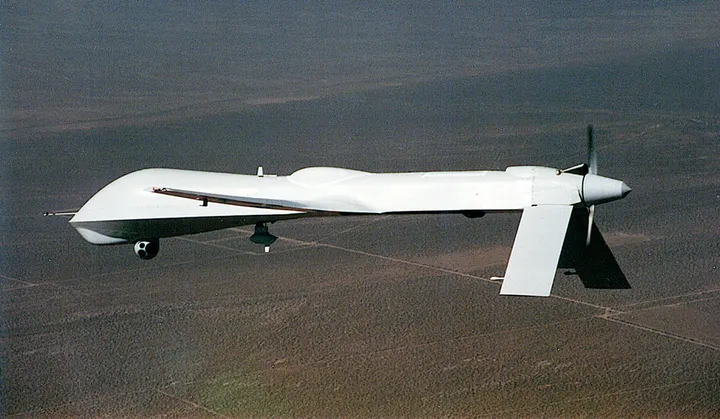
As the world marks the one-year anniversary of the May 2, 2011, assault on Osama Bin Laden's Abbottabad abode, there has been much talk about the various components of the U.S. counterterrorism toolbox. Few have received more attention than the drone.
On April 30, for the first time, the Obama administration admitted to using this weapon against terrorism suspects abroad. In an address at the Woodrow Wilson Center, White House counterterrorism czar John O. Brennan described these "targeted strikes" as both legal and just. Yet perhaps most extraordinarily, he declared that civilian casualties have been "exceedingly rare."
Human rights activists reject -- rightly so -- such sanguine statements, and the case of Pakistan arguably buttresses their argument the most. A Bureau of Investigative Journalism report released earlier this year projects that drone strikes have killed dozens of civilians who were rescuing victims or attending funerals for those killed in previous strikes. The organization also concludes that up to 535 civilians have been killed by drone strikes in Pakistan since President Obama took office (Washington disputes such figures). Meanwhile, the New America Foundation estimates that up to 17 percent of deaths from drone strikes in Pakistan have been those of civilians.
It is important, however, that debates about humanitarian impacts not be fixated solely on civilian deaths. This is because in Pakistan, drone strikes do so much more than kill civilians.
Consider the communities most affected by drones. They are situated in Pakistan's tribal zone, a region long buffeted by war. According to Save the Children, fighting has displaced 250,000 Pakistanis -- most of them women and children -- in one tribal agency alone (Khyber). Throughout the tribal belt on the whole, more than a million have been uprooted by violence. The tribal region, like other areas of Pakistan, was also hit hard by catastrophic flooding in 2010, and many people remain internally displaced from this humanitarian disaster.
So imagine, for a moment, what may ensue when a drone detonates in this region rife with displacement. Even if the strike does not kill civilians, it may destroy a family's home only recently rebuilt, or maim a child ravaged by displacement-related hunger or ill health. Little wonder an investigation by the Campaign for Innocent Victims in Conflict (CIVIC) published in late 2010 found that Pakistani civilians affected by drone strikes are in particularly desperate need of assistance, given that they were suffering from poverty or displacement long before they became civilian casualties.
Equally heartbreaking is the psychological toll. One need not have his or her home destroyed, or a loved one killed, by a drone strike to be traumatized. The mere sound of an approaching drone, in fact, can be just as devastating as its detonation. I have heard Pakistanis speak about children in the tribal areas who become hysterical when they hear the characteristic buzz of a drone. CIVIC's report has found that drones frequently "hum overhead" 24 hours a day, and that six of them sometimes linger above the same area -- "often flying close to the ground and putting people in constant fear of being hit." Imagine the effect this has on psyches, and particularly on young ones already scarred by war and displacement.
Ironically, Washington points to these tactics as proof of the efficacy of drone strikes. In his April 30 speech, Brennan noted that having drones linger over their targets for days allows for "surgical precision," thereby hastening "the ability, with laser-like focus, to eliminate the cancerous tumor called an al-Qaeda terrorist while limiting damage to the tissue around it."
My point here is not to condemn drone strikes outright. After all, they are less deadly to civilians than are many other tools of warfare. And they have eliminated brutal militants such as Pakistani Taliban chief Baitullah Mehsud and al-Qaeda-linked extremist Ilyas Kashmiri. Yet the complex human cost cannot be overstated.
Fortunately, Washington's apparent new transparency on drones provides a silver lining. Now that the U.S. government officially acknowledges their use, it no longer has an excuse not to provide compensation to civilian victims (Washington has in fact already employed such programs to aid civilian casualties in Iraq and Afghanistan). Such a measure may not win many Pakistani hearts and minds. But it would at least illustrate that Washington is, at last, willing to address the tragic consequences of what Brennan describes as an "essential" tool of counterterrorism.
Follow Michael Kugelman on Twitter @michaelkugelman