Seven Ways To Be Happy in a Smoking Country

digg Share this on Facebook Huffpost - stumble reddit del.ico.us RSS
What's Your Reaction?

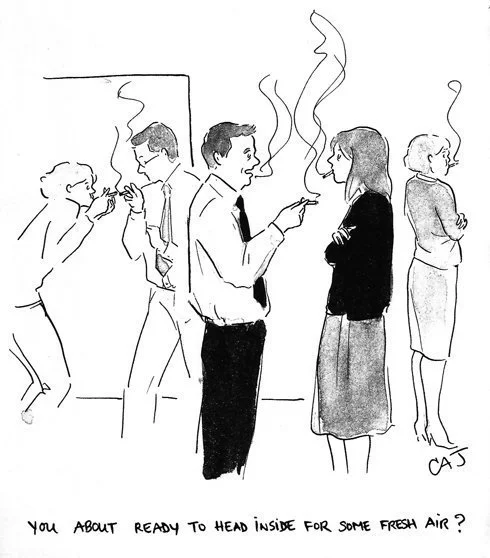
I don't like it when people smoke around me. I don't like breathing cigarette smoke, I don't like getting it on my clothes, hair and skin, and perhaps more than anything else I don't like the inherent civic rudeness of public smoking - the idea that someone can contaminate the air of someone else without a second thought.

But sometimes my desire not to be around cigarette smoke runs up against other desires: for instance, my desire to have a good time on my trip to Spain this summer.

Spain has history, culture, cities, beaches, and really attractive people. Spain has a lot of smokers, too. Spaniards smoke in restaurants, they smoke in bars, they smoke while pushing strollers, they smoke on the beach. Spain has a toothless no-smoking ordinance, so in the majority of smaller restaurants and bars everyone can and does smoke.

I didn't fly to Spain to mainline other people's nicotine, but on the other hand I didn't fly to Spain to be crabby and obsessive. What to do?

One idea central to coaching and positive psychology is that how we choose to perceive things affects how we feel about them. As I walked around Barcelona trying to find a place where I could eat without getting cinders in my eyes, I came up with this list of tips for being happy in a smoking country.

  1. Create a goal, not an expectation. When I assumed that restaurants in Spain would be nonsmoking and discovered they were not, I gnashed my teeth. When I changed this expectation into the goal of finding one of the handful of clean-air dining places, I walked with a different attitude. It was like a treasure hunt: "I know there are some smoke-free restaurants here in Barcelona, and I am going to succeed in finding one! And it will be awesome!"
  2. Practice gratitude. As Martin Seligman points out in Authentic Happiness, when you articulate what you're grateful for, you see the glass as half-full rather than half-empty. I recited some of the things I was grateful for. "I'm grateful that I live in a city that has smoke-free restaurants, and I never even half to think about these things." "I'm grateful that I have this chance to see another culture." "I'm happy that I have the choice to eat out in restaurants."
  3. Compare downward. Comparing ourselves to others makes us unhappy. However, as Sonia Lyubomirsky explains in The How of Happiness, comparing yourself to less fortunate people actually makes you feel happier. I thought, "People in Spain who want to avoid public smoking have a hard time, whereas where I live in New York it's pretty easy."
  4. Anticipate, Relish, Remember and Share. Gretchen Rubin at The Happiness Project taught me this. Any experience yields more happiness if you anticipate it ("dinner in whatever smoke-free restaurant we find will be great tonight!"); relish it ("are these the best patatas bravas you've ever had, or what?"); remember it ("my waitress was so nice last night") and share it ("check out this photo of my favorite restaurant in Madrid - it was awesome and smoke-free!")
  5. Assume positive intentions. If people are smoking two feet away from you, it doesn't necessarily mean that they are deliberately trying to bother you. It's possible they are unaware. It's possible that they have different cultural mores. Is it possible that they contribute to Greenpeace and visit their grandmothers every Sunday. When I assumed positive intentions, I realized that no one was deliberately trying to sabotage my trip. They were just doing their thing.
  6. Ask for what you want. Asking for what you want is the opposite of being powerless and a complainer. A couple of times I asked people not to smoke, usually when I was standing in the reception area of a larger restaurant that had some kind of no-smoking section, and someone obliviously wandered in from the street puffing on a cigarette. Saying, "Disculpe, no se permite fumar aquĆ­," didn't result in anything bad. In each case, the person apologized and put out his or her cigarette immediately. They were just unaware.
  7. Notice what's right. This is another re-framing technique so that what is bugging you is not the entire focus of your thoughts. What was right: Spain was gorgeous. I could speak with people and be understood. It was not crowded. The food was delicious everywhere I went. People were friendly. I had a great time.


Follow Michael Melcher on Twitter: www.twitter.com/MichaelMelcher

I don't like it when people smoke around me. I don't like breathing cigarette smoke, I don't like getting it on my clothes, hair and skin, and perhaps more than anything else I don't like the inheren...
 
Comments
7
Pending Comments
0
iPhone App Promo

Want to reply to a comment? Hint: Click "Reply" at the bottom of the comment; after being approved your comment will appear directly underneath the comment you replied to

View Comments:
- zule I'm a Fan of zule permalink

I have a big emotional charge when people smoke around me. It ties into my larger conversation on how thoughtless people are. I can get pretty self-righteous.

In my training as a coach, I learned these distinctions in communication: (1) charge down - there's little emotional energy in what's being communicated; (2) charge up - there's high emotional energy and (3) charge neutral - there's the right balance for the situation.

When I ask a cigarette smoke to put out their cigarette in a charge neutral way, it works, When I don't, it doesn't!

Also, my definition of happiness is accepting what is. In a smoking situation, I have the choice of "getting off" my position and being with the smoking.

For different perspectives on the relationship between aging and happiness, you may want to visit this site- happiness-after-midlife.com

    Favorite    Flag as abusive Posted 11:29 AM on 09/19/2009
- Halsey I'm a Fan of Halsey 33 fans permalink
photo

Man...I'd put up with smoke to go to Spain, or France or Italy....I can was my hair...put up with stinky clothes..J­UST for the experience of having the means to fly there and stay there a while....I­'ll trade you my non smoking Los Angeles for Barcelona any day of the week..oh..­and twice on a.hhay's....a.hh..las Ramblas...

    Favorite    Flag as abusive Posted 10:22 AM on 09/18/2009
- Bethab I'm a Fan of Bethab 8 fans permalink

Wow...it must be hard to live in your world where you are perfect and others are not.

"If people are smoking two feet away from you, it doesn't necessarily mean that they are deliberately trying to bother you"

They are NEVER deliberately trying to bother you. They don't care about you. It has nothing to do with you. Self-obsessed much?

"inherent civic rudeness of public smoking"

As oppposed to the rudeness of thinking that what you care about matters more than what others choose to do? Sorry...I'­m not a smoker but I'll take being around a smoker over being around a self-rightous, self-important blowhard.

    Favorite    Flag as abusive Posted 11:17 PM on 09/17/2009

You miss the point. Smoking in public causes negative externalities. If someone smokes, they are polluting my air as well as theirs. It's the polluting-­without-as­king that's offensive. I have no involvement in other people's choices so long as they don't restrict mine. And I don't expect to be able to things that bug other people.

    Favorite    Flag as abusive Posted 11:17 AM on 09/18/2009
- Bethab I'm a Fan of Bethab 8 fans permalink

I have the same problem with babies in restaurants/cafes and noise pollution.­..but I'm not allowed to ask people to take their kids home.

    Favorite    Flag as abusive Posted 09:34 PM on 09/18/2009
- David M I'm a Fan of David M 6 fans permalink
photo

If you're interested in a new approach to boost your happiness based on the latest positive psychology research, check out our iPhone app: Live Happy http://www.LiveHappyApp.comm; it's based on the work of Dr. Sonja Lyubomirsky, author of "The How of Happiness" and provides a unique method to create a personalized program to increase your happiness.

    Favorite    Flag as abusive Posted 03:30 PM on 09/17/2009
Comments are closed for this entry

 You must be logged in to comment. Log in  or connect with 

Connect