iPhone app iPad app Android phone app Android tablet app More

Featuring fresh takes and real-time analysis from HuffPost's signature lineup of contributors
Michael Rose

GET UPDATES FROM Michael Rose
 

Jobs, Jobs, Jobs and Green Too: Can Transportation Drive the Future?

Posted: 05/06/2012 4:12 pm

2012-05-06-PresidentObamaVolt.jpg
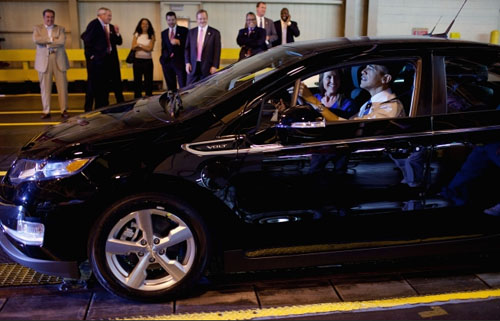
President Barack Obama, behind the wheel of Chevy Volt (Official White House Photo by Pete Souza)


President Obama, who made rescuing the auto companies one of his first goals, officially opened his reelection campaign with a rally in Columbus, Ohio telling the crowd of 14,000 that he aims to take the country "forward" while his presumed opponent, Mitt Romney, will slam on the brakes and try to throw the country into reverse.

Analysts believe a still limping economy with tepid job growth will keep the president on the defensive as he fights to secure a second term. One bright spot, the revival of the American auto industry, saved almost 1.5 millions jobs, according to the Center for Automotive Research and kept the economic damage from spreading even further. The carmakers trip from bankruptcy to profitability was made possible by his support. Oddly enough Mitt Romney, who was raised in suburban Detroit and whose father was a former governor of Michigan and a president of American Motors, still says bailing out the automakers was wrong.

In a similar vein the Republican-controlled House has put up a roadblock to a transportation bill passed by the Senate that has the potential to be a more powerful job engine than the auto bailout. If enacted it would keep over 2.5 million construction workers on the job. But the discussions about our transportation future shouldn't just be about keeping the shovels turning and autoworkers on the job. Yes, we need to look at jobs, but we also need to see we are not in this alone. The United States should be part of a global move toward interconnected, seamless transportation that, in addition to creating jobs locally, reduces the threat of global climate change, enhances trade and improves the health and livability of our rapidly urbanizing world while making sure we don't leave less populated areas behind.

This was the theme of the International Transport Forum recently held (May 2-4) in Leipzig, Germany. The Forum brought together over 750 transport experts, suppliers, government officials and journalists from developed countries to meet with their counterparts from the rapidly developing countries for a series of discussions about the need to craft a vision for an interconnected future. The dire consequences of not changing how we move people and goods underpinned the conference.

"Unless action is taken, I mean, unless action is taken now -- CO2 emissions from transport will skyrocket from a level that is already tremendously high," said Angel Gurria, the Secretary General of the Organization for Economic Co-operation and Development (OECD).

Currently, transportation is responsible for "23 percent of man made CO2 emissions globally," said Gurria. The reason? About 96 percent of transportation is still powered by "fossil fuels." Gurria noted that without immediate action, by 2050 we will see a 50 percent increase in greenhouse gas emissions with a disastrous impact on the living standards of the world.

Electric cars are seen as part of the solution that alone can reduce projected emissions growth 12 percent by 2050, according to Gurria. He sees electrics making a big difference in taxis and delivery vehicles where "trips are short but usage is intensive." But the, "biggest reductions (in the auto sector) will come from fuel economy improvements in conventional vehicles."

Even if we throttle down emissions from passenger cars in developed countries, emissions from transporting freight will probably continue to increase. The big worry comes from the growth and demand for cars in emerging economies like India and China.

Of course, it's the appetite for cars from exactly those countries that has spurred the recovery of the American auto industry as well as kept other global automakers' factories humming. As part of the conference, BMW, whose sales in China recently surpassed its United States totals, hosted a tour of its Leipzig plant. It currently produces 740 cars a day at this factory but has the ability to rapidly increase capacity as needed. The transport ministers didn't suggest countries should curtail auto production but emphasized the need to create systems that are "less dependent on cars."

Urban transportation was a major focus of the conference since it's been estimated that by 2050 over 70 percent of the world's population will live in cities up from 18 percent today.

The number of people riding bicycles to school and work, taking streetcars or buses and walking in Leipzig showed what that future could look like. Traveling through town I couldn't help notice that it wasn't just a few cycling fanatics or students who were reclaiming the streets with their bikes. The city was also linked to the rest of Germany and Europe by an efficient rail system with centrally located train stations that were served by streetcars, buses and taxis that provided connections to airports. Inexpensive rental bicycles were also readily available.

Coming from Los Angeles and seeing that it was easy to catch a streetcar or take a bus from the airport reminded me of how completely our transportation options have been defined by the automobile. As recently as the 1950s, Los Angeles had a streetcar system with over 1800 miles of track. It was ripped up and replaced by wide lanes and freeways that promised the joy of the open road. The good news is that gridlocked LA is rebuilding its light rail system using some of the abandoned right of ways from the system that was destroyed. But even if the city can find the funding to complete its current plans we will only have about 750 miles of track. That's less than half of what existed before.

Connections between cities by improved high-speed rail systems are seen as important ways to reduce dependency on cars and on air travel. This September, Japan is set to launch its fourth generation of high-speed rail since the first lines went into operation ahead of the 1964 Summer Olympics. The new trains have a projected top speed of 205 miles per hour.

In the United States, high-speed rail, like the auto bailout, has been castigated as a wasteful government program. Republican governors Rick Scott of Florida, John Kasich of Ohio and Scott Walker of Wisconsin all turned down available Federal funds. California's governor is happy to take the money to build a system linking Los Angeles and San Francisco but it's become tied up by routing and funding disputes.

Given the fragile state of the economies of the United States and within the European Union, it's easy to understand why any program meets resistance. But even cash-strapped Britain is "reopening some rail stations that were closed prematurely," said Norman Baker, the new transportation minister. "It is possible in times of tight budgets to make improvements," he said.

That's an important lesson for our country. Even though the Obama administration has made funding available for various bridges, roads and rail projects what seems to be missing is a vision for what a modern American transportation system would look like. And why we need to do it now. Our current auto-centric system of freeways serving suburbs festooned with drive ins was first showcased to the public at the 1939 New York World's Fair in the General Motors Pavilion. Dubbed 'Futurama,' this eye popping display of the future packed them in as visitors, seated in moving auto seats, watched a rural diorama be transformed step by step. Farms and small towns were replaced by single family homes in subdivisions ringing gleaming cities served by an efficient and uncrowded network of multi-lane highways. The industrial designer, Norman Bel Geddes, was the Svengali who created this compelling show. He'd caught the eye of GM execs who admired his streamlined products and theater set designs. World War Two interrupted its implementation but after the war, the public was ready to see this fictional Futurama become reality.

Moving forward will require public support inspired by a new vision that conjures up a compelling future of walkable cities and towns, bicycles, streetcars, clean buses, high-speed trains and fuel-efficient cars close to accessible airports. We have a lot to undo and rebuild to get there. China and India and other countries still have the opportunity to get it right the first time. The result for countries, states and cities that join the transportation transformation will be jobs and economic growth, a cleaner environment, reduced concerns about global climate change, healthier people who get more exercise from riding bikes and walking and the knowledge that we've built a sustainable system that meets the needs of our people while connecting us to the world.


Follow Michael Rose on Twitter: www.twitter.com/MichaellRose

FOLLOW POLITICS
 
 
  • Comments
  • 32
  • Pending Comments
  • 0
  • View FAQ
Comments are closed for this entry
View All
Favorites
Recency  | 
Popularity
07:24 PM on 05/07/2012
I would suggest policy makers take the issues one step further and consider the most efficient
transportation methods for various uses/distances. Cities up to 500 miles apart could best be served by rail, especially high-speed rail expresses between those two cities. Airplanes
could best serve distances greater than 500 miles because of the shortened time of travel. Yet as of 2008, there were 344 one way flights between LA area airports (LAX, ONT, SNA, Burbank and Long Beach) and San Francisco area airports (SFA, Oakland and San Jose). That's an excessive amount of air and noise pollution, plus a far-less efficient use of fossil fuel than high-speed rail.

Now if we can just get the geniuses running the high-speed rail authority to focus on getting people from San Diego and LA to San Francisco, rather than to Palmdale, Bakerfield and Fresno. . . . If they made plans to run the line along the west side of the Central Valley, rather than spending hundreds of millions of dollars to go over a high school in Bakersfield, it might be built by now.
06:03 PM on 05/07/2012
Limiting population growth is probably the most effective way to reduce CO2 emissions (not from breathing but all of the CO2 load a new human produces by eating, driving, flying etc.). Having just two children may be the single best thing you can do for the planet. Far more effective than driving an electric car or using LED lights. Even better if you do both. And, you get the added benefit of less crowding, water supply issues, hunger, pollution etc....all for free.
02:22 PM on 05/07/2012
Where did you get the 18% urban population figure? The CIA World Factbook lists the global urban population at 50.5%.

https://www.cia.gov/library/publications/the-world-factbook/geos/xx.html
photo
HUFFPOST SUPER USER
herbertpop
01:47 PM on 05/07/2012
People might use public transportation if it were cheap, easily accessible, fast, and fun.
HUFFPOST SUPER USER
FredNH
free thinker
09:21 AM on 05/07/2012
having grown up in Boston, where public transportation is readlity available, I wonder why so many Americans resist using it.
having traveled in Europe and Asia, where trains handle most of the commuters and short trips (< 250 miles), I see how positive the whole experience can be.
it's all what you get used to...
Genders
Love, Tolerance, Enlightenment
12:56 AM on 05/07/2012
The Volt is the word and idea you were looking for. Obama made it possible.

Rooftop solar can provide both more than our peak afternoon electrical needs, but enough to charge all the electric vehicles we need.
10:05 AM on 05/08/2012
Big Volt fan here (I drive one), but Obama isn't behind the car.

Volt was developed from 2006-2008, before Obama - and before GM bailouts, so the popular idea that its development was financed by taxes is well off base.

The $7500 tax rebate for electric cars was passed by GW Bush in 2008.

Somehow Obama gets the credit (blame) for pushing and subsidizing the Volt, when all this happened during the Bush administration.
Genders
Love, Tolerance, Enlightenment
02:03 PM on 05/08/2012
Obama rightfully gets credit for saving the auto industry.  There would be no volt if he had not.  
photo
Kai-HK
Don't Share My Wealth! Share My Work Ethic!
11:21 PM on 05/06/2012
Supporting failed businesses whose failure is the result of bad business decisions is wrong, whether for banks, auto companies, green energy companies, train companies, etc. the government needs to get out of the business of supporting failure with the hard-earned income of its beleaguered taxpayers.
Genders
Love, Tolerance, Enlightenment
12:57 AM on 05/07/2012
What if they failed because we were helping another business? or because the competition is entrenched and owns the market?
photo
Kai-HK
Don't Share My Wealth! Share My Work Ethic!
01:42 AM on 05/07/2012
Government shoudl not provide welfare, corporate or individual. And there is nothing wrong with an entrenched encumbant that is there because it is competively better, but if it secures its monopoly or power through government protection then that should also be stopped, like unions, the Fed, certain utilities, public schools that are protected from charters through restrictive legislation, etc.

Good point! End unions!

Kai
07:08 PM on 05/06/2012
"In the United States, high-speed rail, like the auto bailout, has been castigated as a wasteful government program"

In all reality, most of us have already seen the "if you build it they will come" coming from the green crew . . . we've seen the claims that about light rail, windmills, solar panels, etc. but let's be honest . . . they've fallen far short.

Here in the USA, I believe people are attached to the freedoms that a car brings. If I have to leave work a little early or a little later so I can stop at the grocery store before running to my kid's baseball game . . . I can do it. There's a reason so few people ride public transportation to work daily.
Genders
Love, Tolerance, Enlightenment
12:59 AM on 05/07/2012
Let's be honest? you would not know honest if it smacked you upside the head.

The truth if solar wind and waste are no the only growing energy systems, fossil and nukes are falling behind.

Even though fossils and nukes get 100 times the total green energy gets. Nukes get 500M$ in breaks per year per reactor, clean coal even more.

Solar is cheaper than nukes. wind and waste half that.

but don't let the facts disturbe you fantasy.
HUFFPOST SUPER USER
FredNH
free thinker
09:24 AM on 05/07/2012
it's all what you get used to...
so many urban dwellers and from other countries have adjusted their lives to use public transportation.
time we made that same adjustment and got over the "convenience" excuse we have for using the automobile
photo
HUFFPOST SUPER USER
herbertpop
07:07 PM on 05/06/2012
Efficient transportation is the engine that will propel this country forward. While China, Japan, Brazil, and England are pushing magnetic levitation, our roads and bridges are crumbling. If only the House could pass the transportation bill.
07:36 PM on 05/06/2012
About 5 percent of Chinese people own a car . . . that's why they ride trains . . . they can't afford a car.
06:06 PM on 05/07/2012
But as they get wealthier they buy cars. China is going to be a huge growth market for automobiles. GM is building a large plant there. Cars offer freedom that other modes of travel can't match, but our economy cannot support it anymore.
07:51 PM on 05/07/2012
Three years ago, China surpassed the U.S. in the purchase of cars. This past year, Chinese consumers bought over 17 million cars to the U.S. at 14.5 million. The rate of increase of the Chinese car market is astounding. We will never again buy more cars than Chinese consumers.

As citizens of the world, we better hope most of these cars, regardless of where they are driven, are electric and that the electricity comes from non-polluting renewable sources.
05:49 PM on 05/06/2012
I agree that he world needs more available and accessible public transportation. But, not only that people need to use it! I recently started catching the bus, mainly out of financial reasons, and as limited as our bus system is here I still think it is an underutilized form of transportation. If more people were to use it the local government might just add more bus routes.
07:34 PM on 05/06/2012
"If more people were to use it the local government might just add more bus routes"

But people don't and every time that bus picks you up . . . it costs the rest of us money because in public transportation . . . we don't even require the users of it to cover the operational costs which is my problem with it.
07:56 PM on 05/07/2012
VikingQuest, do you have a problem with the U.S. military spending $80 billion per year to protect access to the world's oil? http://www.rand.org/pubs/monographs/MG838.html

This is exclusive of the war in Iraq, a war that we fought because of their oil. That's cost us $1.5 trillion and counting. Not to mention thousands of dead soldiers and tens of thousands wounded.

The economic, health and environmental costs of oil are measured in the hundreds of billions every year. You pay for none of these things when you drive your car. Every time you drive your car, you pollute our environment, weaken our economy and make our country less safe because of our involvement in the middle east. Seems you are the one getting the lion's share of subsidies.
03:11 AM on 05/08/2012
You act like I don't pay taxes!!! I do have a car that I pay exorbitant amounts of money to the county for I just choose to save money and to help the environment by catching the bus! The county here just chooses to use the money we pay in registration for other things instead of what it is supposed to pay for, like to fix the roads!