
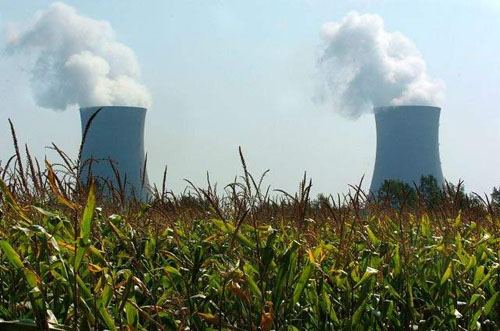
Fermi Nuclear Reactor, Monroe Michigan Courtesy Michael Rose
Nuclear power was sold in the United States as being "Too cheap to meter." This miracle power source that harnessed the might of the atom to light American homes and power their TVs was seen as a way to put a happy face on the horrors visited upon Hiroshima and Nagasaki.
Lewis Strauss who chaired the Atomic Energy Commission in 1954, the predecessor of today's Nuclear Regulatory Agency (NRC), spoke of an era when "atomic furnaces" from fission and fusion reactors would provide clean, safe, reliable, abundant and cheap power for generations to come. It hasn't been the panacea he foretold. In fact, it's been a train wreck of accidents, cost overruns, nuclear weapons proliferation and an ever-growing waste problem that is always on the verge of being solved.
This hasn't stopped the nuclear power industry from promoting its product as the safe, clean alternative to coal for a green future. Wrapping nukes in a green cloak and declaring their oneness with those concerned with climate change has helped to sway public opinion. The banks are still skeptical but the industry, like their friends on Wall Street, has turned to the government for support. The Bush and Obama administrations have kept the light on for nuclear power with loan guarantees, federal dollars for research and foreign policy initiatives like the treaty with India that forgave its transforming a research reactor into a bomb factory.
The impact on the industry of the Japanese reactors destruction as a result of the earthquake and tsunami may reverse the tide of support built by the nuclear industry. But trust me, they won't give up. They'll try to spin the disaster as proof that nuclear power is still safe and that if anything can be learned it's that we need newer nukes, with more safety features, not alternatives. So, to arm the public with some mental shielding from the thought rays likely to be beamed by the misconstruers of fact and swayers of emotion here are 10 myths of nuclear power you need to know.
Myth #1: Nuclear power is safe.
The experience at Japan's Fukushima Daiichi nuclear power complex, the Russian reactor at Chernobyl and the meltdown at Three Mile Island in the United States, the nuclear Trifecta, are the most well known nuclear accidents but there have been numerous accidents, thousands of "incidents" and near misses -- many of which could have led to a disaster.
The biggest fear, in all of these cases, stems from the fact that a nuclear power plant has about as much radioactivity inside it as the bomb that was dropped on Hiroshima. There is more sitting in the adjacent pools where the used nuclear fuel rods are stored. In Japan, we've seen what happens when there isn't enough coolant to cover the fuel rods. The rods start melting and, in a worst case scenario, the China Syndrome, the core melts down and breeches the containment facility. The heat build up can stop short of a China Syndrome but can get hot enough to melt the metal around the fuel rods and create a reaction that produces hydrogen gas that triggers an explosion. Which is what happened in Japan. Having redundant safety measures, a plan B, C and D, doesn't mean they can't all fail.
"The only safe nuclear reactor is 93-million miles away, the sun," said Daniel Hirsch, president of Bridge the Gap, a nuclear policy organization.
Myth #2 Nuclear power will help us kick our addiction to foreign oil.
Senator Charles Schumer (D, NY) on last Sunday's Meet the Press cited our need to get off of foreign oil as a strong reason for pursuing nuclear power. He's wrong. We don't use oil to produce electricity in the United States, we mainly use it to power our cars and trucks and to a much lesser degree, to heat our homes. Unless we're proposing to put a nuke under the hood of our cars this "argument makes no sense," said Hirsch.
Of course, if we all switched to electric cars we'll need power to charge, them but this can be provided by wind, solar and other sources. We don't need nukes.
Myth #3: Without nuclear reactors, the U.S. cannot hope to combat climate change.
It would be like "using caviar to fight world hunger," said Peter Bradford, former Nuclear Regulatory Commissioner and current staff member of the Environmental Law Center.
The least expensive and most productive way to reduce our carbon footprint is to be energy efficient, not to build expensive nuclear power plants.
"The money that was sunk into building the reactors in Japan should have gone into something that would really have helped us combat global warming like solar or wind power," and improving the national energy grid so that it's integrated, said Hirsch.
We can't spend money on everything we should spend it on solutions and not on technology that creates more problems.
Myth #4: The U.S. is in the midst of a nuclear renaissance.
We've had a nuclear bubble but "when builders came to realize the costs it started to dissolve," said Bradford.
The myth of the nuclear renaissance has been an effective public relations ploy of the nuclear industry but we've seen the operators at the Calvert Cliffs, Maryland reactor pull out and the backers behind a proposed reactor in Houston, Texas have also pulled out. Things are sputtering.
"If this is what the original renaissance looked like then we never would have had Michelangelo or Leonardo da Vinci," said Hirsch.
Myth #5: Without new nuclear reactors, we won't have enough power in the United States.
Dave Freeman, who calls himself the "green cowboy," knows something about large-scale power generation. He ran the Tennessee Valley Authority (TVA) and the municipal power department in Sacramento and the Los Angeles Department of Water and Power (DWP). He says this is completely false. The best way to generate new power for the long term is not to build nukes but to invest in large scale solar and wind, coupled with natural gas as a transition in the short term.
The problem has been coordinating the power produced when the wind blows and the sun shines, distributing the power and storage. There are solutions to all of these. "You need to link up the disparate sources to compensate for when the wind is blowing and the sun isn't shining," said Hirsch. He also pointed to new ways that we can store excess energy in batteries or use it to create hydrogen, which can also be employed as a power source.
The problem is "old people have forgotten about the dangers of Three Mile Island and young people never knew," said Freeman.
Nuclear power is a limited resource dependent on mining compared to solar power. An unlimited amount of solar power exists, "which would you choose," asked Freeman?
Myth #6: Why not fund nuclear power just to make sure we do have enough power since there's practically no risk of losing any money with government loan guarantees?
The nuclear industry has asked for loan guarantees from the Federal government because the banks looked at the risk and took a pass. With the loan guarantees in hand the companies can get financing and if they default, or walk away from the projects (which is what happened before) the taxpayers will be stuck with the bill. "It's the same as if you defaulted on your mortgage and the Federal government had to step in to pay the banks back," said Hirsch.
The problem is that these plants are so expensive, and it's not clear that they'd ever be profitable even with guarantees, that the likelihood of companies abandoning the effort mid way through is pretty high. Look at what's happened at Calvert Cliffs and in Houston.
Myth #7: The nuclear industry's past problems were caused by overzealous environmentalists, regulators and the public's fear after Three Mile Island.
"The industry's problems were the result of trying to build too many plants too quickly," said Bradford.
The industry couldn't compete in the marketplace in the US or anywhere else in the world. This is why it turned to loan guarantees that shift the risk to the taxpayers.
Pacific Gas and Electric (PGE) ignored the environmental concerns of one group, The Mothers for Peace, when it was building a reactor near Diablo Canyon in California. The Mothers said that the plant was situated on an earthquake fault and the company just plowed ahead. The Mothers were right and PGE had to go back and retrofit the plant to increase its safety.
"The safety of millions was put at risk to hubris," said Hirsch.
Myth #8: Nuclear power will be an important source for jobs and economic development.
It's true that building the reactors does create jobs, but these disappear when the reactor is complete. And there are staff positions for running the reactors, providing maintenance and security but not enough to warrant the high costs and risks. Building an alternative energy industry is a much better long-term proposition that will create more jobs in manufacturing and stimulate exports. People will need to build the windmills, the photovoltaic cells, install them, maintain them and even replace them as they wear out.
Ironically some fear that building new nukes will chase jobs away because electric rates will have to dramatically increase to pay them off. "No state ever created a net increase in jobs by raising electric rates to commercial and industrial customers. Such a policy drives jobs out of many businesses to create relatively few permanent jobs at the new reactor," said Bradford.
Myth #9: France has found solutions to all of nuclear power's problems.
France is pointed to as demonstrable proof that nuclear power can be affordable and safe. While it's true France gets about 75% of its electricity from nuclear power and that it has avoided a large scale disaster but we don't know very much about their accident record since its industry is nationalized and run behind a veil of secrecy. We've been told that Japan runs its program much better than France, so we can only assume that there have been problems.
One has to believe that their aging reactors are just an "accident waiting to happen," said Hirsch. "They are just playing a game of Russian roulette."
Many point to their ability to make nuclear waste disappear into easily stored glass balls while we continue to battle over where to bury our waste that piles up in temporary storage ponds next to the reactors.
"In high level waste, they are no further along than anybody," said Hirsch. "They just dissolve the waste in highly toxic acid and store it in warehouses in the glass. Which is still radioactive and the glass eventually disintegrates and has to be replaced."
The famous scene of 60 Minutes correspondent Ed Bradley lovingly holding one of the glass balls came to mind. "That was just a prop," said Hirsch.
They also reprocess their fuel to create new fuel but this still leaves "most of the radioactivity to be disposed of," explained Bradford.
It also adds to the costs of the producing nuclear power which is one reason French electric rates are 20% above U.S. rates despite subsidies, according to Bradford.
One big problem is that the French reprocessing creates plutonium that adds to the risk of nuclear weapons proliferation.
Myth #10: The growth of civilian nuclear power won't promote the spread of nuclear weapons, or as it's called, proliferation.
There is no "peaceful atomic power. If promoting nuclear power you are promoting bombs," said Freeman.
According to Victor Gilinsky, a former NRC commissioner, the "main obstacle to obtaining nuclear weapons is the material. Robert Oppenheimer, the father of America's nuclear program, feared that countries could too easily start with a civilian power program and then build a bomb. He proposed that an international authority handle all nuclear material. Eisenhower reversed course and launched the Atoms for Peace program that spread civilian nukes around the world and taught the basics of nuclear engineering to people in countries like Iran. This boosted the earnings of the contractors but laid the groundwork for weapons programs in all the countries that obtained nuclear weapons after the first five nuclear powers. There's "too much greed and too little fear," said Gillinsky. All civilian nuclear programs create spent fuel that can be reprocessed into weapons grade plutonium. This is what Iran, North Korea, India and Pakistan have done.
It doesn't take much. At first you needed a chunk of plutonium about the size of a softball now it's down to the size of a golf ball. "If a country has done its engineering, it can take about a week to go to a bomb," said Gillinsky. "Safeguard inspections are too late."
Currently there are plans to build new nuclear power plants throughout many unstable parts of the world like Algeria, Libya, Egypt, Saudi Arabia, Iran, Kazakhstan and more.
We need to stop looking at nuclear power and concentrate on real clean energy sources like wind and solar. But these aren't really fun challenges for scientists. Building a solar collector or an improved windmill is boring compared to unleashing the power of the atom. Especially, dabbling in that chimera -- the real Holy Grail -- fusion power. Can't beat that for a fun brain twister, one that's sucked up countless billions of federal research dollars but is still "the power of the future." While scientists like to do what's hard, exotic and new, people want and need what's simple, effective, reliable and affordable.
To paraphrase President Eisenhower's speech about the Military Industrial Complex, every dollar we spend on nuclear power is stolen from developing real solutions to our energy needs. Nuclear power, once touted as "too cheap to meter" is really too expensive and dangerous to use.
Many thanks to Peter A. Bradford, a former member of the U.S. Nuclear Regulatory Commission whose presentation "The Myths of the Nuclear Renaissance" inspired this piece.