iPhone app iPad app Android phone app Android tablet app More

Featuring fresh takes and real-time analysis from HuffPost's signature lineup of contributors
Michael Zimmerman, Ph.D.

GET UPDATES FROM Michael Zimmerman, Ph.D.
 

Of Mice and Men: Unseen Dangers in Laboratory Protocols

Posted: 03/19/2012 3:35 pm

Fifty years ago, Rachel Carson shocked the world and gave birth to the modern environmental movement with the publication of Silent Spring. Her clear warning forever changed the way we dealt with pesticides.

Without intending to exaggerate, let me say that it is possible that my colleague at The Evergreen State College, Bret Weinstein, may have made a discovery that is every bit as alarming. His work calls into question the standard model we use to assess potentially negative impacts of drugs. If his analysis is correct, we may well be greatly misunderstanding long-term interactions drugs can have on our bodies, both with respect to cancer formation and significant tissue damage.

To understand what Bret has found, you have to first have a basic understanding of the mechanism via which cells reproduce and die. The part that concerns us here are the tips of chromosomes, called telomeres. When a cell reproduces, its chromosomes duplicate and the two daughter cells each have (mostly) identical, newly formed chromosomes. The telomere plays an important role in this process by protecting the genes toward the end of the chromosome.

As amazing as it is, chromosomal replication is not a perfect process. Each time replication occurs some of the nucleotides at the end of the chromosome are lost and when these lost nucleotides are part of a gene, the gene can no longer function appropriately. Telomeres which are strings of excess nucleotides, nucleotides that are not part of any gene, serve as caps on the end of chromosomes. Every time a chromosome replicates, some of the material that makes up the telomere degrades making it shorter and less functional. Over time, the telomere will become critically short and the cell will no longer be able to divide.

This is well accepted science and Elizabeth Blackburn, Carol Greider, and Jack Szostak were awarded the 2009 Nobel Prize in Physiology or Medicine for their role in discerning how telomeres protect chromosomes during replication. What is also fairly well accepted is the evolutionary reason why telomeres themselves are not longer or are not fully replaced; their limited size means that individual cells can only replicate a finite number of times before they are no longer functional. This effectively provides a natural mechanism keeping cells from reproducing wildly -- or from becoming cancerous. (The cancers we do see have found a way around this safety mechanism. Without it, cancer would be far more common than it currently is.) The serious downside to this, though, is that as cells, and the organisms in which they reside, age, they are less able to remain healthy and repair various sorts of lesions. In essence, there's a balance between cancer prevention and the ravages of aging; warding off the former leads to the latter.

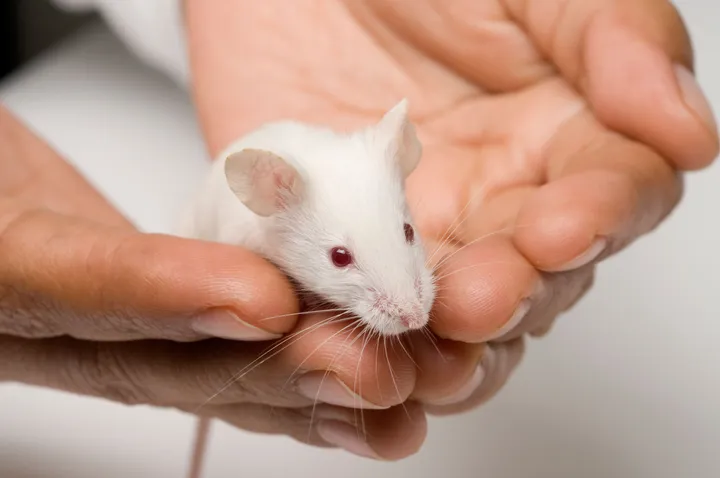
Here's where Bret's ideas come into play. Domestic mice are the animal model of choice for evaluating the effect of drugs and other chemicals on humans. The problem with this is the fact that virtually all mice used in experiments come from the same source and, unwittingly, humans have provided strong artificial selection for remarkably long telomeres in these organisms. Indeed, laboratory mice have far longer telomeres than do their wild relatives.

Why is this so important? As Bret and Deborah Ciszek, his co-author noted in their article in Experimental Gerontology,

With their telomeric failsafe effectively disabled, these animals are unreliable models of normal senescence and tumor formation. Safety tests employing these animals likely overestimate cancer risks and underestimate tissue damage and consequent accelerated senescence.

In other words, using these animals can be terribly misleading. Not surprisingly in light of their chromosomal structure, laboratory mice are notoriously susceptible to cancer while demonstrating extraordinary ability to replace damaged tissue. In this respect, mice are poor predictors for what might happen in humans. Human cells are simply unable to replicate as frequently as those in mice and thus chemical assaults on mice that go unnoticed may well have dire effects in people. Bret believes that this might be the reason that we are increasingly noticing that drugs previously determined to be safe are now being found to lead to various serious ailments like heart disease, liver dysfunction and related organ failure.

Is he right? I honestly don't know -- but I am certain that the science he offers is perfectly sound and that the consequences of his being correct are huge. And I'm confident that there are experiments that could be done to test his hypothesis.

Even more than that, it seems imperative that we think carefully about the ways in which we use lab animals as test organisms. We created the conditions that selected for the telomeres of laboratory mice to be unnaturally long. We need to reverse that process as soon as possible and ensure that this biological aspect of laboratory mice once again mimics the telomere structure of humans. Unless we take this step immediately, there's good reason to believe that many of the controls we've put in place to guarantee our safety simply are not working.


Follow Michael Zimmerman, Ph.D. on Twitter: www.twitter.com/mzclergyletter

Fifty years ago, Rachel Carson shocked the world and gave birth to the modern environmental movement with the publication of Silent Spring. Her clear warning forever changed the way we dealt with pes...
 
 
  • Comments
  • 10
  • Pending Comments
  • 0
  • View FAQ
Comments are closed for this entry
View All
Bloggers
Recency  | 
Popularity
HUFFPOST SUPER USER
Rubyfoo
11:28 PM on 03/24/2012
As pharmaceutical scientists know all too well, mice are not a very good predictor of much having to do with drugs. Unfortunately, we have no way of testing the long-term effects drug combinations on humans. There's no way to do controlled experiments. So there's probably harm done, especially to susceptible individuals, but we'll never get it all sorted out.
01:48 AM on 03/21/2012
I think there is a misunderstand about the meaning of toxicology in drug development. LONG TERM tox studies are not at the heart of drug development for most drugs because most drugs are not meant to be taken long term.

For instance, the effects of a new cancer drug on the cohort of 30 year survivors is of absolutely no concern because for most cancers there are no 30 year survivors. For those cancers for which there are 30 year survivors, there are next to no 30 year survivors (and in many cases not more than a few 5 year survivors) without the cancer drug. Therefore significant toxicological effects are perfectly acceptable.

The situation is markedly different for drugs which have to be taken lifelong. Trials and follow up trials for such drugs are very expensive and very much complicated by the fact that there are so many possible interactions (of which telomeric effects are probably the least important), that it becomes a very hard problem to weigh between the observed long term toxic effects (and their actual causation) and the short and long term efficacy.

Unfortunately there is no such thing as a perfect drug. Every drug, just like every food, is a long term toxin. It has to be weighed against its short term positive effects. The alternative to that is a perfect world without any drugs and with people starving to death because they want to avoid sugar induced diabetes and fat induced cardiovascular events.
04:52 PM on 03/20/2012
The cited article in Experimental Gerontology is from 2002. There has been plenty of time since then to follow up this work in humans, both longitudinally and in cross-section. Has that been done? Has anyone in the last decade corroborated or replicated the cited study?
cosmicdart
paragon of paradigms
02:21 PM on 03/20/2012
Wild mice are easy to find. It would be cool if we could at age 35 detach our old and attach a new short telomere to every cell in our body so we may live as long and healthy as we like. Perhaps someone will invent an automatic nano-machine with a toolbox full of telomeres, and telomere attachment tools that moves about from cell to cell doing this.
01:49 AM on 03/21/2012
Your cancer cells can do that just fine... and they are killing you in the process.
cosmicdart
paragon of paradigms
06:51 AM on 03/21/2012
My nanobots are just making the cells as good as they were at six years of age. Every seven years most of the cells in the human body are replaced through cell division whereby the previous cell is destroyed by another process that has nothing to do with telomere loss otherwise how does it occur in a six year old who has all his telomeres at full length?
photo
HUFFPOST BLOGGER
Clay Farris Naff
Blogger, science journalist, & author
06:42 PM on 03/19/2012
I especially appreciate the qualifiers that Dr. Zimmerman offers. In other hands, a story like this might well be amped up to hysteria. As it is, the story is plenty serious, and we must hope that further research will answer the open questions and lead to better testing.
But we must also hope that this preliminary finding does not add to the cynicism about evidence-based medicine that permeates much of the American public -- fueled by highly dubious and self-serving claims put out by promoters of "alternative medicine" and its products and practices.
To be clear: Zimmerman is not to my knowledge part of the alternative industry I am criticizing, and by the same token the practices of Big Pharma and its regulator, the FDC, should certainly not go uncriticized. All the same, the lesson to draw from Zimmerman's story is not that we should turn away from evidence-based medicine, but that we should demand more independent, methodologically sound, and long-term verified evidence for the safety and efficacy of our medicines.
10:36 PM on 03/19/2012
I think the story is that the source of laboratory mice should change. They all come from the same source and so inadvertently, the supply of mice used have long telomeres and so the test results for these mice may not be good predictors for human reactions to the drugs tested.
01:50 AM on 03/21/2012
This would be true... if only mice would be used for such tests. They aren't. What is used for human toxicology tests are... humans.
HUFFPOST SUPER USER
claraluz
Per aspera ad astra!
05:17 PM on 03/19/2012
Thanks, Dr. Zimmerman, I often wondered about the long-term effect of so-called maintenance drugs taken for many years for chronic conditions. I stopped taking some statins and combinations of statins with other drugs because of adverse effects -- this article offers much to consider when prescribed drugs to be taken for a long time. I hope someone follows-up this research!