They have been ostracized and marginalized in the great U.S. health care reform debate, but now a group of doctors, many from Physicians for a National Health Care Program, are hitting the road and taking action, and they visited Denver on September 14. They will arrive in Washington on September 30 in time for a rally in Lafayette Park, next to the White House.
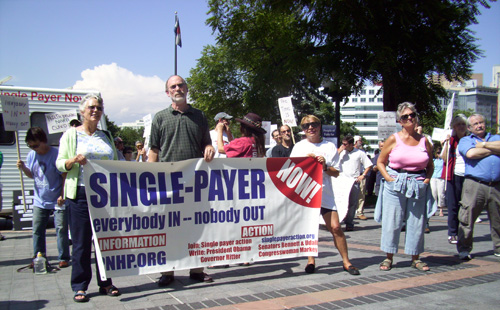
Doctors and others demonstrate for single-payer
Retired physician Dr. Joe Eusterman calls single-payer health care the "fiscally conservative, socially responsible" health care reform. Private insurance is simply not sustainable. When he encountered Wendell Potter, former CIGNA executive, at a recent rally, Potter told him there should be no place for insurances profiteering from primary health care. Dr. Eusterman notes that the Swiss and most other industrial nations don't tolerate for-profit primary care. He cites a recent study by the California Nurses Association demonstrating that a family of four with an annual income of $56,000 would pay just $2,700 per year for health care under HR 676, the proposed House bill for single-payer coverage.
A number of Colorado doctors lent their support to the traveling physicians. Dr. Cory Carroll, a solo family practice provider from Ft. Collins, describes a U.S. "nonsystem" of health care that is "destroying primary care." One of his patients has insurance with a $3,000 deductible, and thus refuses to have a diagnostic colonoscopy because he cannot afford it. Because government insurance payments are more timely and simple to file for, Dr. Carroll notes that 60% of his practice consists of Medicare recipients. Due to laborious, costly administrative paperwork required by private insurances, he predicts he is six months from dropping all commercial insurances.
The U.S. has good practitioners, but we don't get early treatment. "You can't get preventive care in an emergency room," said family practitioner, Dr. Eugene Uphoff. Through his three months in Yugoslavia post-medical school, he viewed a place where medical school is free, and no med student can choose a specialty until they have dedicated two years providing primary care in high-needs, rural areas. He notes it is not uncommon for new doctors in the U.S. to carry medical school debts of $250,000 to $300,000, one reason so many shun primary care for a higher-paying specialty.
A Canadian physician he recently met asked Dr. Bob Seward point blank, "Why don't you Americans take care of your own people?" Dr. Seward spent 15 years at a VA Hospital, where the care was good, and he was never told he could not order a test for a patient. The switchover to electronic records was tough, he said, but reaped many rewards. Though 100,000 vets were displaced by Hurricane Katrina, all of their medical records remained accessible.
Dr. Margaret Flowers flew to Denver to join the doctors' tour through a couple of cities. Dr. Flowers is one of the "Baucus 13" -- doctors, nurses, lawyers and other single-payer advocates who were arrested and charged with "disruption of Congress" after standing up before Senator Max Baucus and the Senate Finance Committee to ask that a single-payer advocate be permitted to testify. The May hearings were intended ostensibly to listen to a representative cross-section of health care stakeholders, but inexplicably marginalized the single-payer model. On June 11 Flowers was finally granted the right to testify before the Senate HELP Committee.
Dr. Flowers left her pediatric practice in Maryland a couple of years ago to work for single-payer health care reform full time. Lack of political will is the only obstacle she sees to meaningful reform. She reminds everyone that the Weinder Amendment presents an opportunity for our representatives to vote for HR 676, a Medicare-for-All reform model after the House reconvenes in September.
The doctors plan visits to congressional leaders on October 1, and intend to request a meeting with President Obama in Washington. Their message to legislators, stated on their website, is to reboot the conversation, and use HR 676 as a starting point for a new health care conversation. Assemble a team of the "best minds among health care professionals" to present a single-payer proposal to Congress. With concerns about deficit spending, single-payer remains the only model that saves enough money to provide comprehensive health care access to all -- a point that has been glossed over in Washington.
The doctors ask that white ribbons be worn and tied wherever visible. If you are in Washington tie a ribbon to the White House fence and take a picture and share it with them, suggests Margaret Flowers. The ribbons demonstrate the dire need for action in memory of the 60 people a day who die without health care access in the U.S.
For more news and commentary from Colorado, check out HuffPost's just-launched Denver section.
Want to reply to a comment? Hint: Click "Reply" at the bottom of the comment; after being approved your comment will appear directly underneath the comment you replied to
I saw the story of arrests in Chicago over doctors protesting insurance denied their patients. It was a brave and good thing to do. There is much wisdom in their argument.
As a Canadian I have come to view health care as a right, and my heart goes out to Americans. I've heard the more reasonable attempts at counter arguments that go beyond calling the rest of world "socialist" (even if people in countries like Canada are also free to choose private care.) I've heard it said that the worst infant mortality rate in the modern world "is not as bad as it seems. The numbers are grossly exaggerated etc." There seems to be much denial.
Both Canada and the US could learn a lot from England where well paid doctors are paid more for practicing preventative medicine and encouraging good health in their patients . American insurers make greater profits the more often claims are denied. It is a corrupt and inhumane system that would call a perfectly healthy baby too fat to receive care, or call everything from acne and spousal abuse pre-existing conditions.
Obama said a single payer system would be ideal if he could start from scratch, but there is such an entrenched system in place and so many lobby dollars that I have to wonder if compromise can be the only way forward for America at this point?
These doctors stand for an honorable ideal, but is it possible?
We need to contact our Congressional Rep's and Senators DAILY about this and tell them that this is the most fiscally sound policy and that they are going to HAVE to wean themselves from their proverbial health insurance teats.
Pure and Simple.
100% agree! I've been doing this for a while now (well, not daily, but often). We also need to send emails with links on how to take action for HR 676 to all our friends and urge them to write to their representatives, sign petitions, etc., etc., ETC. It's go time. In the immortal words of Lucille Ball: "Ricky, this is it!"
I totally agree with the doctor quoted as saying that single payer IS the fiscally conservative, socially responsible health care reform that we need, and I appreciate this blog bringing attention to the matter. This (quote from blog) below is what really gets me about the whole situation: "Dr. Margaret Flowers flew to Denver to join the doctors' tour through a couple of cities. Dr. Flowers is one of the "Baucus 13" -- doctors, nurses, lawyers and other single-payer advocates who were arrested and charged with "disruption of Congress" after standing up before Senator Max Baucus and the Senate Finance Committee to ask that a single-payer advocate be permitted to testify. The May hearings were intended ostensibly to listen to a representative cross-section of health care stakeholders, but inexplicably marginalized the single-payer model." Inexplicably my rhymes-with-hut! Single payer advocates were not given a seat at the proverbial table, even though Obama promised that everyone would be given a seat at the table, because Obama and the rest of the politicians controlling the debate are all in the pocket of Big Insurance!!!! They wouldn't even allow the single payer advocates a voice, a chance to be heard, a chance to testify along with those presenting other ideas, options. What are they so afraid of?
We need HR 676!!!!!!!!!!!!!!!!!!!!!!!!!!!!!!!!!!!!!!!!!!!!!!!!!!!!!!!!!!!!!!!!!!!!!!!!!!!!!!!!!!!!!!!!!!!!!!
Way to go, docs! It's events like this that keep the conversation going and the pressure on everyone to do what's best for the American people.
Dr. Paul Hochfeld will be a member of a panel discussing equality and access to healthcare for rural communities at St. Catherine University in St. Paul Wednesday at 7 p.m. More info at http://www.stkate.edu/news
I'm very proud of my fellow Oregonians for making this trip. Please support their efforts in supporting the American people by cutting out the middleman and in providing Healthcare for all Americans. If you don't believe in this effort, ask yourself this question. What do Insurance Companies have to do with Healthcare? They are who stands between you and your Dr., if you have a Dr. at all.
A Baucus bill will only insure that insurance companies will have a complete monopoly over us all. Insurance company employees have much to fall back on, house insurance, renters insurance, car insurance, boat insurance, motorcycle insurance and yes, they get you at the end with Life Insurance.
The number of jobs that would be created in healthcare and computer technology are enormous.
If you have a chance to welcome them to your town, take the time to listen. Then please, put on your thinking caps.
Not having a single-payer health care system is the absurd position, not the other way around. Why not buy wholesale instead of retail? There is no reason for a health insurance company to be between us and our doctors. Just what value do these companies provide? All they do is transfer money, pay the bills, with money we pay them. Their business model is simple: Profit by paying out less than you take in. Insurance companies can and should concentrate on providing other types of coverage such as life, fire, theft, etc., and could offer supplemental coverage for health. We could have a four-year period of transition so the blow could be cushioned for the employees who are basically paper pushing clerks. Other industries such as steel, automotive, have had to submit to the "creative destruction" of lowering costs in changing times, now it's their turn. Let the providers of care remain a private industry but the paying of the bills not.
Shout out from Chi-Town!
Go Docs!
We look forward to hosting and toasting them in Chicago with Dr. Quentin Young, National Coordinator of PNHP, Saturday Sept 26th at the UIC College of Pharmacy at 11am.
(see MadDocsChicago.Com)
As Senator McGovern said in the Washington Post recently:
"If we want comprehensive health care for all our citizens, we can achieve it with a single sentence: Congress hereby extends Medicare to all Americans."
RAH!
You must be logged in to comment. Log in or connect with