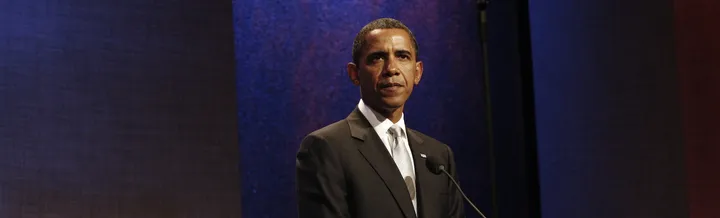
Barack Obama's 2011 State of the Union Address was a solid, steady performance. He clearly values this brand for himself as the Most Reasonable Man in Washington -- a balanced, centrist leader who takes ideas from every side and will work with anyone. It's an image that clearly has some advantages for him; the early reports I've seen from overnight polling and post-SOTU dial tests are very positive. On a short-term basis, the speech is a solid plus for the president. There also was a lot I liked about the speech from the perspective of someone focused on the long-term health of the progressive cause. But there are some big worries I have over the longer term, both for the president and the country.
Here are the things I liked best about the speech:
- The president's full-throated, completely unapologetic defense of the health care bill was great to see. His focus on being willing to look at improvements -- but not back down one iota on the things in the bill that will help people -- was pitch perfect, far better than most of the pretty lame messaging on the bill over the last year.
Even knowing he wouldn't be embracing benefit cuts in the speech, I was still nervous about what he would say about Social Security, fearing that a vague line about being happy to work with Republicans to "fix" or "strengthen" Social Security over the long term would leave the door wide open for a deal later on benefit cuts. But his actual line about strengthening Social Security for future generations "without putting at risk current retirees, the most vulnerable, or people with disabilities; without slashing benefits for future generations; and without subjecting Americans' guaranteed retirement income to the whims of the stock market" was pretty darn definitive. I would have loved for him to go one step further and threaten a veto if Republicans passed such a bill, but this is a good start. I love the idea of paying for investments in research and the jobs of the future by eliminating subsidies to oil companies. And the framing of it was just right: since oil companies are "doing just fine on their own... so instead of subsidizing yesterday's energy, let's invest in tomorrow's." That is entrepreneurial populism at its best. The celebration of the "don't ask, don't tell" repeal and the call for the DREAM Act and comprehensive immigration reform were great moments in the speech. I know this isn't a stereotypically progressive position, but I am a big fan of the president's push to reorganize government agencies. I felt the same way about the Clinton/Gore Reinventing Government push in the '90s. I have always believed that as defenders of the role of government, it is up to progressives when they are running the government to make sure it operates efficiently and effectively, and that it serves the American people with a minimum of hassle and confusion and a maximum of genuinely useful service. Every time some small business person has to deal with excessive paperwork, and every time a consumer looking for help or information from a government agency runs into a wall of confusing bureaucracy, it lessens support for government -- and that is a bad thing. As I wrote after the president's Tucson speech, I very much appreciate his embrace of the metaphor of America as a family. I think it is a metaphor with deep roots in American progressivism, from Tom Paine to Martin Luther King, Jr: that sense that we are all bound together, that we share a common fate and sink or swim together, that we should look out for each other and help each other in times of trouble. That is a profoundly progressive idea, and I hope the president at some point makes a point of expanding on the idea and talking about it more. While it was nuanced, and balanced by very centrist, pro-free enterprise kinds of language, I also very much appreciated Obama's defense throughout the speech of a strong role for government. His historical explanation of how government has helped innovation and long-term economic growth, his clear embrace of the critical importance of some government regulation, and his strong defense of Social Security were all moments in the speech that gave Americans a clear argument as to why government is not the problem, but part of the solution to our long-term national health and prosperity.So there was a lot to appreciate about the speech. Certainly there also were some anti-progressive, irritating moments, too: screwing consumers on medical malpractice, screwing government workers with a wage freeze, screwing us all with the five-year freeze on domestic discretionary spending (which is actually at least a 7 percent cut if you factor inflation in). But more broadly, the speech leaves me concerned for Obama's -- and the Democratic party's -- political health over the next two years in a couple of different ways.
The first relates to Obama's description of, and attitude about, the economy. My fear is that the president and his economic team have convinced themselves that the economy is all coming up roses. I am not so sanguine, and I don't think the American middle class generally is either. The fact that corporate profits, the stock market, and our GDP are all going up has the president in a happy mood, because he believes it when folks like Geithner and Summers assure him that, as the White House team has been saying for the past two years, "jobs are a lagging indicator."
Look, I fully understand why the White House wants to trumpet any scrap of good news they can find about the economy. They have an urgent political need to try and convince people their economic plan is working. And if the economic team is right, and all these corporate profits and higher stock prices start to trickle down, and lots of new workers finally start to get hired, middle-class voters will be a lot happier with the president by the time November 2012 rolls around. My fear is that the damage to the economic fundamentals has been far more severe than the conventional wisdom macroeconomists at the White House realize, and that unemployment problems won't be going away very fast at all. My fear over the long term is that people are going to remember Obama bragging about increased corporate profits and stock prices even as they see unemployment stay high, wages still not rising, and housing prices continuing to be in the toilet -- the same way voters in 2010 remembered his claim that bailing out bankers would lead to new investment and new jobs. That is a nightmare scenario for a president that the middle class still isn't sure is on their side.
Which brings me to my second worry: All this talk about American competitiveness in general is all well and good, but if middle-class folks don't feel the benefits of it any time soon, Obama has a big problem on his hands. There was a lot of talk in that speech about America doing better, America being more innovative and competitive, American business doing well. But it wasn't often in that speech that you got the sense that the president cared about the fate of the typical American working family; the family that might have a member unemployed or in a bad part-time job, the family worried about the fact that their mortgage is underwater because of home prices collapsing, the family whose income hasn't increased much in years as their gas, utilities, groceries, health care, and kids' tuition have all skyrocketed. If Obama has those folks at the front of his mind every day -- if Obama is fighting his heart out for them every single day -- you wouldn't have known it from his speech. And when people are going to vote, especially in economically stressful times, one of the main things on their mind is always: Which of these candidates is more on my side? Who understands my life and my concerns more? When push comes to shove, who will fight for me and my family more?
Especially if I am at least partly right about my first worry, and those middle-class swing voters are still under a ton of economic stress in November of next year, the who-is-on-their-side issue will weigh heavier than ever. I know such things are a little out of fashion to talk about right now, with corporate CEOs and Washington centrists being the president's main advisers. But unless the economy comes roaring back -- and by that I mean jobs, not just corporate profits and stock prices -- this question of who the president really cares about is going to weigh very heavily in the next election.
It was a pretty good speech overall, but it left some big questions hanging. If the jobs picture starts to really pick up, and the Republicans are too obvious about how much they are in bed with corporate lobbyists, this speech will set the stage for the upcoming election cycle very well. If not, the president may have set himself up for a tough road ahead.
Our 2024 Coverage Needs You
It's Another Trump-Biden Showdown — And We Need Your Help
The Future Of Democracy Is At Stake
Our 2024 Coverage Needs You
Your Loyalty Means The World To Us
As Americans head to the polls in 2024, the very future of our country is at stake. At HuffPost, we believe that a free press is critical to creating well-informed voters. That's why our journalism is free for everyone, even though other newsrooms retreat behind expensive paywalls.
Our journalists will continue to cover the twists and turns during this historic presidential election. With your help, we'll bring you hard-hitting investigations, well-researched analysis and timely takes you can't find elsewhere. Reporting in this current political climate is a responsibility we do not take lightly, and we thank you for your support.
Contribute as little as $2 to keep our news free for all.
Can't afford to donate? Support HuffPost by creating a free account and log in while you read.
The 2024 election is heating up, and women's rights, health care, voting rights, and the very future of democracy are all at stake. Donald Trump will face Joe Biden in the most consequential vote of our time. And HuffPost will be there, covering every twist and turn. America's future hangs in the balance. Would you consider contributing to support our journalism and keep it free for all during this critical season?
HuffPost believes news should be accessible to everyone, regardless of their ability to pay for it. We rely on readers like you to help fund our work. Any contribution you can make — even as little as $2 — goes directly toward supporting the impactful journalism that we will continue to produce this year. Thank you for being part of our story.
Can't afford to donate? Support HuffPost by creating a free account and log in while you read.
It's official: Donald Trump will face Joe Biden this fall in the presidential election. As we face the most consequential presidential election of our time, HuffPost is committed to bringing you up-to-date, accurate news about the 2024 race. While other outlets have retreated behind paywalls, you can trust our news will stay free.
But we can't do it without your help. Reader funding is one of the key ways we support our newsroom. Would you consider making a donation to help fund our news during this critical time? Your contributions are vital to supporting a free press.
Contribute as little as $2 to keep our journalism free and accessible to all.
Can't afford to donate? Support HuffPost by creating a free account and log in while you read.
As Americans head to the polls in 2024, the very future of our country is at stake. At HuffPost, we believe that a free press is critical to creating well-informed voters. That's why our journalism is free for everyone, even though other newsrooms retreat behind expensive paywalls.
Our journalists will continue to cover the twists and turns during this historic presidential election. With your help, we'll bring you hard-hitting investigations, well-researched analysis and timely takes you can't find elsewhere. Reporting in this current political climate is a responsibility we do not take lightly, and we thank you for your support.
Contribute as little as $2 to keep our news free for all.
Can't afford to donate? Support HuffPost by creating a free account and log in while you read.
Dear HuffPost Reader
Thank you for your past contribution to HuffPost. We are sincerely grateful for readers like you who help us ensure that we can keep our journalism free for everyone.
The stakes are high this year, and our 2024 coverage could use continued support. Would you consider becoming a regular HuffPost contributor?
Dear HuffPost Reader
Thank you for your past contribution to HuffPost. We are sincerely grateful for readers like you who help us ensure that we can keep our journalism free for everyone.
The stakes are high this year, and our 2024 coverage could use continued support. If circumstances have changed since you last contributed, we hope you'll consider contributing to HuffPost once more.
Already contributed? Log in to hide these messages.