Mike Miley

Mike Miley

Posted: September 7, 2009 06:11 PM

Quentin Tarantino and Morally Responsible Cinema

digg Share this on Facebook Huffpost - stumble reddit del.ico.us RSS
What's Your Reaction?

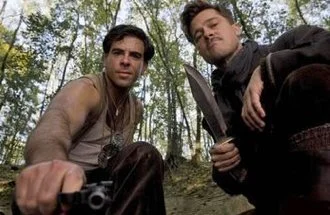
Many bloggers and readers have gotten into a debate on whether or not the violence in Quentin Tarantino's Inglourious Basterds is morally responsible and whether or not Tarantino's film (and entire body of work) has anything to say about violence, atrocity, or anything at all, for that matter. There have been thoughtful posts by Johann Hari, Michael Judge, Michael Jones, and Tom Matlack, to name a few. This is a valid discussion, but why is this limited to Tarantino? I understand that his film is brand new and all, but what about all the other films and filmmakers whose depictions of violence suggest a "moral emptiness"?

Sure, there's Griffith and Riefenstahl, but those are too easy. What about the glorification of violence in Michael Bay's work, which treats destruction and death as something to be marveled at with slack-jawed wonder? Or Independence Day, which even surpasses WWII-era films in its jingoistic celebration of each exploding alien spacecraft? Or even in the revered opening to Saving Private Ryan, which, while a virtuoso piece of visceral filmmaking, seeks to wow us with its unrelenting devotion to piling up bodies (each wiped out in a unique and visually arresting way, kind of like slasher films do) for our vicarious thrills? Or last year's The Dark Knight, whose ultimate justification of violence, torture, spying, and self-loathing resembles Dick Cheney's approach to the War on Terror? And this is just a list of the first few films that pop into my head. Are these all that different from what Tarantino's doing?

Tarantino's been the whipping boy for this kind of critique ever since Michael Madsen's Mr. Blonde cranked up the Stealers Wheel in Reservoir Dogs 17 years ago. Since then, each of his films has offered up at least one scene of violence played for laughs: the "I Shot Marvin in the Face" scene in Pulp Fiction, De Niro shooting Bridget Fonda mid-bitchy nag in Jackie Brown, the scene where Lucy Liu decapitates a man in Kill Bill, the hysterically lurid car-killings of Death Proof, and now the Nazi-scalping of the Inglourious Basterds. Of all these, only the scene in Reservoir Dogs is played somewhat seriously. The rest get a big laugh or a sharp stomach twist, seemingly dividing audiences into those who "get it" and those who don't.

Tarantino gets singled out as being morally vacant because he makes violence funny, and he's successful because he's really good at it. I know that there should be nothing funny about the "I Shot Marvin in the Face" scene and its extended comic aftermath, but I laugh anyway. Every time. And yet I'd like to think I'm a rather well-adjusted individual, even though I can quote most of that sequence from memory. Why is it so funny? How does Tarantino make us laugh at acts that should make us puke?

Tarantino's brand of violent comedy works because he foregrounds his films in the world of cinema, not the world of reality. He never expects to be taken seriously. Other films, like those of Michael Bay or Spielberg, insist on a level of verisimilitude and "reality" that Tarantino simply isn't interested in. Inglourious Basterds is the prime example of this. Just compare it to Saving Private Ryan. Private Ryan shoves its commitment to detail and realism down our throats; its shock and awe is that it is "so, like, for real." Tarantino's film, on the other hand, doesn't give a damn about reality. Just look at its climax, where WWII ends in the most improbably and historically inaccurate way possible, a sequence so over the top that it slips into parody not only of itself but of cinema as a whole. In fact, the only aspects of history attended to in Basterds with any sort of care for accuracy is the history of Ufa studios -- in other words, the movies.

It's this self-conscious disconnect from reality that provides viewers with a "safe" place to root for (and laugh with) killers, drug dealers, and sword-wielding assassins. Just as there was no all-Jewish death squad, there are no killers anything like John Travolta and Samuel L. Jackson, nor any ex-all-female gang members who not only wield swords but also dress like Bruce Lee in Game of Death in reality. But they do exist in the movies in abundance, and the movies often seem to be Tarantino's only frame of reference. His characters speak in overly crafted, hip "movie" dialogue that is often spoken for its own sake rather than to "say" anything, his scenarios are crafted more for their relationship to other movies than for their resemblance to reality, and what politics he has are more focused on Madonna lyrics and failed TV pilots than they are on foreign or domestic policies. In fact, he's not even interested in personal politics, because his characters are not people but characters in a movie.

The apotheosis of this sensibility may be in the Jack Rabbit Slim's of Pulp Fiction, which could easily serve as a metaphor for Tarantino's entire body of work. In the same way the restaurant immerses the patron in a hyperreal 1950s diner, Tarantino places the viewer in a hyperreal cinema world, a world in which the only thing that exists are the movies -- all movies, every movie, brought to life in the same place. People get killed, people's lives overlap in "chance" run-ins, people's backstories are told in anime, and people shoot at people standing five feet away from them and miss. In a world like this, violence is a device and blood is little more than a color. Tarantino himself has said as much. This amounts to a celebration of the image, a revelry in our biggest cultural export and the most universal of languages. If cinema can be compared to a candy store, then Tarantino is the kid on an all-out binge, cramming as many brightly-colored packages into his bag as he can afford on his allowance, without giving a thought to any of its nutritional value. It's all sweet and he wants to drown himself in it.

But still the big question remains: is this morally responsible? Is treating blood as a color reckless? Hell yes. And so are the vast majority of movies that contain violence. The fact of the matter is that cinema has always been very good at making violence look cool. The old Hays Code may have required films to say that crime doesn't pay, but the films always did so as an afterthought. Sure, Scarface (either version) gets gunned down at the end, but that doesn't cancel out the ninety minutes (or three hours) the film has devoted to lionizing his reckless life in specific detail.

It's no coincidence that most bloggers have called attention to the film that explores this issue the best: Stanley Kubrick's A Clockwork Orange. The film also happens to be the most notoriously violent, so-called "morally objectionable" film of the last 50 years, but that is because the attitude of its hero is mistaken for the attitude of the film. What Kubrick offers in this film is a sophisticated examination of our relationship to image and to reality. The film is dangerous because Kubrick refuses to simplify this debate, or even to comment on it as it happens. Instead, he puts it all in the viewer's lap. The film gives us a morally empty hero and chronicles his actions with little overt affect, leaving the viewer to sort through the "meaning" of the events by examining his/her own reaction to them. This is very complex stuff, and the problem is that we as a culture do little to educate ourselves on how to read such visual material, so the film gets read as a celebration of violence and banned when it should be used to teach people about violence and its representation.

In many ways, we're still stuck in the same mindset of early cinemagoers who watched trains approaching the camera and ducked under their seats. While we know now that the train will not hit us, we do still have trouble separating cinema from reality. This is at the center of the Tarantino debate and any debate over whether or not cinema should be "morally responsible."

Demanding that cinema be morally responsible or socially redeeming is asking art to continually affirm the status quo by indoctrinating us on how to live, discrediting the viewer's own intellect and free will. Pushing that line too hard will lead to a kind of reactionary censorship that will make the Hays Code look radical. After all, didn't Nazi Germany think Triumph of the Will was morally responsible?

Perhaps this is one of the things that is good about Tarantino, regardless of what you think of him: his films have the potential to advance discussion of the relationship between cinema and reality. That is, if we really want to talk about it with a clear head. But if we're really going to get into a full-on knee-jerk condemnation of the moral irresponsibility of his work, then we'll have to pack a lunch because then we'll be required to take on just about every R-rated film there is, and that could take all night.


Follow Mike Miley on Twitter: www.twitter.com/Don't Tweet

Many bloggers and readers have gotten into a debate on whether or not the violence in Quentin Tarantino's Inglourious Basterds is morally responsible and whether or not Tarantino's film (and entire bo...
 
Comments
196
Pending Comments
0
iPhone App Promo

Want to reply to a comment? Hint: Click "Reply" at the bottom of the comment; after being approved your comment will appear directly underneath the comment you replied to

View Comments:
Page: 1 2 3 4 5 Next › Last » (5 pages total)
photo

"Morally responsible" art is a bankrupt and extremely dangerous idea.
Soviet Social Realism. German "entartete Kunst" and Islamic and Christian censorship are a clear proof.
In fact, the idea of " morally responsible" is immoral.

    Favorite    Flag as abusive Posted 04:35 AM on 09/10/2009
photo

Normally, I can't stand Tarantino films.

Inglorious Bastards is a major exception.

Oddly, not at any point during the movie did I find the violence funny.
Although there were some funny moments, for sure.

I think he has excelled in this movie.

I thought it might have been morally irresponsible to rewrite history, but as we know: "The victors write history". Who's to say that something like this didn't happen and we never knew about it, because of national security clearances?

Who would have really approved of a top Nazi being given a full pardon and a home in Nantucket?

War is the immoral thing, not this movie.

    Favorite    Flag as abusive Posted 04:16 AM on 09/09/2009
- alkamm I'm a Fan of alkamm 42 fans permalink
photo

Good points! I think the Scottish government might have made a deal with the SS officer if he'd had an incurable cancer and his government had a lot of oil, but I digress.
That being sad, I laughed when some of the Nazis got their just deserts. Kids would to. This same phenomena of moral denunciation by those who'd censor art out of existence goes on with video games as well. Used to be comic books too. The imagination can handle it, let me tell you. It's fun to laugh at violence. If you have a sense of humor, you can laugh at the misfortunes of others because you realize they are not real, only characters.

    Favorite    Flag as abusive Posted 11:15 AM on 09/10/2009
- langej I'm a Fan of langej 10 fans permalink
photo

I think you miss the point: Tarrentino films are not just morally vacant, they are morally reprehensible BECAUSE they make violence funny. The fact that other filmmakers strive to glorify violence is a condemnation of their films, not a vindication of Tarrantino's. I suppose we could say: oh well, so what if it increases anomie and desensitizes weak minds, hence making our society a less pleasant place to live; it sells movies and it s not as bad as roadrunner. But do we really want to say that?

    Favorite    Flag as abusive Posted 03:52 AM on 09/09/2009

Roadrunner and Bugs Bunny cartoons make violence funny. Voltaire's satirical Candide gets pretty gross and violent in parts. Macbeth anyone? Yeah, it doesn't treat violence and mental cruelty as a barrel of laughs, but it was pretty damned violent. So you gonna ban them, too?

Again, if you don't like it, don't watch it. If stuff like that stopped selling then the studios would stop making them.

    Favorite    Flag as abusive Posted 09:36 PM on 09/09/2009
- alkamm I'm a Fan of alkamm 42 fans permalink
photo

Don't read fairy tales if you don't have a sense of both humor and the delightful fiction of the evil in this world punished without restraint or nuance! Weak minds? Those are the minds that couldn't handle the Grimm's Fairy tales' cutting off the evil stepsister's feet in Cinderella or killing witches that abduct youngsters. Kids have strong enough minds to understand the importance of killing the evil characters in fairy tales. Read Bettleheim's "Uses of Enchantment."

    Favorite    Flag as abusive Posted 10:53 AM on 09/10/2009
- yesman I'm a Fan of yesman 4 fans permalink

Thank you for this perceptive piece. It's not wrong to question Tarantino's (or anyone else's) filmic moral compass. But the endless hand-wringing over Tarantino's movies does miss the point. I was troubled by the violence in his films at first too. But then I "got it." His movies are really cartoonish. No one excoriates Chuck Jones for moral vacuity because Wile E. Coyote gets callously crushed by boulders. Tarantion's movies are essentially on the same moral plane--they just happen to be not animated. Whether it's a good thing to have a major filmmaker whose films are on the same moral plane as cartoons is another question.

    Favorite    Flag as abusive Posted 01:30 AM on 09/09/2009
photo

I absolutely agree. Tarantino's films, all of them that I can remember seeing, are purely comic book oriented (and I don't mean Archie, Betty and Veronica. LoL) but acted out by human actors, and should be viewed as such. Just put ALL the eggs in one basket and call it "Pulp Fiction" and his style is clear and evident and that title fits all his films and if a book were written discussing all of Tarantino's productions, it too should be called "Pulp Fiction." That is what his work is about and like and he is unique and brilliant in his methods regarding his films.

People should relax and not read things into his satirical melodrama's that simply aren't there. He has his own style, it is different and interesting and I don't think he had any intentions of winning the Nobel Peace Prize when he created his body of work. Props to Quentin for stepping out on a ledge and doing it a little different from other people, and appreciate his art form for what it is and nothing more.

Pulp fiction is much more than the title to a 1994 film, it is a description of a melodramatic story, bound in paper, that is fictitious as in "not true."

    Favorite    Flag as abusive Posted 04:12 AM on 09/09/2009
- alkamm I'm a Fan of alkamm 42 fans permalink
photo

Tarantino wrote a new Arthurian legend in Pulp Fiction, full of violence and bad people getting their comeuppance. Characters make moral decisions within a violent and morally ambiguous world. These are fictions in the best sense, higher than reality.
The Mort d'Arthur was originally a pulp fiction, collected stories like those the Grimm Brothers found, full of violence and moral direction. Tarantino's latest work leads the viewers to continually examine their own moral compasses in relation to the examples Tarantino crafted.

    Favorite    Flag as abusive Posted 10:56 AM on 09/10/2009
- mudshark12 I'm a Fan of mudshark12 5 fans permalink

Great post by Mike Miley who, like me can dig what QT is up to in his films. Originally I thought after seeing the trailers that maybe this flick was an updated Dirty Dozen, it was nothing of the kind. Here we have yet another Quentin Tarentino masterpiece. I guess Quent just has this talent for carnage as I'm not offended by what he is showing the audience.

    Favorite    Flag as abusive Posted 11:19 PM on 09/08/2009
- mom2luke I'm a Fan of mom2luke 8 fans permalink

I don't like his movies ... went to pulp fiction/resevoir dogs only b/c my husband dragged me... the violence haunts me to this day ... wish i could delete them from my brain.
they're engrossing of course, but not in a good way.

i'm of the relgious liberal left (yes, we really exist) .... if his movies were censored and the most disgusting parts cut i'd be glad. i'm suddenly remembering that i was a tipper gore fan. saying you can watch such hideously graphic violence and "sex" and not be affected by it is just lying to yourself....it's just BAD for us, bad for 'family values' for our kids. just gross.

    Favorite    Flag as abusive Posted 10:20 PM on 09/08/2009
- elan4444 I'm a Fan of elan4444 7 fans permalink

Thank you. A voice of sanity emerges.

    Favorite    Flag as abusive Posted 01:28 AM on 09/09/2009

I'm sorry you had to see a film that scarred you, nevermind a second one. But what in the world makes you think it's Tarantino's duty or responsibility to make sure everyone who sees his movies is "okay" afterward?

If you don't want your kids seeing his movies, I perfectly understand. I for one hope that I can one day let my future kids go see it with the faith that they can handle it with their sanity and perspective intact.

    Favorite    Flag as abusive Posted 03:29 PM on 09/09/2009

Censorship? We already have a ratings system. You should be mad at your husband not at QT.

    Favorite    Flag as abusive Posted 05:04 PM on 09/09/2009
- alkamm I'm a Fan of alkamm 42 fans permalink
photo

Do you lie awake disturbed by the images in fairy tales? Does the killing of witches bother you? Have you ever read the Mort d'Arthur, a great moral guide full of violence and summary justice? When you read your Bible, do you use it to realize it's teaching you both what to do and what not to do, that the violence in this sacred work is designed to portray our flawed natures and the misapplication as well as the proper application of violence? When the treacherous are punished, do you imagine that the writers of your sacred work were too violent in their judgements?
Would you like to censor away or focus group the above out of existence if you could? Why not?

    Favorite    Flag as abusive Posted 11:00 AM on 09/10/2009

Sorry, you completely lose me (and reality) when you say that QT succeeds only because he vaults thru sheer hyperbole over the pit of amorality. And Tarantino should be so lucky if Pulp Fiction were a metaphor for his work as-a-whole.

Pulp Fiction was a masterpiece of moral filmwriting. Jules finds true redemption at the end; and not only *if*, but specifically *because* his changes are the tentative beginnings of the ponderment of the foundations of real morality.

The art of viewing Tarantino is the art of seeing how a man reconsiles the pursuit of dog-eat-dog philosophy with a primal, deep-seated need to discern the moral grain to the workings of the universe. These are the lessons of Lao Tse, Zhuang Tse, Jesus, Buddha, Mohammed... and now, in his own way, Tarantino.

Yeah, he postures like a "bad boy", but don't let that influence your viewing of his films. You're watching a man whose professional career is that of a man who discovers, each time he writes a script, yet-another way to tease redemption out of an apparently bleak landscape.

    Favorite    Flag as abusive Posted 09:38 PM on 09/08/2009

Interesting take, I never thought of it like that. You might be right, I'm definitely not going to argue with you at this stage... this will take some thinking over..

    Favorite    Flag as abusive Posted 03:31 PM on 09/09/2009
- alkamm I'm a Fan of alkamm 42 fans permalink
photo

As with all great fictions, the real work goes on in the viewer's mind. You picture yourself in the story, or the story brings out your own sympathies and sensitivities and how these fit into a moral framework. Tarantinos work is deeply moral because it bids us examine our own lives, and to see different aspects of our minds at play in the form of characters.

    Favorite    Flag as abusive Posted 11:03 AM on 09/10/2009
photo

It's called entertainment and is a getaway from real life. Worry about wars, clean water , food and the federal government taking away our freedoms. Dark movies are great, dark policies of are governments are not.

    Favorite    Flag as abusive Posted 08:42 PM on 09/08/2009
photo

Tarantino is simply catering to the desires of the people which are being intentionally degraded by the government's involvement in the public schools and teaching children all behaviors are to be tolerated. Obama isn't subjecting his children to that trash teaching but will ensure the less fortunate have no choice.

    Favorite    Flag as abusive Posted 08:39 PM on 09/08/2009
- geroldf I'm a Fan of geroldf 5 fans permalink

You guys don't get it.

QT baits the viewer to laugh along with brutality.

In the movie, it's OK for Americans to be sadistic killers and enjoy it, because we're the Good Guys. Get it?

    Favorite    Flag as abusive Posted 08:06 PM on 09/08/2009

Violence is not funny and this film was a waste of my time and money. It was trash!

    Favorite    Flag as abusive Posted 08:02 PM on 09/08/2009
photo

Let me get this straight... You went to see a Tarantino flick because you thought there would be no violence? or because you thought the violence would not be funny?

Great comments from Mike Miley..

    Favorite    Flag as abusive Posted 08:27 PM on 09/08/2009
photo

If you haven't figured out yet the style of Tarantino's films, then I don't have much sympathy for your complaint. If you don't like what he does, why go?

    Favorite    Flag as abusive Posted 08:35 PM on 09/08/2009
- plsps I'm a Fan of plsps 7 fans permalink

My censorship is I will not go see it. I have gone to movies lately that were not worth seeing and some times I just walk out. I can't see why some are even made. They are some that are grotesques, some are degenerate, and some just show how illiterate the people that made them were. I'm just not entertained by such.

    Favorite    Flag as abusive Posted 07:21 PM on 09/08/2009

I'm not a fan of Tarantino's violence. In fact, I don't even like my horror films to show excessive gore or totally unopposed evil. So you can imagine my own surprise at my feelings of delight when I saw that episode of The Simpsons where the depicted Tarantino (not too long after he made Natural Born Killers) was decapitated with cartoonish brio. I think that was the social critic having the last word with an immature director who evades responsibility for the possible consequences that may come from glorifying violence. I don't want QT to get away with saying that he's making art and not something culpably real any more than I want radio hosts Limbaugh or Beck to resort to that pis aller of saying that they're just entertainers. Artists, just like right-wing radio blowhards, need to grow up and consider how ignorant and impulsive people respond to their messages.

    Favorite    Flag as abusive Posted 07:00 PM on 09/08/2009
- yesman I'm a Fan of yesman 4 fans permalink

Um, Tarantino didn't make "Natural Born Killers"--that would be Oliver Stone. NBK is a terrific film that does consider moral issues in a way that Tarantino does not.

    Favorite    Flag as abusive Posted 01:34 AM on 09/09/2009

You are right that Stone directed the film NBK, but Tarantino did write the story the movie was based upon--if we can consider the following web page to be accurate.
http://www.imdb.com/title/tt0110632/

    Favorite    Flag as abusive Posted 04:58 AM on 09/09/2009

No, I'm sorry, but equating radio-hosts and cable pundits with film directors is disingenuous.

Also, how can you express disgust at blood and gore, then feel "delight" when Tarantino's head is cut off? In a kid's show, no less? You're defeating your own point. You don't like Tarantino, fine, but your feelings about him have nothing to do with the discussion on film violence.

    Favorite    Flag as abusive Posted 03:36 PM on 09/09/2009
- elan4444 I'm a Fan of elan4444 7 fans permalink


Recently a young marine's last moments on earth were captured on film and published in some newspapers. It was reality, and it was tragic. I can only hope that we are not so inured to depictions of violence that we cannot separate the reality from something we have seen in the movies. Why was the American public so shocked when Pearl Harbor was attacked? Because our country does see things through a moral compass, and we never thought a country would use its sons the way Kamakazie pilots were sacrificed. Since we calculated the Japanese lacked the capacity to make a round-trip flight to the island, not to worry, their pilots would have to get back home, right? A study made by the military discovered that only one in four American soldiers were using their rifles to shoot to kill during WWII.The same with the events of 9/11, Americans couldn't envision a heinous crime such as that. I did go to see the Inglorious Basterds movie, but since I don't view movies as the be-all and end-all of a meaningful life, I have to write it down as another indulgence of someone who has never experienced personal violence, and, of course I hope he doesn't. But, I would like him to be more responsible. Depicting Jewish soldiers taking their vengeance on German soldiers by scalping is pretty ridiculous and not at all worth the $9 I paid for admission to the theatre.

    Favorite    Flag as abusive Posted 06:02 PM on 09/08/2009

You're displeased with the lack of realistic anchoring in Tarantino's (and many others') movies. That is an opinion you're free to have, which I don't agree with. But to suggest that his movies shouldn't have been made in the first place is missing the point of the Arts as a whole. They can, but don't have to, make us think about our lives and reality. Sometimes it's just art for Art's sake.

    Favorite    Flag as abusive Posted 03:39 PM on 09/09/2009
- averygard I'm a Fan of averygard 16 fans permalink

One of the few things I never understand about so many of my fellow liberals is the lack of this idea that, although we can do something, we might consider whether we should do it. I do not believe in censorship of any form (although in my opinion we already have it—our news is effectively censored and the quality of our entertainment is censored in its own way on the basis of what corporations are willing to pay for and how low of a common denominator movie-makers, etc., seem willing to sink). Yes, now we can in movie-making get away with showing more violence than ever before in cinema history. But should we? Yes, we can now exploit women much more openly and explicitly than ever before, thanks to so many esteem-less or broke (or both) women willing to let you do it. But should you? I mean ethically, the fact that you can, does that mean that you should? I can’t grasp why no one ever seems to ask these questions. Yes, people have become so f’d up that they find violence funny (and in America, based on the violent crime rates, plausible as a solution), and therefore a savvy person can take advantage of the basest level of reptilian kind of thinking involved here. But should they?

If the only way you can make a movie funny or interesting is continual and graphic violence, you might just have a very limited imagination.

    Favorite    Flag as abusive Posted 05:59 PM on 09/08/2009
- elan4444 I'm a Fan of elan4444 7 fans permalink

Really good point. Those who are easily entertained must be his fans. I mean, this stuff is not hard to make. What is hard to make is a thought-provoking movie that reveals something of the human condition. Take "The Celebration" by Thomas Vinterberg. Thomas Bo Larsen is amazingly despicable in his role, you totally forget that he is acting. I never forgot that Brad Pitt was acting in Inglorious Basterds. It has to do with the director's ability - I don't think he used his cast to their potential - such a waste of talent.

    Favorite    Flag as abusive Posted 01:43 AM on 09/09/2009
- alkamm I'm a Fan of alkamm 42 fans permalink
photo

A sense of humor requires that you realize jokes use characters in a completely intellectual manner. If you feel for blondes, for instance, you can't get how blonde jokes display ways the human mind can use rationality improperly. They are instructive, not exploitative. In the Mideast, they use Mullah Nasrudin, a buffoonic imam who illustrates mental disfunctions in humorous ways.
Same goes with the use of our imaginations in violent fairy tales like Tarantino's. We realize that characters in the story are designed to illustrate moral positions and their lack. Just as there are real witches in life who abduct children and abuse them for their own personal uses, fairy tales staff their stories with witches who deserve death and get it. Same with the Arthurian legends which Pulp Fiction and Reservoir Dogs channel.
These stories help us understand how we make compromises, summary judgements, and they ask us how we'd react in these extreme situations, or in the little situations we find ourselves in that are less extreme. Fairy tales, as I've said several times in this blog, are there to help us realize our brains have areas we need to deal with, and children know evil characters deserve death and actually can't stand it when the nuanced punishments don't fit the crime.
.
The limited imagination is in those who mistake the violence as real, as sort of you tube reality instead of fictional reality, a higher reality that they need to stretch their imaginations to accomodate.

    Favorite    Flag as abusive Posted 11:11 AM on 09/10/2009
Page: 1 2 3 4 5 Next › Last » (5 pages total)
Comments are closed for this entry

 You must be logged in to comment. Log in  or connect with 

Connect