Earlier this month global climate negotiations wrapped up for the 17th time in Durban, South Africa. An agreement to continue to talk and hopefully agree on a treaty binding to everyone by 2020 is progress of a sort. Meanwhile, scientific consensus predicts that if we keep doing what we're doing, global temperatures will increase 3.6 to 7.2 degrees Fahrenheit (2 to 4 degrees Celsius) by 2100, about the same level of warming that occurred following the Last Glacial Maximum almost 20,000 years ago -- except about 100 times faster. Certainly any effort to prevent the high end of that prediction has to be a top priority. But timetables for action, like the one that came out of Durban, suggest we're probably already locked into a big temperature increase, and we need to start preparing for the consequences.
With estimates that the world's population may hit at least 9 billion people by 2050, our legacy will be a world much different than the one we know. According to NASA , in 90 years most of Earth's land that is not covered by ice or desert is projected to undergo at least a 30 percent change in plant cover -- changes that will require people and animals to adapt and even relocate. The combined impact of a warmer planet and an extra 2 billion people will be jarring to say the least. It won't be easy, but people can move, and the lucky ones will. But many plants and animals will be trapped, unable to adapt in a world that is changing much faster than it has in the past and unable to migrate past man-made blockades like cities and highways. The reality is we're going to have to help them.
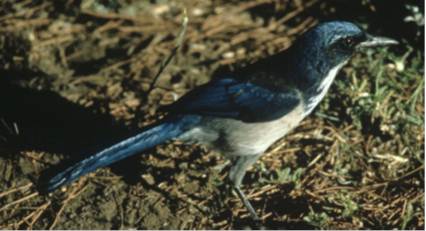
The island scrub-jay may be the new poster child for this challenge. It is the only island restricted bird species in continental North America. The only place you'll see one is on Santa Cruz Island, just off the coast of Santa Barbara, California. So it is going to be in trouble if climate change makes Santa Cruz Island unsuitable. A recent paper in the journal BioScience suggests a number of ways that could happen. For example, diseases like West Nile virus are becoming more prevalent with global warming, and when birds like jays get West Nile they tend to die. Fortunately, there are a number of things that we can do to reduce the risk of extinction of the jays -- like moving them to an island that is likely to stay cooler in the future. Two islands sure seem better than one in this case.
What's interesting about the case of the island scrub-jay is that while the bird appears to be doing fine right now, science tells us that there are problems on its horizon. This gives us the opportunity to think through what we can do proactively to reduce the threat of climate change. It will be a good test case because we're definitely going to need practice thinking through this kind of issue. What will we do when entire plant and animal communities can no longer make it in San Diego, their optimum climate shifting to San Francisco? How about species whose home habitats go away in other countries and a relatively short trip north just won't cut it? Is it zoos or oblivion? Or are there other options? This is startling talk to conservationists focused on protecting nature where it is today. But in reality humans have altered 75% of Earth's ice-free land. We are already changing and managing the planet -- just not by design. Helping the diversity of life adjust and survive the Age of Man even as we try to survive ourselves will be our biggest challenge since Noah built his ark. A little bird told me so.
Follow Mike Sweeney on Twitter: www.twitter.com/mppsweeney
http://thinkprogress.org/romm/2012/01/01/395922/german-solar-output-increases-2011/
Oh no. Sunlight. Help me. I'm shrinking!
http://www.nytimes.com/2012/01/04/business/global/german-joblessness-falls-to-lowest-level-in-two-decades.html?_r=1
Ditto for Denmark, which already gets 25% of its TOTAL ENERGY from renewables?
From the Pentagon's Quadrennial Defense Review (2010):
-------------------------------------------------------------------------------------------
Climate-related changes are already being observed in every region of the world, including the United States and its coastal waters. Among these physical changes are increases in heavy downpours, rising temperature and sea level, rapidly retreating glaciers, thawing permafrost, lengthening growing seasons, lengthening ice-free seasons in the oceans and on lakes and rivers, earlier snowmelt, and alterations in river flows.
Assessments conducted by the intelligence community indicate that climate change could have significant geopolitical impacts around the world, contributing to poverty, environmental degradation, and the further weakening of fragile governments. Climate change will contribute to food and water scarcity, will increase the spread of disease, and may spur or exacerbate mass migration.
While climate change alone does not cause conflict, it may act as an accelerant of instability or conflict, placing a burden to respond on civilian institutions and militaries around the world. In addition, extreme weather events may lead to increased demands for defense support to civil authorities for humanitarian assistance or disaster response both within the United States and overseas.
http://www.defense.gov/qdr/images/QDR_as_of_12Feb10_1000.pdf
"Its charter is not the science of climate change, but the national security impact of phenomena such as desertification, rising sea levels, population shifts, and heightened competition for natural resources."
from the CIA web site:
https://www.cia.gov/news-information/press-releases-statements/center-on-climate-change-and-national-security.html
p.xi, Dept. of Defense Task Force,
"Trends and Implications of Climate Change for National and International Security", Oct. 2011
http://www.fas.org/irp/agency/dod/dsb/climate.pdf
"...if all of the measures currently recommended to reduce emissions from human activity are implemented, the predicted temperature rise will vary from a minimum of 2degs.C to as much as 7degs.C by the end of the 21st century. A rise of more than 2degs.C is likely to have serious consequences for the human habitat."
But their real fear is loss of jobs and lifestyles caused by transitioning away from fossil fuels.
Yet, they never look at the other side of the coin: potential jobs and lifestyle losses due to unaddressed climate change.
Here's what one Sandia U.S. National Labs Study suggests:
"... perform a detailed 70-industry analysis of economic impacts among the interacting lower-48 states. We determine the industry-level contribution to the gross domestic product and employment impacts at the state level, as well as interstate population migration, effects on personal income, and consequences for the U.S. trade balance.
We show that the mean or average risk of damage to the U.S. economy from climate change, at the national level, is on the order of $1 trillion over the next 40 years, with losses in employment equivalent to nearly 7 million full-time jobs."
https://cfwebprod.sandia.gov/cfdocs/CCIM/docs/Climate_Risk_Assessment.pdf
Then there's the U.K.'s Nicholas Stern Review, the World Bank's former Chief Economist, who figures a 2% annual drag on GDP, vs. perhaps an eventual 20% drag if we do nothing.
http://en.wikipedia.org/wiki/Stern_Review
http://www.independent.co.uk/environment/climate-change/lord-stern-on-global-warming-its-even-worse-than-i-thought-1643957.html
Mitigation.
HTH.
Since the climate includes a lot of "sloshing around" (as Dr. James Hansen says), a rule of thumb is that it takes about 30 years of data to establish a clear trend. This is not difficult to understand when you consider that it takes time for the ocean to heat up. Keep that in mind when you look at the graphs.
Again.
Precisely !
E.g., when Mt. Toba erupted ~71k (+/- 5k) years ago,
http://en.wikipedia.org/wiki/Toba_catastrophe_theory
mankind immediately adapted by dwindling to perhaps less than 10,000 mating pairs. This may have forced then normals to tolerate those who had already mutated toward complex symbolic reasoning, physically understanding our universe, enthralling artistic expression, and sublime spirituality - rocketing them culturally far beyond then-prevailing average homo sapiens, Neandertals, Denisovans, and Homo Erectus.
Meanwhile, human mating remains w/i a tight DNA range bounded by identical twins to useable inanimate objects. However, admixtures between humans and earlier hominids appears to be low, with a maximum of 4 - 6% Denisovan DNA carried by some Melanesians.
http://en.wikipedia.org/wiki/Denisova_hominin#Interbreeding_with_modern_humans
So, current consequences are perhaps apparent only among a few regressive, reality-denying shills here.
Yet, overall, such advances in assimilating and modeling reality allowed humans to migrate to and populate all corners of the world, starting ~ 60 - 70k years ago.
Thus, from a paleontological perspective, near-extinction events remain an excellent opportunity for kick-starting human mutation and emigration - assuming terrestrial non-habitability, this time to other planets perhaps !
So, we should all be keenly anticipating near-extinction events like the one now looming.
I say hello to all the people playing cute semantics with the phrase “climate change”.
OK, here is the deal. What we supporters and members of the scientific community are warning you about is catastrophic climate change. Nobody is denying that climate is always changing. The problem comes when your climate changes faster than you can adapt to it. And our climate is in a period of rapid change now. At the very least, we should all be having a discussion about what to do about this when, whatever the cause, places like Texas get devastated by desertification. At the very least, we should be talking about what to do about the Ogallala Aquifier drying up. At the very least, we need to recognize that the unforeseen consequences of rapid change can be devastating. At the very least, we need to be talking about the extreme vulnerability of a centralized power grid when, for instance, we pass through the next period of extreme ice storms.
But no. No, what we are doing is arguing over the number of scientists who can dance on the head of a pin. Fine. Double done on false Madison Avenue generated security and certainty. I have to look away though. I don’t have the stomach for watching people chase afte the receding ocean just before the tsunami.
Because they do, in astounding numbers.
Further, since the turn of the century, the rate of warming has declined. Many sources indicate the earth's temperature simply hasn't increased at all, and 2011 was one of the coldest years since 2000. Likewise, with sea level indicators, the rise in sea level has tapered off, with modest declines occurring in major coastal cities, such as San Francisco and Los Angeles, based on tide station data. In addition, Average winter temperatures in the U.S. have been falling over the first decade of the 21 st. Century. People should prepare for more severe winters, more similar to those several decades ago, rather than the relatively warm winters of the late 20th Century.
Every day people have to adjust to the temperature changing by about 20 degrees, from midnight to noon. A half of one degree rise or fall in average temperature isn't going to hurt anyone at all.
U.S. National Academy of Sciences, 2010:
-----------------------------------------------------------------------------------------
Human activities are influencing climate. As discussed in the following chapters, scientific evidence that the Earth is warming is now overwhelming. There is also a multitude of evidence that this warming results primarily from human activities, especially burning fossil fuels and other activities that release heat-trapping greenhouse gases (GHGs) into the atmosphere. Projections of future climate change indicate that Earth will continue to warm unless significant and sustained actions are taken to limit emissions of GHGs.
http://www.nap.edu/openbook.php?record_id=12782
The defenders are calm and cool headed when it comes to facts, but warm hearted when it comes to concern for the well being of others.
The deniers are hot headed when they respond to facts, but have a cool, even coldhearted disregard for the the well being of others.
I think this key fact helps to clarify the nobility of the defender's motivation.
http://www.youtube.com/watch?v=JfnddMpzPsM
James Hansen of NASA wants trials for climate skeptics, accusing them of high crimes against humanity
http://www.guardian.co.uk/environment/2008/jun/23/fossilfuels.climatechange
Robert Kennedy Jr. called climate skeptics traitors
http://www.associatedcontent.com/article/308598/doubting_global_warming_could_be_treason.html?cat=75
Yvo de Boer of the UN calls climate skepticism criminally irresponsible
http://www.usatoday.com/weather/climate/globalwarming/2007-11-12-united-nations_N.htm
David Suzuki calls for politicians who ignore climate science to be jailed
http://www.nationalpost.com/news/story.html?id=290513
Joe Romm encourages the idea that skeptics will be strangled in their beds
http://www.climatedepot.com/a/1174/Update-Romm-defends-remarks-as-not-a-threat-but-a-prediction--Strangle-Skeptics-in-Bed-An-entire-generation-will-soon-be-ready-to-strangle-you-and-your-kind-while-you-sleep-in-your-beds
Green Peace wants you to know that they know where you live.
http://joannenova.com.au/2010/04/greenpeace-are-coming-we-know-where-you-live/
Dear Orkneygal,
Isn't prominent global warming "skeptic" Dr. Robert M "Bob" Carter committing de facto global warming fraud by misrepresenting increasing global temperature trend lines as flat?*
Isn't that like a climate science scam, a global warming hoax, a blatant and indefensible lie?
Bob Carter is a leader of and/or major contributor to several of the most prominent organizations that are "skeptical" of man-made global warming, including:
* The Heartland Institute
* The International Climate Science Coalition
* The Science & Environmental Policy Project
* The Science and Public Policy Institute
* The Nongovernmental International Panel on Climate Change
Also:
You Orkneygal have indicated that you live in New Zealand - what relationship do you have with Bob Carter's global warming "skeptic" organization the New Zealand Climate Science Coalition?
Please finally answer these questions instead of continuing to run away from them - thank you.
------------------
* http://scienceblogs.com/deltoid/2011/07/bob_carters_trend_lines.php
The trend line over the past century has been curving upwards, right through the present.
Orkney cherry picks a data anomaly. 1998 was the hottest single year. We can see on the trend line that 1998 is way off the curve, just as previous years have been. But the recent decade was the hottest decade, replacing the previous decade, which replaced the decade before that. The overall trend is hotter. And accelerating.
http://www.woodfortrees.org/plot/hadcrut3vgl
http://climate.nasa.gov/keyIndicators/
A gentle warming from about 1910 to 1940
A nasty cooling trend from 1940 to 1970
A gentle warming from about 1970 until the present day, although temperature has been in a slight decline sine the peak in 1998.
The careful observer will note that the trend for 1910 to 1940 is approximately the same as from 1970 to 2010.
Despite the increase in atmospheric CO2 levels, the warming rate today is basically the same as it was from 1910 to 1940; a period of time when the human population was a tiny fraction of what it is today.
There is no evidence of any acceleration in the most gentle and hospitable warming trend of the last 100 years. Despite increasing CO2 levels, warming is not accelerating. There is no evidence of CO2 causing a negative feedback in the instrument record.
The Rommulans' claims of looming catastrophe due to atmospheric CO2 levels have no basis in the data from the real world
http://tinyurl.com/7zpdvec
Actually, the careful observer will note that this claim is false. The 1970-present is approximately 150% of the earlier trend:
1910-1940: 1.1 degC/century
1970-present: 1.6 degC/century
http://bit.ly/uL4ETY
http://bit.ly/vjB7O8
Your claim is demonstrably untrue.
I hope that pointing this out doesn't put me afoul of any New Zealand laws.
This is explained in much greater detail by a peer reviewed study published in the Proceedings of the National Academy of Sciences.
http://books.nap.edu/openbook.php?record_id=11676&page=R1
As well don't exaggerate how pleasant and balmy conditions may have been for the Norse settlers in Greenland. At its peak, the colony consisted of two settlements, the Eastern and the Western Settlement, with a population of 3,000-5,000. In Collapse Jared Diamond describes how the settlers endured a very harsh and meagre existence.
http://en.wikipedia.org/wiki/History_of_Greenland#The_demise_of_the_Greenland_Norse_settlements
http://www.newyorker.com/archive/2005/01/03/050103crbo_books
In short, see if you can move on to another talking point.
let us know how the climate scientists have reconciled the archeological records and the botany science with the climate science.
Good to see you agree, finally, that global warming is happening. However, it is not a good thing for all the species that are getting superstressed. Life evolved for conditions as they were, not as they are becoming over the course of a single century. Would any sane person declare that warming has been good for food production in Texas, or in the wheat belt of Russia? Global warming is NOT a good thing, at the accelerated rate we
are causing and witnessing.
If you knew anything about science you would know that.
Texans (and Russians, also) tend to think they live in the most important place in the world and therefore will whinge loudly about any perceived dis-comfort..
Orkney dismisses these with a wave of the hands as a 'discomfort.'
While I agree that humans are in part responsible for current climatic changes, the fact remains that this has happended many times before with the last being a short lived one around 1000AD. It came and went fast, but wiped out a lot of humanity in the process.
For all of those that have specific opinions and are promoting measures that you believe will slow or stop the change, consider this: we have no way to stop volcanic activity, nor the earth itself. As it currently stands all of this could become moot quickly as the only thing that stands between the present population and the four horsemen are fungicides, herbicides & pesticides. Everyone likes to complain, but while you are doing it, remember that only 1% of the U.S. population is feeding this land and exporting another 30% to the rest of the world. Ag. problems are rising along with all else.
Have a good prayer.
I do have a smidgen of knowledge and what is found in a pit with a trowel and paint brush tells a tale of the past. Geology and hydrogeology are science.
Are you disputing that? If so, where is your peer-reviewed evidence.
If you're not prepared to dispute that, then what makes you think that a gradual transition to a low-carbon economy will have little or no impact on global warming mitigation? Where's your evidence?
I am an amatuer, but with a wide scope. Age, empirical observation mixed with classrooms and a backdoor ability into the ARL archives makes for opinions. Thank you.
Some of your colleagues at the U. of Madrid seem to think everything is locked into a ten mile zone between the crust and sthe Strat. However, if you are correct you can add another piece of speculation as the mix being carried on the Trop also would explain the blight outbreaks, and they are NUMEROUS. The only thing keeping us from a soylent green is fungicide.