iPhone app iPad app Android phone app Android tablet app More

Featuring fresh takes and real-time analysis from HuffPost's signature lineup of contributors
Min Zhu

GET UPDATES FROM Min Zhu
 

Jobs and Growth: Can't Have One Without the Other?

Posted: 05/ 2/2012 12:08 pm

As Frank Sinatra crooned about love and marriage, so it seems about jobs and growth: "This I tell ya, brother, you can't have one without the other."

The IMF's latest World Economic Outlook projects global growth of 3½ percent this year. To the person on the street, what matters is how this growth translates into jobs and wages. The news on the jobs front, unfortunately, remains grim.

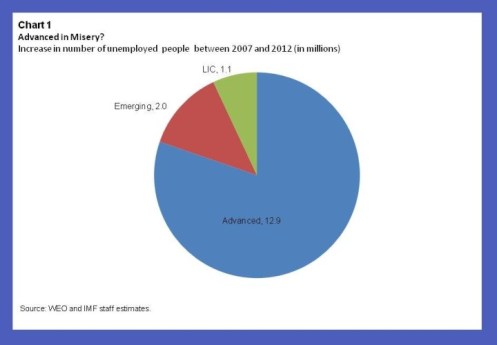
Five years after the onset of the Great Recession, 16 million more people are likely to remain unemployed this year than in 2007. This estimate is for a set of countries for which the IMF forecasts unemployment rates; adding in some countries for which the International Labour Organization provides forecasts only boosts the number.

The bulk of this increase in unemployed people has been in the so-called advanced economies (the IMF's term for countries with high per capita incomes), as shown in the chart below.
2012-05-01-1.JPG


Why isn't the jobs picture better? Quite simply, it's because the growth picture isn't very good.

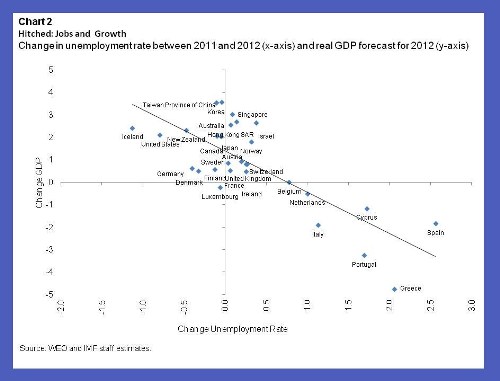
Consider Chart 2, which shows how for advanced economies the change in unemployment rates expected between 2011 and 2012 correlates with the IMF's forecasts for growth this year.
2012-05-01-2.JPG


Countries such as Cyprus, Greece, Italy, the Netherlands, and Spain, where GDP is expected to decline in 2012 are the ones where unemployment is expected to increase this year.

In Iceland, New Zealand, and the United States, where GDP is expected to grow, unemployment rates are expected to decline.

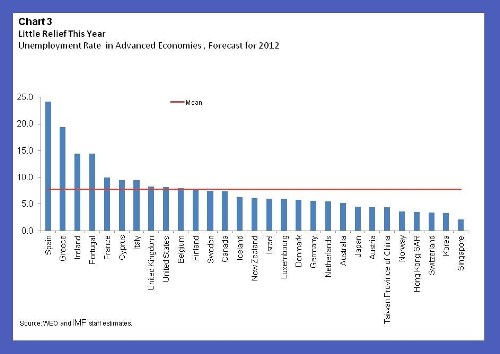
While these declines are welcome, unemployment rates are still expected to remain high in most advanced economies this year.

The average unemployment rate in these economies is expected to be 7¾ percent, with several populous economies such as the United States, France, the United Kingdom at or above this average.
2012-05-01-3.JPG


Policy response

The need to bring down these high unemployment rates is paramount.

That's why the IMF stated in its recent World Economic Outlook that "the highest priority, but also the most difficult to achieve, is to durably increase growth in advanced economies, and especially in Europe."

Specifically, policies must be strengthened to solidify the weak recovery and contain the many downside risks.

In the short term this will require:

  • more efforts to address the euro crisis;

  • a temperate approach to fiscal restraint in response to weaker activity;

  • a continuation of the very accommodative monetary policies; and

  • ample liquidity to the financial sector.

From iMFdirect blog.

 
FOLLOW BUSINESS
 
 
  • Comments
  • 2
  • Pending Comments
  • 0
  • View FAQ
Comments are closed for this entry
View All
Recency  | 
Popularity
HUFFPOST SUPER USER
Robert SF
02:33 PM on 05/02/2012
"Why isn't the jobs picture better? Quite simply, it's because the growth picture isn't very good."
===

Absolutely wrong since jobs growth isn't even keeping up with economic growth. It's incredible how even "expert" at the IMF have their heads so stuck in outdated paradigms that they cannot see what is plainly in their faces. Thomas Kuhn wrote about this in "The Structure of Scientific Revolutions." It seems even scientists cannot think "outside the box," so every explanation for why a theory isn't working is derived WITHIN the theory itself. That's why even Einstein could not accept quantum mechanics. He was too wedded to his pre-quantum paradigm.

In any case, the job picture is so poor because "work" has become less and less important to production. More and more, production is capital-intensive, not labor-intensive. In other words, the machines are doing all the work. That is why job growth lags while productivity surges.
photo
BBackSoon
Hello, I must be going.
12:43 PM on 05/02/2012
As far as the US goes, we also need some kid of Trade Policy so we don't just give away our markets to goods made in Less Advanced economies.

We need to install some real Tariffs on cheap foreign goods. The 2.5% we now charge is a joke. And since China charges something like 25% when US made Goods enter their country, maybe it is time we did the same?

Hell even 10% would help.

Look at the shelves of your favorite store, and when you can find US made goods, compare the price to the Foreign made goods, the difference is not all that great. So with just a little help the US made good could have the cheaper cost and therefore be the product of choice, and this would boost Demand and therefore allow companies to hire more US workers to meet the is demand.

I know it is economics, but business won't hire because there is no demand, and there is little demand because people don't have jobs.