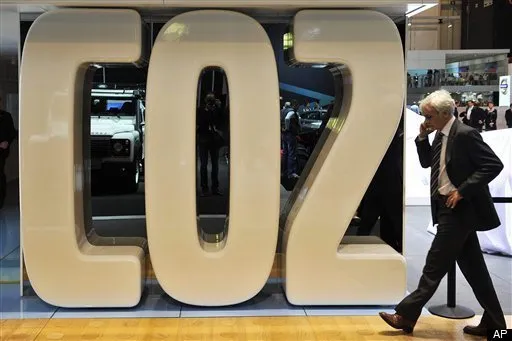
This week's bankruptcy filing by General Motors is a painful lesson for shareholders who failed to grasp the profound risks of the company's failed business strategy. It's a lesson all shareholders should consider in scouring their portfolios for risks.
As climate change business impacts take hold, a growing number of investors are boosting their attention to the risks and opportunities from global warming that are embedded in their portfolios.
GM failed to respond to climate risks by continuing to produce high-polluting gas-guzzlers that few consumers wanted -- a key factor in its downfall. What other companies might falter? And which are measuring their carbon footprint, setting pollution reduction targets and seeking new clean energy opportunities?
In short, which U.S. companies are best positioned to lead the pack in the great green race for a low carbon future -- a race that legendary venture capitalist John Doerr calls the "biggest economic opportunity of the 21st century."
For decades investors have turned to companies' SEC filings to answer such questions.
A report released today by Ceres and the Environmental Defense Fund shows that 100 global companies with the most at stake in preparing for a low carbon future -- companies in the electric power, coal, oil and gas, transportation and insurance sectors -- are providing scant information to investors on their risks and opportunities from climate change.
Fifty-nine of the companies evaluated made no mention of their greenhouse gas emissions in 10-K reports filed in 2008; 28 did not discuss risks, and more than half failed to disclose their actions and strategies for addressing climate-related business impacts. Even more revealing, the very best disclosure provided by any company surveyed could only be described as "Fair."
The report is a clarion call for the SEC to issue formal guidance on climate-related disclosure, and it bolsters investors' long-held pleas for better corporate reporting.
Even electric power producers, which generate about 40 percent of U.S. CO2 emissions, and are on the front lines of climate change action, had minimal disclosure. The best performers were Xcel, AES, and PG&E. Xcel disclosed past and projected emissions. AES went further and attempted to quantify potential costs from complying with proposed pollution-reducing legislation in Washington.
DTE Energy's disclosure hit rock bottom. Its 2008 10-K report simply states:
"There may be legislative action to address the issue of changes in climate... We cannot predict the impact any legislative or regulatory action may have on our operations and financial position."
That's not much for investors to hang their hat on.
Among oil companies Shell had the best disclosure, reporting past and current emissions, emissions reduction targets and a timeframe for meeting these commitments. Shell also outlined its participation in carbon trading programs, and investments and research into alternative energy.
Exxon Mobil's disclosure was abysmal, as was Massey Coal's. If all companies reported like they do, investing would be akin to throwing darts.
Investors are also pushing for better corporate disclosure on other environmental, social and governance issues. Water scarcity, child labor in contract factories, and executive compensation are examples of ESG issues that can impact a company's bottom line.
"What we seek is not radical, but rooted in the SEC's duty to follow the most fundamental investor protection principle there is: the right to know," said California State Treasurer Bill Lockyer, one of 14 leading investors who petitioned the SEC last October to include climate change and other material ESG issues in disclosure requirements for companies.
Some institutional investors have concluded, and there's research to back them up, that attention to ESG issues correlates with financial performance.
Financial service firms are also taking notice. Bloomberg is launching a groundbreaking ESG data service for its customers that could revolutionize financial markets with transparency. Starting late this year, clients using Bloomberg's 250,000 data terminals will have access to all publicly available ESG data from 2,000 to 3,000 companies.
And just last month, the world's largest stock exchange group, NYSE Euronext, announced a partnership with ASSET4, a database of ESG information on 2,800 global companies, marking the first time a stock exchange will provide investors with key ESG performance indicators.
Still, integration of ESG factors is not mainstream. As Bloomberg's Emil Efthimides said of its new initiative, "Eleven percent of assets under management are socially responsible (investors who already use ESG data). Now the other 89 percent will get a chance to see this data. Maybe they'll dabble in it or even request the information from companies. It will become a virtuous cycle."
But without a mandate or clear guidelines from the SEC, disclosure will remain spotty and inconsistent, making it difficult for investors to benchmark companies relative to their peers.
The SEC must reaffirm its role as the central authority for all business reporting and provide clear disclosure standards on climate change and broader ESG issues.
Today's economic crisis would not have occurred if transparency and accountability were the norm. Reclaiming these fundamentals through better disclosure of climate and other ESG factors will help secure the lasting prosperity of our nation.