
iPhone app iPad app Android phone app Android tablet app More

Featuring fresh takes and real-time analysis from HuffPost's signature lineup of contributors
Mira Sucharov

GET UPDATES FROM Mira Sucharov
 

Reviving Hebrew

Posted: 05/22/2011 2:50 pm

There is much hand-wringing over Jewish continuity, but less attention is paid to cultivating serious Jewish literacy. One factor that is especially neglected -- to our peril -- is the centrality of Hebrew language knowledge.

I recently spoke with Greg Beiles, a vice-principal at the Toronto Heschel School, and the curriculum and training director at the Lola Stein Institute. About Hebrew, he is succinct: the future of the Jewish people depends on it.

Greg knows that language is a critical piece of transmitting collective identity. Whether through the Judaism as "civilization" idea that Mordecai Kaplan proposed or the sense of Jewish peoplehood that finds its expression in modern Israel, Hebrew serves as a communal anchor.

So many expressions of Hebrew culture, Greg explains, such as the poetry of Hayim Nachman Bialik and Yehuda Amichai, rely on wordplay with Judaic textual references. The reader of these modern Hebrew poets is propelled backward and forward through the centuries.

Outside of Israel, Hebrew knowledge has become sadly lacking. There is something troublesome about a people that doesn't understand the words in its own liturgy or in the homeland's national anthem; a people that can't understand the proceedings of an Israeli Knesset session and who can't translate a verse from Naomi Shemer's wildly popular "Jerusalem of Gold." Jewish parents typically assign a Hebrew name to their babies, but I would guess that most would not have known the meaning without the help of a dictionary.

As American-Israeli writer and translator Hillel Halkin has lamented, "A Jewish culture in translation is a culture that has lost its flavor."

At my childhood summer camp (Camp Massad in Manitoba) we instinctively understood what was at stake. The entire camp program -- every song, play, announcement, simulation, sports game and bedtime kiss -- was (and still is) conducted in Hebrew. There is something heady and intoxicating about speaking a language which links members of an ethnic group near and far, today and yesterday. And when the language is not your native one, there's a risk-taking element: there is less perhaps pressure to be as profound or as funny. Because of that, moments of wit and insight can spontaneously emerge. But when we did recite our morning prayers, chant a leisurely Shabbat service or sing Hebrew folk songs, the words rolled off our tongue. At Camp Massad, Hebrew was not a foreign language. It was our language.

Unfortunately, many parents are gradually devaluing Hebrew knowledge as a central pillar of their children's education. Parents are opting for fewer and fewer hours of Jewish education (if any Jewish schooling at all).

Part of how to get parental buy-in is to pitch Hebrew as an acquired cognitive skill like any second language. "And Hebrew's root structure makes it particularly analytical," Greg adds.

Think about the letter combination s, p/f, r. From playing with those letters, almost by magic, you can tease out the words book, author, library, story, tell, count and number. (Arabic is structured similarly, as if to remind us that our fates are intertwined.)

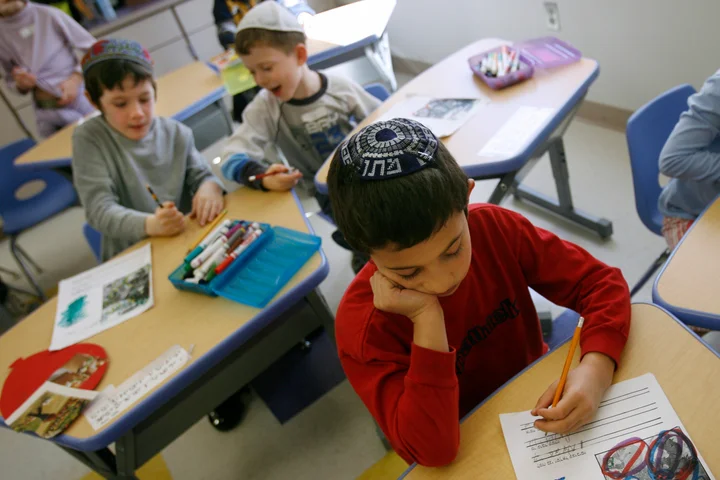
How can we increase Hebrew knowledge in our communities? At the most basic, all Hebrew and Judaic instruction at any Jewish school (day or supplementary) should be a Hebrew immersive experience: Ivrit b'ivrit.

The use of Hebrew should be maximized in Jewish preschools, JCC programs and all Jewish camps. Teens going on Israel trips could be offered the option of language class while there and certainly before going. Adults could get together to enjoy a Hebrew salon. Private donors and Federation planning arms might even consider rewarding programmatic Hebrew use through grants and allocations.

When my first child was 9 months old, I made the decision to speak only Hebrew to my children. More than six years later, it's been an exciting, though challenging, journey. While I sometimes wonder if using a second language is a barrier to intimacy, I also revel in what sometimes feels like our secret code.

Modern lore has it that Eliezer Ben Yehuda, the founder of modern Hebrew, didn't allow his son to be exposed to any other languages. Today, that sounds unduly doctrinaire; we now know that multilingualism -- not unilingualism -- is the key to language facility. But for his time, Ben Yehuda was a visionary. Who will be the 21st-century Hebrew visionaries within our communities?

At the Passover seder, we proclaimed avadim hayinu; ata b'nei horin. How much sweeter it is to sing about our past enslavement and our modern freedom in the language that binds us as a people (even if modern Hebrew says achshav rather than ata and herut rather than horin). The Hebrew chain is gleaming, calling out for its people to grasp it


Follow Mira Sucharov on Twitter: www.twitter.com/sucharov

There is much hand-wringing over Jewish continuity, but less attention is paid to cultivating serious Jewish literacy. One factor that is especially neglected -- to our peril -- is the centrality of H...
 
 
  • Comments
  • 139
  • Pending Comments
  • 0
  • View FAQ
Comments are closed for this entry
View All
Favorites
Recency  | 
Popularity
Page: 1 2 3  Next ›  Last »  (3 total)
photo
HUFFPOST SUPER USER
Allan Richter
06:44 PM on 06/04/2011
“There is much hand-wringing over Jewish continuity, but less attention is paid to cultivating serious Jewish literacy. One factor that is especially neglected -- to our peril -- is the centrality of Hebrew language knowledge.” (Sucharov)

I agree on the importance of the Hebrew language and cultivating serious Jewish literacy. The sacred language is also valued by Christians. Hebrew is increasingly being offered in high schools, colleges and universities. This is a welcome trend.

Hebrew is the torch of Jewish learning. “Learning was for two thousand years the sole claim to distinction recognized by Israel. ‘The scholar’, says the Talmud ‘takes precedence over the king’.” (A. Leroy Beaulieu, 1893).
photo
HUFFPOST SUPER USER
TheWM
aka The Wrong Monkey
03:17 PM on 05/26/2011
I accidentally hit "post Comment" too soon. Let me continue:

I find it impossible to believe that the modern State of Israel's adoption of Hebrew could have been accomplished so quickly and successfully and smoothly if there had not been all along a substantial core of Mideastern Jews who had always kept the language thoroughly alive as a spoken idiom.

That's just how it seems to me.
photo
HUFFPOST SUPER USER
TheWM
aka The Wrong Monkey
03:13 PM on 05/26/2011
I wonder whether reports of the death of Hebrew, between the Hellenistic period beginning in the 4th century BC and the efforts of Eliezer Ben‑Yehuda in the late 19th and early 20th centuries, haven't at times been greatly exaggerated. I gather that there is some controversy among historians about the extent to which Aramaic replaced Hebrew as the spoken idiom. This question is made more difficult by the fact that Aramaic and Hebrew are somewhat similar. In any case, it is certain that there was never a time in which new, original written material in Hebrew ceased to be produced. I don't wish to diminished the great accomplishments of Ben‑Yehuda and other scholars of his time, but I find it hard to believe -- no, make that impossible to believe that the state of Israel's adoption of Hebrew as an official language could have been accomplished
10:54 PM on 05/24/2011
The unique thing about Hebrew is that many American Jews can conduct Kabbalat Shabbat or Ma'ariv service like a pro, yet can't order a beer in conversational Hebrew. One can recite several prayers from memory or read text smoothly, yet have no grammar or vocabulary to express a simple thought. People don't realize the foundation they may already have.
07:22 AM on 05/25/2011
ב"ה

I should share with you my favorite "first time in Israel speaking Hebrew outside a classroom" story.

I was on a program in Israel and I'm used to American appliances. We weren't given any ovens, just a burner that needed to be lit. But they didn't give matches. So I went to the SuperSol to see if I could find matches. They didn't have them in the place that was equivalent to where I would find them in a store in the US -- so I went to the cashier and said,
אני צריכה משהו אבל אני לא יודעת את המילה
(I need something but I don't know the word)
What can I say, there were no matches in the Tanakh.
Then I made a flicking motion and said
עושים כזה ויש אש
(You go like this and there's fire)
She looked at me funny, so I again flicked and said
חתיכת עץ ועושים כזה ויש אש
(A piece of wood, you go like this and there's fire)
Ah, she said,
גפרור
Sure, I thought, whatever you say. They were right there next to the cigarettes. She handed me a box. I would never have thought to look there.

(So what I usually say is if I don't know a word, at least I can talk my way around it)

דבי
Debbie
05:01 PM on 05/23/2011
It's amazing how how in Hebrew Adam (man) and Adamah (earth) are connected. Earth (Eretz) Retz (run) hint of earth running or revolving? Mayim (water) connected to Shamayim (sky). Peirot (fruit, fruchte, fruit) etc. And the letters are interchangeable like the 2 words Shalom (peace), Eretz (land) in Hebrew if you combine same Hebrew letters it gives you two other words with same letters:: Otzar (treasure) Shalem (whole). i.e. whole treasure. Just amazing.
08:03 PM on 05/23/2011
It has been taught that Shamayim contains both water (mayim) and fire (aish).

That is what makes Hebrew so fascinating is its word combinations and interrelationships between terms as you pointed out with adam and adamah. Also dom for blood is connected to adam and adamah and there is the parah adumah (red heifer). The term adumah for red relates to adam and adamah .
04:42 PM on 05/23/2011
I learned conversational Hebrew at my own pace with a set of two brand new MP discs and all inclusive workbook.

Your own Ulpan with prof. announcers and I think its also available in languages.

It's from Havin10@gmail.com
photo
HUFFPOST SUPER USER
TheSarge
Armed Crawdad BodyGuard
04:26 PM on 05/23/2011
Well I had no idea my comment would give spawn to such a deep discussion. Since I was young I was able to learn languages quickly, and speak them without an accent or I can add geographical accents. Arabic was the easiest for me besides of course Spanish, which I dominated quickly. But Hebrew for some reason or another has caused me problems. I actually had to think when I was trying to learn it. I got frustrated and switched to Ancient Greek LOL
photo
HUFFPOST SUPER USER
MarcEdward
likes all cats more than most people
04:20 PM on 05/23/2011
I'm so glad I was born without the burden of culture and tradition.
HUFFPOST SUPER USER
Sal Glen
10:44 PM on 05/23/2011
So sadddddddddddddddddddd.
07:26 AM on 05/25/2011
ב"ה

I'm with you, Sal. So sad. -- it's hardly a burden, it's what gives our lives structure and meaning. Why do you think Jews are so steadfast in wanting to remain Jews, for the most part?

Debbie
photo
HUFFPOST SUPER USER
Miriam Breslauer
04:17 PM on 05/23/2011
I always regretted being unable to learn Hebrew despite 13 years of Hebrew school lessons. In one of my Hebrew schools the teachers that were supposed to be teaching us Hebrew just never bothered to do so. They were too busy saying crap in Hebrew about us kids to bother teaching us. Sure a few the kids were disruptive, but that didn't account for the long periods where we weren't disruptive and yet we learned nothing.
07:28 AM on 05/25/2011
ב"ה

Hebrew School is a strange animal. When I was teaching in Hebrew School, the kids were mostly only there to please the grandparents and couldn't have cared less. It was very hard to teach. I tried to teach them about the Jewish Calendar -- I gave a test after I taught it -- all the students either failed or got 100%

Debbie
HUFFPOST SUPER USER
Dannyisme
Venceremos
03:32 PM on 05/23/2011
I'd also take exception to the final comment on how Hebrew has changed. Sure `achshav is more commonly used than `ata. But to get across the idea of b'nei horin, hofshiyim would probably be a more proper translation. It works in Hatikvah, where it says Lihiyot `am hofshi ... (to be a free nation) Herut is too ... well, Likudniki.
12:31 PM on 05/29/2011
Not sure what you mean about achshav. Achshav is Talmudic - as in Pirkei Avot, Hillel's immortal - Im Lo Achshav Eimatai (If not now - when?)
HUFFPOST SUPER USER
Dannyisme
Venceremos
03:24 PM on 05/23/2011
As a professional translator of Hebrew, specializing in modern Israeli film, I have to agree with the idea that Hebrew is a remarkably rich language, but would add that it benefits more than just Jews to learn it. How can anyone appreciate the Bible as literature without understanding the rich wordplay that runs throughout it? And I say this as someone who understands the Bible as a human creation, not a Divine one.

My one contention with the article is that Hebrew has, over the years, become politicized and identified with one approach Jewish life that revolves around the State of Israel. The resurgence of Hebrew 100 years ago came at a cost. Rich Diaspora languages and cultures that naturally evolved Jewish languages and cultures such as Yiddish and Ladino all but disappeared. Certainly the Holocaust had much to do with that too, but I wonder at the focus on reviving one language and not the others. It is the combination of all these approaches to Jewish life and the languages that represent them that made for a diverse Jewish experience.
07:34 AM on 05/25/2011
ב"ה

There has been a resurgence of both Yiddish and Ladino. I used to subscribe to Aki Yerushalayim, the Ladino language magazine (the only reason I don't get it now is not through lack of desire but lack of funds). Yiddish is spoken in many Hareidi families (our local Bostoner Rabbi and his family speak Yiddish and the boys don't even speak English). I hope they continue to re-surge (and I'd love it if Judeo-Arabic and other Jewish languages would too -- personally I think American Jews are developing our own Judeo-English, and I agree with the writer of the book "The Word" who says that all words in all languages come essentially from Hebrew).

Debbie
03:34 PM on 05/25/2011
A couple contentions regarding your contentions:
The view of Hebrew as being antithetical to Yiddish and other Judeo-languages is mistaken. Hebrew words are what give the Yiddish loshn its neshumah. My wife has a relative who's been learning very secularized "Yiddish" at a formerly-communist institution for years, and can't really get it since all the Hebrew parts of it remain foreign to her. Yiddish is the byproduct of a multi-lingual reality involving living in medieval Germany and reading intensely in Hebrew+Aramaic, while keeping much of the Semitic element very much alive in the spoken vernacular.. and then continuing this reality among later communities in Poland, Russia, Romania and then New York and Benei Braq or Meah Shearim. A yiddish-speaker doesn't even talk about his family (mishpukheh), his troubles (tsures) as a lowly porter (a shofele ba'al-agolah), or ask the time (sho'oh) without using Hebrew. it's poshet (simply) not efsher (possible). The resurgence of Hebrew over the past couple centuries (since the Haskalah) came as a continuation of medieval literary Hebrew culture, and simply had a more modern character to it, and far from coming at a cost, it is what will allow Judeo-hyphen languages to maintain their vivacity if they can at all into the future, and what will allow Hebrew/Jewish culture to continue to exist. Not all Hebrew-speakers are necessarily Zionist, whether in Israel or Montreal. Though in US the poor Hebrew level most Jews can give that impression.
04:56 AM on 05/26/2011
Even in terms of basic chronology, Jews never really stopped writing in Hebrew so it is wrong to suggest that Hebrew somehow took a place entirely reserved for Yiddish. In fact, actually writing in Yiddish was more of a novelty that only began in the renaissance and later became a real literary language only in the late 19th and early 20th c. Beforehand it was considered a spoken "jargon" that was better written in either pure Hebrew (among rabbis, poets, etc.) or in purer German (academia, probably business and others). Yiddish was the language of mothers in their homes and on the street (mame loshn). in the late 18th/early 19th c., when Napoleon was seen by some as a liberator of european Jewry (the "emancipation"), poems were written to him in Hebrew, and official correspondence between his representatives and the rabbis (to figure out how Jews could be integrated as "Citizens" into a modern "nation-State") was written in Hebrew, and decisions were communicated to the Jewish communities in Hebrew, since that is what Jews read.
photo
HUFFPOST SUPER USER
courtb
10:59 AM on 05/23/2011
I always wished that I could have done an Ulpan course rather than university Hebrew classes. I had to take a year's break inbetween the beginner and intermediate course and that year hurt my language skills. Add to that a class full of Israeli students looking for an easy A and I completely shut down (insecure fear of sounding stupid for struggling), hated the class, and stopped attending.
photo
HUFFPOST SUPER USER
Dorian Kunkel
08:52 AM on 05/23/2011
My husband and children all speak, read and are competent in Hebrew. They all attended Day Schools (while I did not). Their Hebrew names were given with much thought and are used during services, in fact even among my more Reform friends, they gave Hebrew names with meaning and honor.
We have friends who speak Yiddish to their children so these kids are fluent in 3 languages.
photo
HUFFPOST SUPER USER
Tunghoy
My other car is a TARDIS
08:11 AM on 05/23/2011
I've learned Hebrew, Spanish and French, and found Hebrew grammar to be the simplest. To speak conversationally, there are really only 3 tenses you need: present, simple past and simple future. (There is also a "command" tense, which is a shortened form of the present.) And most of what you need to know about the past tense is vowel changes.

As Mira alluded to, most verbs consist of 3 consonants. Once you know what those are, you can plug in the vowels you need for the grammar (plus a leading letter for future tense).
07:37 AM on 05/25/2011
ב"ה

It's not just verbs, but nouns and adjectives/adverbs that you can create or infer by knowing the 3 (or 4 -- the 4 are mostly foreign words like Telephone) letter shoroshim (roots).

Debbie
photo
Indigo1941
Time traveler.
08:07 AM on 05/23/2011
Those are cogent and rational arguments in Canada where bilinguialism is a part of the social structure with French and English hold equal or nearly equal places in the law. In the States the issue is complicated by immigration and prejudice and the issues of social and ethnic diversity. A liberal education necessarily includes foreign language study even though most Americans resist attempting mastery of any foreign language, regardless of their ethnicity. An Irish-American might say "Erin go bragh" on St. Patrick's Day and a German American might say "Sauerkraut" and make it sound like a foreign word and a Jew can say "Mazel tov!" without pausing to think about it and we'll all smile about our wonderful diversity and go right on speaking English. Good old English, it can assimilate anything!