
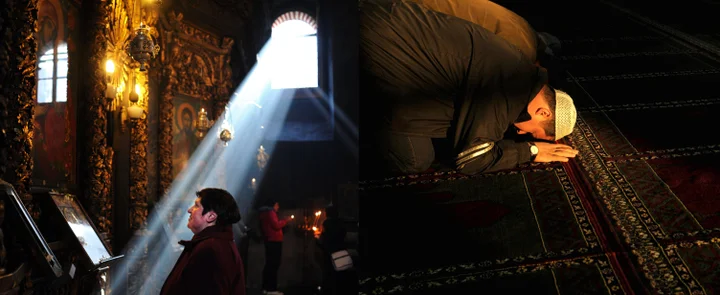
Muslims and Christians can work together to depose dictators and assert the power of the people. We've seen it happen on the Tahrir Square in Cairo during the 2011 revolution in Egypt, with devout Muslims and Coptic Christians protesting side by side. But can Muslims and Christians work together to build a democratic society in which rights of all are respected, the rights of minority Coptic Christians no less than the rights of majority Muslims? They can, if they have a common set of fundamental values. But do they? They do, if they, both monotheists, have a common God.
Ever since 9/11, the most common question I am asked when I speak about these two religions is whether or not Muslims and Christians worship the same God. Muslims don't push the question. But Christians do, vigorously -- in Europe, Asia and Africa no less than in North America. Maybe that's not surprising. In the manual of the terrorists who flew the planes on a suicidal mission it read: "Remember, this is a battle for the sake of God." In the name of God and with expectations of glory in this world and rewards in the next, they killed themselves and thousands of innocent civilians. To many Christians it seems obvious that the God who spills the blood of the innocent and rewards suicidal missions with paradisiacal pleasures can't be the God they worship.
The question, however, isn't mainly about the terrorists and their God. It's about Muslims generally. It draws its energy from a deep concern. To ask: "Do we have a common God?" is to worry: "Can we live together without bloodshed?" That's why whether a given community worships the same god as another community has always been a crucial cultural and political question and not just a theological one.
Here are the realities we all face:
Growing, intertwined and assertive -- communities of Muslims and Christians will live together. But can they live in peace building together a common future?
At the height of the Iraq War in 2004, influential TV evangelist and former U.S. presidential candidate Pat Robertson said: "The entire world is being convulsed by a religious struggle. The fight is not about money or territory; it is not about poverty versus wealth; it is not about ancient customs versus modernity. No. The struggle is whether Hubal, the Moon God of Mecca, known as Allah, is supreme, or whether the Judeo-Christian Jehovah God of the Bible is supreme." Fighting words these are! Two supreme divine beings always means war.
The fact of the matter is this: fearful people bent on domination have created the contest for supremacy between Yahweh, the God of the Bible, and Allah, the God of the Quran. The two are one God, albeit differently understood. Arab Christians have for centuries worshiped God under the name "Allah." Most Christians through the centuries, saints and teachers of undisputed orthodoxy, have believed that Muslims worship the same God as they do. They did so even in times of Muslim cultural ascendency and military conquests, when they represented a grave threat to Christianity in the whole of Europe.
After the fall of Constantinople (1453), the city named after the first Christian emperor and a seat of Christendom for more than 1,000 years, Cardinal Nicholas of Cusa, a towering intellect and an experienced church diplomat, affirmed unambiguously that Muslims and Christians worship the same God, albeit partly differently understood. Significantly, in response to the fall of Constantinople and the Muslim threat, Nicholas of Cusa advocated "conversation" rather than "crusade," a strategy pursued doggedly though unsuccessfully by his friend, Pope Pius II. For Nicholas believed that war could never solve the issue between Christendom and Islam.
We live in a different world than Nicholas and Pius II did, but our options are roughly the same. We should resolutely follow Nicholas. The terrorists must be stopped. As to the 1.6 billion Muslims, with them we must build a common future, one based on equal dignity of each person, economic opportunity and justice for all and freedom to govern common affairs through democratic institutions. Muslims and Christians have a set of shared fundamental values that can guide such a vision partly because they have a common God.
On Feb. 18, during the "Day of Celebration," Sheik al-Qaradawi -- one of the most influential Muslim clerics in the world, exiled from Egypt since 1961 -- addressed the crowd of over one million. He began by noting that he is discarding the customary opening "Oh, Muslims." In favor of "Oh, Muslims and Copts." He praised both for bringing about the revolution together. And he added, "I invite you to bow down in prayer together." Such prayer, addressed to the common God in distinct ways, lies at the foundation of hope for a new Egypt.
Whether Muslims and Christians worship the same God is also the driving question for the relation between these two religions globally. Does the one God of Islam stand in contrast to the three-personal God of Christianity? Does the Muslim God issue fierce, unbending laws and demand submission, whereas the Christian God stands for love, equal dignity and the right of every individual to be different? Answer these questions the one way, and you have a justification for cultural and military wars. Answer them the other way, and you have a foundation for a shared future marked by peace rather than violence.
Miroslav Volf is the author of 'Allah: A Christian Response' (HarperOne; February 2011), the Henry B. Wright Professor of Theology at Yale Divinity School, and the Founding Director of the Yale Center for Faith and Culture.
Muslim Beliefs about God - ReligionFacts
God in Islam - Wikipedia, the free encyclopedia
Answers.com - Is the Christian God and the Muslim God the same God
Allah in Islam - The Concept of Allah (God) in Islam
Muslims and Christians can agree to disagree without being disagreeable. Respectfully we can if willing even as our respective Holy Books contain divergent theologies of God.
No
cf the Quran:
"Behold! the angels said "O Mary! Allah giveth thee glad tidings of a Word from Him: his name will be Christ Jesus, the son of Mary held in honour in this world and the Hereafter and of (the company of) those nearest to Allah." (3:45)
"Say ye: 'We believe, in Allah and the revelation given to us and to Abraham Isma`il Isaac Jacob and the Tribes and that given to Moses and Jesus and that given to (all) Prophets from their Lord... and we bow to Allah (in Islam).'" (2:136)
what Muslims rejects is just the claim that Jesus is God. To us Jesus is a mighty messenger of God, the Messiah (or in greek Χριστός Christos) that will return.
"O people of the Book! commit no excesses in your religion: nor say of Allah aught but truth. Christ Jesus the son of Mary is (no more than) a Messenger of Allah and His Word, which He bestowed on Mary, and a Spirit proceeding from Him: so believe in Allah and His Messengers. Say not "Trinity": desist: it will be better for you: for Allah is One Allah: glory be to him: (for Exalted is He) above having a son." (4:171)
God=Allah=God
The "im" in the word is the plural of respect.
http://en.wikipedia.org/wiki/Elah_%28disambiguation%29
God = Aramaic "Eli" (Word used by Jesus himself when talking about God)
Remember "Eli Eli Lama Sabaktani" or "My God, My God, why have you forsaken me?"
God = Arabic "Allah" or "Al - Lah" translated as "The God".
Arabic, Aramaic and Hebrew are sister languages. Which is why you see variations of the same word being used for the name of God.
In reality the last testament contains a promise from God that it will be protected and preserved for ever. Even its language got protected in consequence. This leaving miracle should push people to think. It means that we cannot take the modifications to the old or the new testaments to say God please forgive us.....
Please read this : http://en.wikipedia.org/wiki/Satanic_Verses. I would like to know your comment.
A Quote:
"The Satanic Verses incident is reported in the tafsir and the sira-maghazi literature dating from the first two centuries of Islam, and is reported in the respective tafsīr corpuses transmitted from almost every Qur'anic commentator of note in the first two centuries of the hijra. It seems to have constituted a standard element in the memory of the early Muslim community about the life of Muhammad.[1] The earliest biography of Muhammad, Ibn Ishaq (761-767) is lost but his collection of traditions survives mainly in two sources: Ibn Hisham (833) and al-Tabari (915). The story appears in al-Tabari, who includes Ibn Ishaq in the chain of transmission, but not in Ibn Hisham. Ibn Sa'd and Al-Waqidi, two other early biographers of Muhammad relate the story.[4] Scholars such as Uri Rubin and Shahab Ahmed and Guillaume hold that the report was in Ibn Ishaq, while Alford T. Welch holds the report has not been presumably present in the Ibn Ishaq.[5]"
Can you please explain why Abraham was asked by God to kill his son Issac?
Quite prophetic.
As to whether both worship the same God: In a broad sense, of course they do; they both worship the God of Abraham. The Qur'an even sounds like the Old Testament prophetic books. As one narrows in focus, both religions have filtered their perception of God first through their Founder's cultures and down through history through various cultures as the religions spread. But then, if one focuses too narrowly, every believer recreates God in his/her own image: I've seen Baptists who claim that if you don't believe in a pre-tribulation "rapture," you're not worshiping the same God, they are, even if you claim to be Christian.
John 14:9-11 "Jesus said to him, “Have I been with you so long, and yet you have not known Me, Philip? He who has seen Me has seen the Father; so how can you say, ‘Show us the Father’? Do you not believe that I am in the Father, and the Father in Me? The words that I speak to you I do not speak on My own authority; but the Father who dwells in Me does the works. Believe Me that I am in the Father and the Father in Me, or else believe Me for the sake of the works themselves."
John 8: 56-58 ""Your father Abraham rejoiced to see My day, and he saw it and was glad.”
Then the Jews said to Him, “You are not yet fifty years old, and have You seen Abraham?” Jesus said to them, “Most assuredly, I say to you, before Abraham was, I AM.” "
Isaiah 9:6 "For unto us a Child is born, Unto us a Son is given; And the government will be upon His shoulder. And His name will be called Wonderful, Counselor, Mighty God, Everlasting Father, Prince of Peace."
God is spirit. The Holy Spirit is also referred to as the Spirit of Christ and as the Spirit of the Father. Jesus was God made flesh.
1In the beginning was the Word, and the Word was with God, and the Word was God.
2The same was in the beginning with God.
3All things were made by him; and without him was not any thing made that was made.
4In him was life; and the life was the light of men.
5And the light shineth in darkness; and the darkness comprehended it not.
6There was a man sent from God, whose name was John.
7The same came for a witness, to bear witness of the Light, that all men through him might believe.
8He was not that Light, but was sent to bear witness of that Light.
9That was the true Light, which lighteth every man that cometh into the world.
10He was in the world, and the world was made by him, and the world knew him not.
11He came unto his own, and his own received him not.
12But as many as received him, to them gave he power to become the sons of God, even to them that believe on his name:
13Which were born, not of blood, nor of the will of the flesh, nor of the will of man, but of God.
14And the Word was made flesh, and dwelt among us, (and we beheld his glory, the glory as of the only begotten of the Father,) full of grace and truth.
If so, can you please explain why the name "Allah" appears in the first 12 verses of the Book of Genesis of the Old Testament?
http://www.biblegateway.com/passage/?search=%EF%BA%97%EF%BB%9C%EF%BB%AE%EF%BB%B3%EF%BB%A6+1&version=ALAB
Allah written in Arabic looks like this: اللهُ
You are trying really hard with Eric....but, it's useless with righty religious folk like him.
They all said Love God (whatever one's concept or lackthereof is)
and
Love each other.
Fear being the opposite of Love.
I 'believe', I 'testify' that it is fear and fundamentalism that causes wars and hatred, and will be the destruction of humanity!!
Says the person who appears to have the "answers". And the worst part is that you're a mod.