
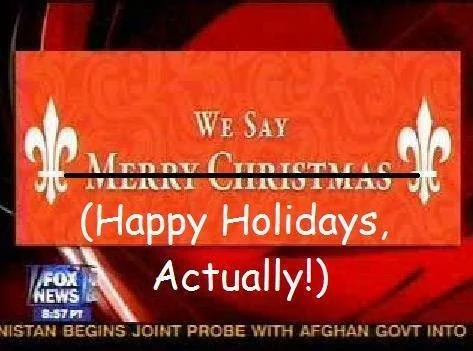
After enduring eight years of a president who was determined to impose his religious beliefs on the country, I've just about had it with people trying to shove religion down my throat. Maybe that is why I have no patience for the (completely ludicrous) claim that there is a "War on Christmas," made by right-wingers like Bill O'Reilly. But what put me over the top is that now a deputy editor of the once reputable Wall Street Journal has weighed in on the issue, actually equating the current economic crisis with the fact that people say "Happy Holidays" instead of "Merry Christmas."
Daniel Henninger wrote in the WSJ yesterday:
"This year we celebrate the desacralized 'holidays' amid what is for many unprecedented economic ruin -- fortunes halved, jobs lost, homes foreclosed. People wonder, What happened? One man's theory: A nation whose people can't say 'Merry Christmas' is a nation capable of ruining its own economy."
Henninger's point is that the economic downturn was caused by "borrowers, lenders and securitizer shamans" who were "operating in a zero-gravity environment, aloft on moral hazard," which was due to a loss of "responsibility, restraint and remorse." He goes on to say that "responsibility and restraint are moral sentiments," and that "the steady secularizing and insistent effort at dereligioning America has been dangerous." He claims that the "disappearance of 'Merry Christmas'" is indicative of this "dereligioning." Thus, the link between not saying "Merry Christmas" and the failing economy.
Convinced? Me neither.
Somehow, people like Henninger and O'Reilly think it's important that people say "Merry Christmas" rather than "Happy Holidays." But what Henninger and O'Reilly don't seem to want to understand is that the United States of America, as much as they would like it to be otherwise, is not a Christian nation. The majority of its citizens may currently be Christian, but, again, that does not make the country, as an institution, Christian.
(Full disclosure: I am a nonreligious Jew, so the "War on Christmas" crowd will, no doubt, dismiss all of my opinions.)
The last time I checked, the First Amendment was still in full force and effect. As a reminder, it says:
"Congress shall make no law respecting an establishment of religion, or prohibiting the free exercise thereof; or abridging the freedom of speech, or of the press; or the right of the people peaceably to assemble, and to petition the Government for a redress of grievances."
You will notice in the very first words of the Bill of Rights that the founders made it clear, in no uncertain terms, that there was to be no one religion "established" for the country. The First Amendment makes clear that everyone should be allowed to practice his/her religious faiths ("or prohibiting the free exercise thereof"), but that no one faith was to be elevated above the others by the government. Being Christian does not make one more American.
And yet that is exactly what the O'Reillys and Hennigers of the world seem to want. I'm sorry to report this fact to them, but not everyone in this country celebrates Christmas. According to a Pew Forum on Religion & Public Life study from earlier this year, 1.7 percent of the population identified themselves as Jewish, 0.6 percent as Muslim, 0.7 percent as Buddhist, 0.4 percent as Hindu, 0.7 percent as Jehovah's Witness, and more than 0.2 percent as from "other world religions." On top of that, according to the Pew study, more than 16 percent of Americans do not consider themselves any religion.
All of that translates into millions of people who do not celebrate Christmas. Do O'Reilly and Henninger think that these people should be made to feel "other," outsiders in the American experience? I hope not. That is not what America is about. Many of the founders of the country moved here to flee religious persecution. They just wanted to be free to practice their own religion here. And that doesn't mean that only they get to do so.
This country has some tragic history when it comes to its treatment of minorities. We enslaved African Americans as recently as 145 years ago, and we had laws on the books repressing them until quite recently. It was only 65 years ago that we rounded up American citizens who just happened to be of Japanese descent and placed them into internment camps solely because of their country of origin. And it was only two weeks ago that three states voted to amend their constitutions to ensure that homosexuals cannot enjoy the same marriage rights as heterosexuals.
In light of that history, it seems to me that we, as a nation, should be looking at more ways to come together and make everyone feel a part of the American family, not stressing our differences and making those in the minority feel as though they are not true Americans. And through the simple act of saying "Happy Holidays" instead of "Merry Christmas," we, as a country, can show our tolerance for other faiths and make everyone feel a part of the holiday season.
If nothing else, doesn't it come down to simple manners? Why would you want to say "Merry Christmas" to someone that doesn't celebrate the holiday? Clearly, such a greeting is only going to make the recipient uncomfortable, pointing out that he/she does not practice the same religion that the majority of the country does. Meanwhile, the dreaded "Happy Holidays" invocation is actually inclusive and polite, saying, in effect, "There are a lot of holidays this time of year, so if any of them apply to you, we hope it's a nice time for you." Isn't such a tolerant attitude more in keeping with what the United States is supposed to represent?
Of course, nothing I've said would stop those who observe Christmas from going to church, decorating their houses (inside and out) and celebrating with their families and friends. And certainly, saying "Happy Holidays" in public venues doesn't stop two people from greeting each other with "Merry Christmas" when they both observe the holiday. My only point is that in public displays, when not all of the recipients will be Christian, there is nothing wrong with using the more inclusive "Happy Holidays." That idea hardly constitutes a "War on Christmas."
There is also a dangerous, insidious strain to the movement complaining of a "War on Christmas." Go back to Henninger's words in the WSJ. He says that "the steady secularizing and insistent effort at dereligioning America has been dangerous." I refuse to accept that the immorality of finance professionals is due to a lack of religious piety. The implication is that without religion, there can be no morals or ethics. I, and I'm sure many others out there, absolutely reject such an assumption. Moral behavior does not have to come from the teachings of a religion. An atheist is every bit as capable of drawing on his/her beliefs to lead an ethical life as a religious person.
And by turning to an argument about Christmas, Henninger is also implying that it's not enough to be religious, you have to be an adherent of his religion. That is certainly a dangerous idea, and it is also completely sanctimonious, given the myriad scandals that have enveloped U.S. churches in recent years. Being religious didn't stop, for example, priests from molesting boys (and the church covering it up), nor did it prevent Rev. Ted Haggard, the founder of the New Life Church, from getting caught buying crystal meth and patronizing a male prostitute (after crusading against homosexuals).
I would further argue that the injection of religion into politics has not produced the kind of moral and ethical behavior Henninger longs for. It seems to me that the emergence of an argument that if you oppose the Republican party and support the Democrats, you are somehow not righteous in the eyes of the church, is a pretty dangerous way of thinking. I don't think it's helpful that a South Carolina priest would tell his parishioners that they should not accept Holy Communion if they voted for Barack Obama. And I don't think the national interest is served by actions like the recently deposed Republican North Carolina U.S. House of Representatives member Robin Hayes saying during the campaign that "liberals hate real Americans that work and achieve and believe in God."
Clearly, I'm not making the argument that all religious people are bad. (Sorry, but I can't help but anticipate the potential "he is criticizing religion!" charge of those who believe there is a "War on Christmas.") What I am saying is that there is nothing in being religious that makes someone inherently more moral and ethical than someone who is not religious.
So you'll forgive me if I don't buy into the Henniger/O'Reilly view of America. I see this country as a place in which we respect the religious beliefs of all of our citizens, and, more importantly, we would not seek to impose our faiths on our neighbors. And yes, I would like to see a country where we don't seek to make non-Christian citizens feel like they are not part of the national fabric by pointing out to them, again and again, that they are different than a majority.
Or, put another way, I want to live in a tolerant, respectful country that says "Happy Holidays," rather than a divisive nation that seeks to make people uncomfortable by saying "Merry Christmas." Isn't that what "peace on earth, good will toward man" entails? There is no war on Christmas. We only ask that those who celebrate the holiday not insist that those who don't celebrate with them. Actually, that statement of my belief is my declaration of war on the war on the "War on Christmas."
Happy holidays everyone.
Want to reply to a comment? Hint: Click "Reply" at the bottom of the comment; after being approved your comment will appear directly underneath the comment you replied to
It's not vital to the maintaining of a democracy that the majority be penalized for being the majority. I don't personally give a squat what (if anything) people say, "Merry"-wise, but anyone insulted by outright acknowledgement of our culture's chief popular festival is an idiot or an egoist.
"HAPPY FESTIVUS!"
Yeah, for the rest of us!
Heck, I always considered "Happy Holidays" to be a much shorter way to say "Merry Christmas and a Happy New Year ... and I hope you had a great Thanksgiving too!" It's the "holiday" season isn't it?
I don't find "Merry Christmas" to be any way offensive, even though I'm agnostic. "Christmas" may have "Christ" in the name, but it was LOOOOOONG ago turned into a secular American holiday, revolving around presents and family. Bill'o the Clown won't be changing that, no matter how much he screams.
And as for Daniel Henninger and his article in the WSJ ... laughably funny. I think we can find one or two self-proclaimed Christians who are much more responsible for our economic state than any store's or the public's acceptance of "Happy Holidays."
If we keep going down this same road for much longer, the only greeting any of us is going to hear is " Got any spare change?"
I have no problem with happy holidays or just plain howdy during the Christmas season. My problem is that of priorities. In a world full of pain where should we rank the discomfort of a non-Christian being greeted with a Merry Christmas? Am I being insensitive when I imply that not all hurts are equal?
Mitchell you said:
"O'Reilly and Denninger are saying there is something horribly wrong with saying Happy Holidays. They believe that the soul of our country is at risk because people commit the horrible crime of saying Happy Holidays. Denniger, in the WSJ article I linked to, blames the economic crisis on the moral failing of the nation that is exemplified by saying Happy Holidays instead of Merry Christmas..."
To extrapolate, they're saying xtians are morally superior to everybody else; thererfore, xtians are the reason America is superior. They're saying that anyone who capitulates and says Happy Holidays is allowing those pesky secularists and idol worshippers, et al, to claim the same moral highground.
They take it even farther when they assert that this is no mere insult to the pious, it's an outright attack on the one true faith.
And this is exactly why the GOP married Evangelicals. Moral superiority by association.
Many years back I went to China as a Chaperone with a Washington State wrestling Team... We visited the Jade Temple in Shanghai China... There was a Monk burning some incense and doing prayers... I am not a Buddhist... But I liked the "Vibes" that were there... Several of us lit the incense and offered up silent prayers...
When we got back to the Team Bus, some of the Wrestlers were upset, saying as Christian's, they felt it was sacrilegious to pray in a Buddhist Temple...
I told them Spiritually, Respectfully, Honoring the Sacredness of anyone's Religion should never be offensive.... And, the Monk warmly replied to our request and also said he would feel Honored in us offering up prayers...
I have NO problem with Respectfully sharing Spirituality with anyone... And I am NOT in agreement with Organized Religion... I am however, very supportive of the Spirituality, that Organized Religion seems to ignore, or Fear...
LarBear, nice post. Now, look at the other end of the religious spectrum: the Lutheran Church Missouri Synod (LCMS - not to be confused with the much larger Evangelical Lutheran Church of America, ELCA). The LCMS forbids -- repeat, FORBIDS -- interfaith prayer with non-LCMSers. The LCMS calls this "syncretism." When an LCMS representative participated in the interfaith service shortly after 9/11, the LCMS hierarchy suspended that representative for "syncretism"! It gets uglier than that -- google LCMS 9/11 yankee stadium when you can.
So, to your last point, LarBear, the LCMS is an entire organized religious entity that ignores, fears, and heck, is plain TERRIFIED of authentic spirituality!
Mitchell:
I live in Woodbury, Vermont, where for the last two months there has been this bizarre situation ongoing that involves the Pledge of Allegiance.
Search for: Woodbury + Pledge of Allegiance for details.. .but understand that none of the media coverage so far gets the story straight. Check out the FOX NEWS clips on YouTube... for the most inaccurate reporting I have seen in a long time.
This whole deal has the same flavor as the "war on Christmas" meme.
I think that there is something else going on here, beyond Christmas and the Pledge. It seems to me that there is an attempt to "make an outsider" of anyone who doesn't toe the orthodox line.
The vitriol surrounding this Pledge deal -- which is ultimately not about the Pledge but about the behavior of a b*lly -- is scary and unsettling.
The fundamental issue at hand is the calling of someone as "anti-American" if they don't espouse the "traditional orthodoxy", whether or not that orthodoxy even exists.
Thanks for your article, Mitchell.
Mitchell:
I live in Woodbury, Vermont, where for the last two months there has been this bizarre situation ongoing that involves the Pledge of Allegiance.
Search for: Woodbury + Pledge of Allegiance for details.. .but understand that none of the media coverage so far gets the story straight. Check out the FOX NEWS clips on YouTube... for the most inaccurate reporting I have seen in a long time.
This whole deal has the same flavor as the "war on Christmas" meme.
I think that there is something else going on here, beyond Christmas and the Pledge. It seems to me that there is an attempt to "make an outsider" of anyone who doesn't toe the orthodox line.
The vitriol surrounding this Pledge deal -- which is ultimately not about the Pledge but about the behavior of a bully -- is scary and unsettling.
The fundamental issue at hand is the calling of someone as "anti-American" if they don't espouse the "traditional orthodoxy", whether or not that orthodoxy even exists.
Thanks for your article, Mitchell.
I'm an atheist, but I celebrate (if that's the right word--maybe "enjoy" would be better) Christmas. It's been ingrained in me since I was a kid, it's part of how I grew up, and it's pretty. I like the music, the decorations, the traditions. Christmas is big enough to enjoyed by everybody who doesn't have an ax to grind.
What I DON'T like is the economic emphasis on it every year, for which we have Wall Street and the media to thank. The sales reports begin the day after Thanksgiving and persist until the last quarter statements come dribbling out. If there's a war on Christmas, that's it.
How about not telling me what I should say? How about letting me decide if I want to say Happy Holidays or Merry Christmas? It is not a personal attack on you if I say Merry Christmas. We should be able to say whatever greeting we want. We shouldn't have to walk on egg shells. Get over it and Merry Christmas!
"How about not telling me what I should say?"
Exactly. I mean, what if someone feels minimized or invalidated by HIS thoughts and views?
I'd love to witness his reaction if someone told him to cease for the good of all. That would be entertaining.
What should really worry us is that such elementary staples of fairness and democracy have to be explained to anyone at a liberal blog. The left ain't what it used to be, is it?
You missed his point: There is no war on Christmas. He is not telling you what to say. If you have no feelings for how you come across to your fellow humans, so be it. I don't consider that a "personal attack" just rude. But please be aware, you missed the point.
"He is not telling you what to say."
He's telling us what NOT to say, which is the same difference.
In a democracy, it's vital that we protect the minority from the tyranny of the majority, yes. But that doesn't translate to asking the majority to tip-toe around the minority. Rights exist for all, regardless of how we are grouped.
That's the point I think that he (and you) are missing.
However, if the author wants to lead by example, maybe he can inspire the rest of us. He can tip the first toe by putting a damper on HIS views and values, lest someone feel invalidated, minimized, inconvenienced, or suppressed by same. Fair enough?
MORALITY IS NOT SCRIPTURE.
MORALITY IS THE MITIGATION OF SUFFERING.
I have no problem with "Merry Christmas" if you KNOW the person celebrates Christmas, "Happy Hanukkah" if you KNOW they're Jewish, "Happy Kwaanza" if you KNOW they celebrate Kwaanza. Otherwise, the courteous thing to do is to say something inclusive like "Happy Holidays." Maybe the people who are so insecure about their religion that they feel EVERYONE else MUST acknowledge it could come up with a signal, like a baby Jesus pin or something, to let everyone know that their day will be RUINED if they are wished a happy holiday. On the other hand, maybe they could just GROW UP.
When you trash religion, does it give you a temporary rush? A euphoric high?
And how long before you have to repeat the process? And does it take a higher dose of faith-hating each time?
I'm just wondering if behavior like yours is analogous to addiction, and, if so, to what extent. My intentions are purely scientific. Thanks in advance.
Exactly so--O'Reilly, Henninger, and the other "Christian soldiers" cannot or will not acknowledge that there are millions of citizens of this country who are not Christians and don't celebrate Christmas. I'm Jewish and if someone who doesn't know me personally (e.g. a clerk in a store) wishes me "Merry Christmas", I smile and return a similar greeting. And I send cards to and receive cards from my non-Jewish friends in December. I do have a problem with people who try to foist their religious beliefs (whatever they are) on me at this time of year. Again--there is a tremendous religious diversity in this country. People who fantasize about a "war on Christmas" are just looking to start trouble!
Hear hear! Exactly.
Surely the world would be a better place if people of all religions were were welcome to extend a blessing to others in their own way, and if we all learned to welcome the good wishes of people different to ourselves, without trying to force them to offer only goodwill that meets our own terms and conditions.
See Mitchell Bard's Profile
MaxChampion, I appreciate your comment, but it seems to me that your argument actually is more against the O'Reilly/Denninger position than mine.
I did not write this article as a screed against people saying Merry Christmas to me. I wrote it in response to the O'Reilly/Denninger nonsense that there is a War on Christmas. THEY are the ones huffing and puffing that the world as we know it is coming to an end because people say Happy Holidays instead of Merry Christmas.
The purpose of my article was to show how dangerous and wrongheaded their position is.
As a person raised as Catholic, but no longer considers myself "religious" but "spiritual", I see no reason for objection to a "Happy Holidays" greeting....one that addresses all the seasonal religious holidays of the winter season, be it Christmas, Hannakuh, Eid, or Kwanza. After all, it is a holiday season of "giving" in all aspects. Even though my husband and I do not practice a religion, we look forward to the tradition with a tree and decorations and, now, with a granddaughter who will be raised Jewish, she will celebrate Christmas with us. And by the way, the Christian notion of Christmas was rooted in the pagan celebrations of the month of December, pre-Christianity era. It was a time for celebration at the end of the year to welcome in the next new year, in alignment with the Winter Solstice. A time of celebratory feasts and good luck gift-giving....It was the Christians' fear of pagan customs that led the Bishop of Rome, around 350 AD, to officially link it to the birthday of Christ, which date is actually unknown. I hope to instill the "spirit" of the season into our granddaughter rather than a religious connection....So "Happy Holidays" to all of you bloggers!
You must be logged in to reply to this comment. Log in