
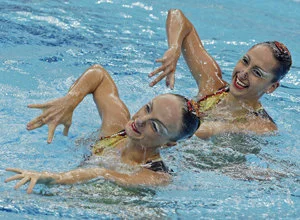
The swimming races are over, diving and synchronized swimming events are wrapping up, but there remain echoes of interviewers asking athletes, particularly Michael Phelps, questions like, "How did you do it?"
I have been following with great intrigue the Speedo LZR swimsuit controversy. Some believe this has provided an unfair advantage to the swimmers wearing them in the Olympic Games, making them faster than those without the suits. However I recently happened upon another possible reason why the Olympic swimmers in general are getting faster and faster.
Would you believe it could be the water?
An article posted on PhysOrg.com by Mary Anne Simpson, describes the ozonation technology that was used in the Water Cube in Beijing (and in fact in six of the past summer games since 1972), to replace the irritating, nasty side effects of highly chlorinated water.
If you ever swam competitively (or have just done a few laps in the pool) you are likely familiar with that burn in the lungs and eyes associated with highly chlorinated pools. Chlorine is not a very friendly chemical to humans - according to standard chemical data sheets, it is an eye and lung irritant.
There are negative environmental impacts that result from the use of chlorine, which have been studied extensively by the EPA. It is thought that the result of EPA regulation will eventually be alternate disinfection approaches being used in our drinking and water treatment systems. "Eventually" is a key word there, it takes time to shift infrastructure that processes millions of gallons of water per day.
It is however a terrific disinfectant for the low cost, which is why it has been historically used in both drinking/water treatment, and in pools. But when you are talking about hundredths of seconds between swimmers' times, even a slight reduction of lung capacity could negatively impact performance.
On the other hand, ozone is considered a more environmentally friendly water disinfection alternative to chlorine because it does not produce unwanted by-products. This means that the use of ozone does not create other unwanted chemicals (called "disinfectant by-products") that have been found to be detrimental to health. The breakdown product is simply oxygen - so it is considered to be "greener" than chlorine in that regard.
ProMinent ProMaqua is the German-based company that has been quietly getting the job done around the world for these facilities. But it is a monumental engineering feat. According to a June press release from ProMinent,
The challenge is to reliably disinfect approximately 16,000 cubic metres of water in the six training, diving and competition swimming pools. Thanks to a programmable logic controller and clearly arranged display and operator control panel, the compact Bono Zon systems are easy and safe to operate. The ozone generators are designed for minimum power and cooling water consumption and are therefore extremely gentle on the environment.
For the curious, Bono Zon is neither a Japanese steakhouse nor the lead singer of U2. It is ProMinent's ozone production and delivery system that takes ambient air and converts it to ozone by applying a high voltage of several thousand volts (not to be attempted at home!) between two electrodes. There are numerous added controls and safety features to ensure the air is conditioned, backflow and mixing is controlled, and the entire reaction is conducted under vacuum.
You want to talk serious "clean & green" technology? This company has more than 100 global patents pending and issued, covering their various equipment and delivery technologies. And they have been around since their founder, Professor Viktor Dulger developed his first ozone dosing device in 1971. It was used the very next year at the 1972 Munich Olympics.
So could it be that Olympians in Beijing dove into a clean pool of water, free of chlorine irritation to swim to their world records and medals?
I thought I only needed the Speedo LZR to be a Phelps-like or Coughlin-like swimming machine, but it looks like I might need an ozone system too.