In the weeks leading up to the House hearings on "the radicalization of American Muslims," anti-Muslim rhetoric continued apace in some segments of the media. At an Islamic Society of North America dinner in Arlington, Virginia last month, over 200 Muslims shared their concerns as panelists discussed the challenges facing the Muslim community. Professor Ingrid Mattson, the immediate past president of the organization, began the program by reminding the audience, "We are not alone -- our interfaith family has our back."
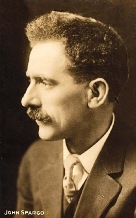
This is not the first time Americans of faith have stood behind a religious group singled out for suspicion. In 1921, at a time of widespread, virulent defamation of Jews, John Spargo, a lay Methodist minister, social critic and activist, said "It should not be left to men and women of the Jewish faith to fight this evil ... Anti-Semitism commands our special attention today ... but my plea is not for pro-Semitism." Rather, he opposed efforts to "divide our citizenship on religious lines." He did so out of "loyalty to American ideals." In a lecture later that year, Spargo called religious hatred "American treason." In his eyes, the "Jews' problem" was actually an American problem.
In the years immediately following the First World War, more than half the Jews in America were foreign born. As Spargo noted, "It is always difficult to avoid suspicion of the different groups we have drawn from other countries where there has been a barrier of language, creed or customs." Efforts were underway that would, by 1924, radically restrict immigration. A revived Ku Klux Klan, dormant since 1870, gathered force. Within the context of rising racism and xenophobia, Spargo was particularly outraged by the level of bigotry directed at Jews.
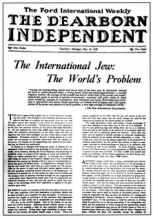
In February, 1920, Attorney General A. Mitchell Palmer published a report entitled, "The Case Against the Reds," in which he asserted that the Department of Justice had discovered "upwards of 60,000 ... organized agitators ... in the United States," while broadly hinting that many were Jews. That same year, Henry Ford, the leading industrialist in the country, introduced the Protocols of the Elders of Zion to American readers, printing the first of a series of articles titled "The International Jew: The World's Problem," in newspapers that he owned and widely distributed. Never before (or since) have Jews in America felt so vulnerable.
Not unlike Muslim Americans today, Jews were a diverse community that sometimes disagreed over strategies and tactics. The American Jewish Committee, founded in 1906 by American Jewish lawyers and businessmen concerned for the fate of Jews in Russia, debated how to respond to their own situation, as did the more recently created Anti-Defamation League, begun in 1913 in response to the Leo Frank trial in Georgia. Should they consider litigation? Was a boycott of Ford cars too radical a response? Perhaps, some suggested, the recently published "Jewish Contributions to Civilization" should be widely distributed. Others thought to counter, point by point, the lies in the anti-Semitic literature.
What the Jews themselves could not have hoped to make happen, John Spargo did. The New York Times reported on Jan. 16, 1921 that, "A protest against anti-Semitic propaganda in the United States, bearing the signatures of President Wilson, William H. Taft, Cardinal O'Connell and 116 other widely known men and women of Christian faith, was made public here tonight by John Spargo, Socialist author." Signers included church leaders, secretaries of state, and university presidents. Among those who lent their names were William Jennings Bryan, Clarence Darrow, and W.E.B. Dubois.
Ninety years later, we find ourselves at another moment that calls for interfaith solidarity. After Congressman King announced his plans, 51 organizations, including Christian, Muslim, Unitarian and Sikh groups, signed a letter to the House leadership strongly objecting to the hearings. On Sunday, March 6, Jewish and Christian leaders spoke alongside Muslims at a rally in Times Square; some 300 people stood in the rain that Sunday bearing signs reading "Today, I am a Muslim Too." As the first day of hearings ended, an interfaith coalition held a press conference, announcing the official launch of Shoulder to Shoulder: Standing with American Muslims; Upholding American Values, a campaign of national faith-based organizations and religious denominations to promote tolerance and put an end to anti-Muslim bigotry.
John Webster Spargo would approve. He would also urge us to expand our ranks and make our witness stronger and more visible. Our interfaith family should assure Muslim Americans that we do, indeed, "have their back." That said, Spargo would remind us that the problem we are facing is not the "Muslim's problem." It is a problem for Americans. And we will address it ... shoulder to shoulder.
Rabbi Nancy Fuchs Kreimer is a member of the Steering Committee of "Shoulder-to-Shoulder".
Rabbi Justus N. Baird: What if Jews Knew That Americans Love Them?
King Hearings on Muslims Show Deep Partisan Rift - NYTimes.com
Peter King's hearings: Are Muslims our enemy? [VIDEO] | Nation ...
Rep. Peter King Planning Hearings on Muslim "Radicalization ...
Peter King: I'll Hold Hearings On Radical Islam
The Fix - Peter King hearings: Was anything accomplished? (POLL)
Rep. Peter King's hearing on American Muslims a 'very personal ...
Rep. Peter King's Hearing on American Muslims: How Radical? How ...
2) Recognizing that there are people who follow such religious doctrines with the express objective of committing violence in the name of their religion, is not racism or discrimination.
3) Recognizing that certain religious doctrines contain overt political mandates to be achieved, to the detriment of all persons's outside of that religion, is not racism or discrimination.
Islam is not a race, it is a socio-political ideology. Therefore, to claim that critique of Islam is an exercise of racism is to miss the point entirely.
Allegations of hatred and bigotry are good show for those who are less than critical, but there is no substance in such allegations. Those who criticize the hearings seem capable only of making conclusory remarks, completely ignoring in the process the reality that Islam unequivocally inspires acts of terrorism. Islamic terrorism is a unique existential threat to the security of the United States, a fact acknowledged by highest levels of government.
As Ayn Rand said: "You can ignore reality, but you cannot ignore the consequences of ignoring reality."
A religion can have many differing doctrines, depending on the particular sect or church. While "recognition" is purely a matter of one's opinion, it IS discriminatory to treat somebody differently or hold them to a higher standard of behavior based SOLELY on their religion (such as demanding that a community take responsibility for an individual's actions).
2) Violence like during the Holy Inquisition, for example ?
3) Political mandates such as gaining control of congress in order to conduct anti-American McCarthyist hearings into Islam (and then maybe other religions) ?
These hearings go beyond "critique" and have begun with a very accusatory premise. While not "racist", they are certainly bigoted. "Critique" would entail having at least a basic understanding of what it is one seeks to criticize.
I'm sure the vast majority of American Muslims just want to get on with life and have no interest in taking over the world or killing "infidels". The biggest "existential threat" to the United States is it's own greed, and a superiority complex that assumes that the lives of non-Americans are intrinsically worth less, and that America deserves to have whatever it pleases, regardless of the suffering of others. Very closely tied to that attitude, is the real "existential threat" to all of humanity, Global Warming. It is no coincidence that Muslim-bashers tend to be Global warming deniers.
Which brings me to your last point...
Religion: " Doctrines, beliefs, and actions that an individual or group are devoted to."
Religion is an ideology like any other.
2) There are two senses of discrimination. One is discrimination as prejudice, or unfair treatment. The other is discrimination as scrutiny, or a method of distinguishing things. Noticing legitimate differences in religious tenets held by different people is not discrimination in the prejudicial sense. Thus, to note that there is a particularly strong link between Islam and Jihadist terrorism is not prejudice. It is the acquiescence of a fact.
3) You have yet to point out in what regard the hearings are bigoted. Bigoted, like one version of discrimination, implies prejudice. Prejudice is holding pre - conceived beliefs against contrary factual basis. The hearings are not centered around any preconceptions against the weight of fact. The hearings are a response to direct evidence, as noted by the Justice Department, FBI, and other organs of law enforcement, of Islamic doctrine inspiring Jihadist terrorism.
4) The hearings are a response to ACTIONS committed expressly in the name of Islam, namely terrorist attacks and attempts. Religious actions are distinct from religious beliefs. Having said that, religious beliefs are capable of inspiring actions. Beliefs are not inert considerations. Intent is paramount. If intent and motivation can be derived from religious beliefs, there is no reason why they should not be scrutinized.
Iow's, what the ears hear isn't matching what the eyes see. American citizens have a right to be concerned about their future.
An example of what I am proposing would be similar Muslim group who holds a fundraiser for a good cause, looking good on the outside, but inviting a known radical guest speaker. What's that all about?
I think you should disconnect from your senses that are not registering the fact that when so-called Musslim countries have tyrants, the victims are mostly Musslim. Who speaks for them? I would assume that attacking their nominally Musslim oppressor is the same as coming to the defense of the Musslim victims.
Mr. King certainly is a complex character, and there certainly is enough complexity regarding this issue, and it's not as one sided as your article makes it.