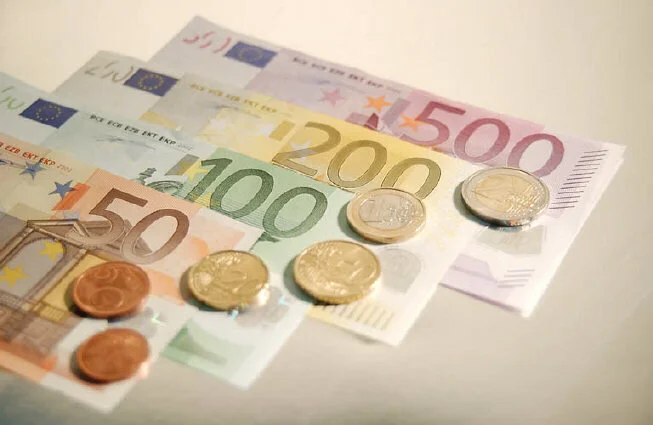
The problem with the euro is not Greece. Nor is it Portugal, Italy, Spain or Ireland. It is not even the French or German financial institutions that may hold the debt of these governments.
The problem with the euro is the euro.
We are now hearing a multitude of silly claims by the Keynesian money-manipulators that every country needs its own currency, so they can be devalued "when necessary." Actually, that is what Europe had only a decade ago, and it was so wonderful that they abandoned it in disgust.
Rather, the problem is that there is no proper management protocol for the euro. The European Central Bank is basically crossing its fingers, hoping that financial turmoil won't lead to currency turmoil.
Group prayer is a poor way to manage a currency. The fundamental problem here is that the ECB doesn't have an effective protocol, or method of operation.
Let us assume that the fear is that financial turmoil will lead to a decline in the value of the euro. If that problem appears, the simple solution is to reduce the numbers of euros in circulation, thus increasing their scarcity value. Technically, this is known as a "reduction in base money," and is accomplished by selling government bonds off the ECB's balance sheet, taking euros in return, and effectively making the euros disappear. It sometimes goes by the name of "unsterilized intervention."
This method is 100% effective. In fact, it constitutes the normal operating procedure of currency boards, which are in use worldwide with considerable success.
Let's assume that the ECB discovers its proper operating procedures, and is able to maintain the euro's value even in the midst of considerable financial turmoil. What then?
In that case, let the weak governments default. Greece has spent 105 of the past 200 years in default. This is nothing new. Perhaps a collection of governments would then default soon after.
A government default is not necessarily a bad thing for the economies of those countries. Let's say you ran a nice beachfront inn in the Greek Isles. The sun still shines. The sand is still there. Tourists from Britain and Sweden keep showing up. What difference does it make if the government in Athens didn't make their latest payment?
The immediate effect of default would be that the laughably corrupt Greek government would no longer be able to issue debt. The politicians' credit cards would be cut off. Also, the government wouldn't be paying the 6% of GDP it now pays as interest on that debt.
Two things that, arguably, might be good.
As it is, the ECB is demanding that the Greek government reduce its deficit from 13% of GDP to 3% of GDP in three years, a reduction of 10% of GDP. Under the default scenario, the deficit would go to zero, but that would be a contraction of 7% of GDP in one year, because the government wouldn't pay interest on the debt.
It's basically the same thing. Ten percent in three years or seven percent in one year.
Government default is often accompanied by a currency implosion, as expectations run high that the government will attempt to finance itself with the printing press. However, in this case, the euro would prevent that outcome.
The second thing that often happens is that the government goes on the rampage, appropriating the wealth of private citizens by any means possible. This could mean higher taxes, capital controls, nationalization, and other forms of outright theft. This is a tough environment for private business.
But it doesn't have to be that way. Greece should follow the Magic Formula for economic management: Low Taxes + Stable Money.
The euro would provide the Stable Money. Then, we need Low Taxes. How about a 13% flat income tax? This would be the best thing the Greek government could do to get its economy fired up again.
This idea is so far from today's conventional wisdom that some people probably think I'm crazy. Cut taxes when the government can't pay its bills?
No, I'm serious. It would work. How do I know it would work?
Because Russia did it in 2000. Remember, Russia defaulted on its bonds in 1998. The economy was in ruins. Russia's leaders decided that the best thing they could do to get the economy running again would be to reduce taxes dramatically. They implemented a 13% flat tax in 2001, replacing a system with a top income tax rate of 30%. In 2002, corporate tax rates were cut from 35% to 24%.
It worked: from 2001 to 2007, the average income of Russian workers increased by a mind-blowing 30% per annum in nominal terms. This was not only a nice recovery, it was the best economic expansion in Russia in over a hundred years.
The ECB has to learn how to make its money stable, by using direct adjustment of base money supply. Greece has to learn how to lower taxes, following the example used in Russia and imitated throughout Eastern Europe. The effects of proper implementation of the Magic Formula would be ... like magic.