- BIG NEWS:
- Ghana
- |
- Natural Disasters
- |
- Honduras
- |
- Iran
- |
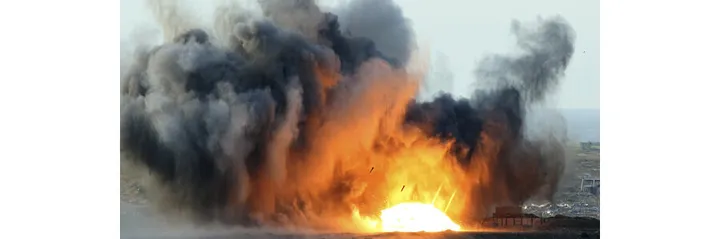
"y Hamas launch missiles not peace?" complained the Israeli Consulate in New York during a December 30th press conference held on the microblogging site Twitter. Meanwhile, during that fourth day of Israeli air strikes against the Gaza Strip, the Palestinian death toll passed 350. Many around the world, shocked by the flagrant disproportionality of Israeli bombs, have been searching for a way to ask, "y don't u?"
The international reaction has been long on frustration but short on alternatives. After all, Hamas did violate an agreed-upon cease fire by lobbing rockets over the border, however ineffectively compared to Israel's American-supplied F-16s. And Israel has tried to reign in its own ferocity by calling Gazans' cell phones in the advance of an attack and by trading its cluster bombs for brand-new GBU-39s, designed to reduce collateral damage.
However grateful for any such care, conventional wisdom holds the sneaking suspicion that Israel is bound by some unalterable law of the jungle to unleash its might, as in Lebanon in 2006; it is doing what powerful states are supposed to do. In the face of it, we can only hope that the Gazans will choose to pursue their cause with peace and not missiles, lest their dangerous neighbor grow angry.
The history of the 20th century has seen the discovery of nonviolent action as the weapon par excellence of the weak. In Gandhi's India, King's Jim Crow South, the Danish resistance to the Nazis, communist Poland, and countless other times and places, strong-willed people brought powerful regimes to their knees without the help of deadly weapons. Their stories are epics of courage and self-sacrifice.
Palestinians, too, have seen their share of nonviolent heroism, most recently with the Free Gaza Movement, whose boat carrying doctors and activists was attacked on December 30th while trying to break the Israeli blockade. If all these others can win their rights peacefully, people rightfully ask, what right have Gazans to use rockets? Fewer ask the same thing about Israel and its F-16s.
This may be because the century of world wars and nuclear superpowers offered few models of nonviolent action for governments to measure themselves against. Even Gandhi once concluded, "The State represents violence in a concentrated and organized form." For those of us who really would like to see peace rather than missiles, in Gaza and elsewhere, it is time to create examples in the new century of powerful states, not just movements with no other option, choosing nonviolent methods against the temptation to use violent ones. If nonviolence could work against Axis Powers, as it did in Denmark, it can against the Axis of Evil, too.
Making this choice will take no less bravery and sacrifice than we applaud in our troops deployed abroad, to say nothing of strategic imagination. If the poorest victims of oppression can do great things nonviolently, a superpower should be able to accomplish things even greater. The success of peace-building strategies during the surge in Iraq, compared to the shock and awe of before, suggests that these are not pipe dreams.
Breaking away from the cycle of violence demands a deeper understanding of what violence is in the first place. Yes, the Gazan rockets are violent. But so was the blockade imposed on the Strip by Israel and Egypt, blessed by the largest supplier of aid to both countries, the United States. Just as the perpetrators of violence spread far and wide, nonviolent solutions deserve a committed international effort.
Rather than leaving it to the smallest, least powerful, and longest-suffering side of the conflict to assert its rights nonviolently, the powerful can dampen the blasts of Hamas's rockets with mercy. Israel and its backers need to make the real sacrifices necessary to offer the Palestinian people a solution worthy of their dignity. It will not come cheap, but no cost is dearer than more war.
While President-elect Obama keeps quiet on the attacks in Gaza, pundits are mining his past utterances for clues. "If somebody was sending rockets into my house, where my two daughters sleep at night," he said in a southern Israeli town in July, "I'm going to do everything in my power to stop that. And I would expect Israelis to do the same thing." This has by and large been taken as an endorsement of Israel's onslaught. Let us hope that when Obama takes office this month we learn that, in his mind, power can mean something better than bombing raids.
These are not just the philosophical musings of a new...
I'm pleased to announce the launch today of two new HuffPost...
Long before $150,000-gate, Sarah Palin seemed to...
The Obamas dropped by the Vatican on Friday, with daughters...
Yesterday evening, Greg Sargent reported on The Plum Line that one of Alaska Gov. Sarah Palin's key reasons...
I never actually heard the words made famous by a certain man on a certain TV show. Instead I got a lot...
Jim Hansen is director of the NASA Goddard Institute for...
Don't write off Saint Sarah all you political pundits,...
ANCHORAGE, Alaska — The former fiance of Gov. Sarah Palin's...
Hermione herself, Emma Watson, charmed David Letterman and...
Think Progress flags David Brooks telling...
While we of course do not claim to know anyone's thoughts, we nominate these...
The Daily Show's John Oliver is unhappy with mainstream journalism, and even drearier...
For this week's installment of their "Lunch with the FT" feature the...
Al Franken's been anointed as Minnesota's junior senator, but how did the...
SYDNEY — Residents of a rural Australian town hoping to protect the earth and their wallets...
"What's for dinner?" A lot of us ask that question right...
Want to reply to a comment? Hint: Click "Reply" at the bottom of the comment; after being approved your comment will appear directly underneath the comment you replied to
Israel, who controls the entry and exit into Gaza by land, sea and air, the opportunity to receive some aid and supplies for 3 hours every day. Palestinians are welcome to participate in delivering the aid and supplies, unloading the trucks, distributing the supplies and aid, and everyone can then pick up what they need, as long as they return to the safest place they can find within three hours. Those who are jewish, must be very proud of their leaders. Sixty years ago, when the United Nations partitioned Palestine, and granted recognition to the government of Israel, I'm sure they must have intended for Israel to take control of the borders of Palestine, and to decide who can enter or exit, how much food, fuel, and healthcare the Palestinians could be entitled to. For Israel to think it does not have to accord respect for Palestine's sovereignty, today, leaves me with the huge question of whether any jewish person deserves respect.
I appreciate your comments. JoeBenAvraham, you're right, it's important to condemn Hamas's destructive mission. I do at least point out, "Yes, the Gazan rockets are violent," and I probably should have gone further to mention Hamas's mission. I only focus on Israel because Israel is in such a comparatively powerful position, while the Gazans are pretty much in a state of economic and political desperation. Also Israel is killing far more Gazans now than Gazans are killing Israelis. Regardless of how Hamas acts, I believe, Israel and its international supporters are in a position to make real moves to improve the lives of Palestinians. Whatever the adversary, injecting violence into the situation makes it worse.
And c-hope, you're right, I'm rather non-objective toward the facts and pushing my ideology. My ideology is a desperate desire to see tremendous violence inflicted on human beings, whomever they are, stop. The 10,000 Israelis you mention, remember, are comparatively few compared to the hundreds of thousands of Palestinians who have been exiled from their ancestral lands with no really habitable place to go.
Thank you for your post. I hope to read more brilliant ideas like this in 2009.
I hope that people will start to realize how counterproductive violence is. If one wants to fight just because they like to fight, then they should duke it out on stage, like wrestlers and leave the people out of it. Violence as a policy has never 'won' or 'worked' or whatever other word you want to call it.
Do results matter? Is there an objective, and if so, is it definable?
If the way to measure success in Gaza, is by how many are killed, or by what conditions Israel can force onto their enemy, then violence needs to be seen as the myth it really is. Because the answer to those questions, as you point out, is that peace and self determination, have been achieved before.
It can be done.
If Israel wants peace, a lofty goal for sure, then it has some seriously back breaking, tough, hard work ahead. Israel will need courage and lots of brave people.
Is Israel strong enough to achieve peace? Is Hamas?
Funny that Schneider would state the following: "Breaking away from the cycle of violence demands a deeper understanding of what violence is in the first place."
Yet, he totally evades examining Hamas and follows the losing recipe of trying to micro-analyze Israel.
Hamas *is* the state in Gaza. Democratically elected as people around the world love to remind us. But when you examine the Hamas state ideology and policies, we find they are encapsulated in article 13 of it's charter. Hamas has two key mindsets that explain this current mini-war:
1) The peace process is "contrary to the beliefs of the Islamic Resistance Movement"
and
2) "There is no solution to the Palestinian problem except by Jihad."
Schneider's narrow view of the situation thus deprives his readers of the root cause of the conflict on the other side of the border. Hamas actions are always aimed at their goal of jihad and the "liberation" of all of Palestine...in other words, a holy war to destroy Israel.
Schneider shows the fallacy of his arguments by ignoring these critical facts.
In other words, they have no room in their world for Jews/Israel. Ever.
Israeli supporters ask constantly. "What should Israel do? We're being attacked." But when an answer is given, it is always dismissed. There is a justification for every single thing. Reminds me of Bush, no regrets and if called out he can always just say, "so what?"
But, since so many answers are demanded of peace supporters by Israeli supporters, maybe for once, I'd really like an honest answer to my question.
What is Israel trying to achieve, and if it's peace and security, how can that ever be achieved? How much is Israel willing to pay for this security?
I fear that Israel's zeal for security is going to never the less become textbook defined genocide.
Your security, by the definition Israel gives, is going to take getting rid of all the terrorists. By saying that the people need to be killed to get rid of the terrorist, is basically saying that Israel wants to get rid of most of all of the people of Gaza. But it's not genocide because their all Hamas supporters.
They want to get rid of you, and you want to get rid of them. Trust will never exists.
Wait, unilaterally disengaging from Gaza wasn't a sacrifice. Wake up you and see where it got us. 10,000 Israelis with their lives ruined after being forced to evacuate, and as thanks we received the election of Hamas. and this war is just the cherry on top. Its time for you to evaluate the facts objectively instead of pushing your ideology
Israel did not truly disengage from Gaza. It turned Gaza into a giant prison camp of the most inhumane sort. And at the same time it kept stealing land in the West Bank and permitted radical Zionists to act like Cossacks and engage in vicious pogroms against the civilian population. Zionist spin isn't convincing most of the world. They are awake to the crimes of Israel.
You must be logged in to reply to this comment. Log in or