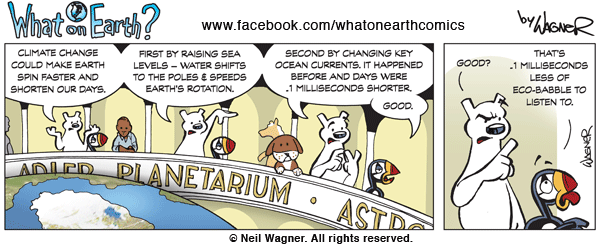
The basic premise behind man-made climate change is a simple one: Earth's atmosphere naturally contains greenhouse gases that keep our planet warm enough to be liveable. When we burn fossil fuels, though, we increase the amount of greenhouse gases in the atmosphere, disrupting Earth's ideal balance nature had developed. The result is global warming (an increase in the planet's average annual temperature) which, in turn, triggers climate change.
Some impacts of global warming and climate change are exactly as you'd expect -- weather is getting warmer and glaciers are melting. Other impacts, though, are less predictable: sea levels are rising; global health is facing major problems; the size of plants and animals is changing; satellites are traveling faster in their orbits; and mountains are getting taller. And now, a new study suggests that climate has the potential to actually speed up Earth's rotation, resulting in some shorter days.
Stephen Marcus and his colleagues at NASA and the Institute of Earth Physics of Paris in France say the Antarctic Circumpolar Current slowed abruptly for two weeks in November 2009. The resulting faster rotation during that time shortened each day by 0.1 milliseconds. While they're not sure of the cause of the slower current in this case, they acknowledge that it is more likely to slow again more often in the future as a result of climate change. Not only could climate change impact the ocean current, but those rising sea levels I mentioned earlier will shift water towards the poles, drawing mass closer to Earth's axis, thus increasing the rate of Earth's spin.
If these climate-triggered impacts come to pass, we'll all owe a debt of gratitude to global warming: creator of a shorter 39.999999 hour work week!
Special thanks to guest artist Reena Wagner for her contribution of the puppy character, "Puggis" that makes an appearance in today's strip.
• • • • • • • • • • • • • • • • • • • • • •
Like "What on Earth?" on Facebook.
Become a Fan here at The Huffington Post.
Seth Shostak: Armageddon: 1,000,000,000 A.D.
Shawn Lawrence Otto: Review: The Hockey Stick and the Climate Wars
Chris Ladd: Food Science, Climate Science and Politics
A New Spin on Earth's Rotation | LiveScience
NASA - Top Story - CHANGES IN THE EARTH'S ROTATION ARE IN ...
Global warming/Climate Change: earth rotation, world health ...
This means that, in order to actually understand the final outcome, we would have to do some rather lengthy research of our own... probably exceeding the level of detail any of these scientists have engaged in.
I have to apologise to Neil Wagner... he has done his homework. Sadly... I am afraid that there is still no material for a good joke in there... I am still not laughing after having spent about an hour on this research and... to be honest... I don't care enough to go all the way to the bottom of this.
"Detection of the Earth rotation response to a rapid fluctuation of Southern Ocean circulation in November 2009" GEOPHYSICAL RESEARCH LETTERS, doi:10.1029/2011GL050671
That's a short term response to a shift in ocean circulation. Nothing to get excited about, as it will change in the future.
"Ocean bottom pressure changes lead to a decreasing length-of-day in a warming climate"
GEOPHYSICAL RESEARCH LETTERS, VOL. 34, L06307, 5 PP., 2007
doi:10.1029/2006GL029106
This is a long term effect of the ocean bottom pressure changing the mass distribution in the crust. For sure nothing one can estimate with high school level physics. I can't figure out a way to check the result of the authors without understanding their research in detail and redoing their calculations.
The third source
"The Sea-Level Fingerprint of West Antarctic Collapse" Science 6 February 2009: Vol. 323 no. 5915 p. 753
deals with the Antarctic ice sheet's role in particular and I can't tell from the abstract how complete their model is.
"A new study" has been said for polar bear farts causing cancer and cars turning alive and killing people. Give me scientific articles not suggestions and hypothesis.
Interesting. I wonder how. This article seems to suggest the opposite.
http://www.newscientist.com/article/dn16545-antarctic-bulge-could-flood-washington-dc.html
[2012]
http://www.newscientist.com/article/mg21328515.100-ocean-current-slowdown-made-earth-spin-faster.html
1) Wind slows down -- earth spins faster
2) Ocean current slows down -- earth spins faster
[2007] (I couldn't find this one on first read, which is why "I wondered how".)
http://www.newscientist.com/article/dn11555-global-warming-will-make-earth-spin-faster.html
3) Higher latitude waters more dense -- earth spins faster
4) Tidal friction -- earth spins slower [non-climate change related]
[2009]
http://www.newscientist.com/article/dn16545-antarctic-bulge-could-flood-washington-dc.html
5) Less ice sheet gravity pulling water to poles -- earth spins slower
It is a very complex nonlinear problem. I had really only thought about the tidal part prior to your article. Thanks.
Where does this author get the idea the earth would speed up. ?
* Climate models: http://www.skepticalscience.com/climate-models.htm
* Milankovitch cycles: http://www.sciencefriday.com/blog/2010/11/climate-change-whats-normal-whats-not/
* Climate doesn't have cycles: http://www.skepticalscience.com/news.php?n=512&p=3
If the past can help us great then it is useful otherwise looking in the past becomes a distraction from the present.
Is there something wrong with being told that you tried and failed? Smart people can learn from that and try, again. Only the not so smart ones complain that they are not being treated nicely.
If the notion is that sea-levels are rising due to a melting of ice caps (Goreans would say due to human causes), then the clear implication rather is a shift of water mass (whether ice or water) from the poles to other locations. These locations would be anywhere but at the poles and would by definition SLOW rotation as the mass would have greater angular momentum.
One question, though: the basic facts referred to in the cartoon were pulled from the linked article in New Scientist. So a legitimate source of information was citing NASA's Jet Propulsion Laboratory, the Institute of Earth Physics of Paris, and the Max Planck Institute for Meteorology in Hamburg. Do you feel their research doesn't qualify as "reality"?
I would have said the very same... the poles melt down, water shifts to the equator, the rotation slows down. If there is another effect that over-compensates for this, then you have a case where you are losing the very audience who is on your side, at least without all of us doing some more research on the topic.
And as far as I can tell timing in humour is the critical thing... nobody laughs after researching moments of inertia change due to climate change... so the effect is gone one way or another.
http://articles.businessinsider.com/2010-06-18/news/29962195_1_inertia-rotation-axis
http://www.sciencefriday.com/blog/2010/05/the-abcs-of-human-impact/