Energy efficiency has often been called the "low-hanging fruit" of our battle against climate change. An appropriate metaphor, as Climate Progress's Joe Romm points out, because energy efficiency "grows back."
"The efficiency resource never gets exhausted because technology keeps improving and knowledge spreads to more and more people," says Romm.
In fact, energy efficiency and conservation make up four wedges in the Carbon Mitigation Initiative's Stabilization Wedges game. The CMI is a joint effort of Princeton University, BP and Ford Motor company and its Wedges game lets players try different strategies for reducing greenhouse gas emissions by 200 billion tons in the next 50 years.
But energy efficiency has more going for it than some game pieces and the "hanging fruit" catch phrase. Global management consulting firm McKinsey & Company says current (or soon-to-be) energy efficiency technology could do much of the heavy lifting in reducing carbon dioxide emissions to 80% below 1990 levels within 40 years.
And here's some more good news: When engineers, designers and scientists seek to develop energy efficient solutions, they need not look far for inspiration. Biomimicry is a new field which asks its practitioners to identify a human need for efficiency and design a solution that mimics nature's solution to a comparable challenge. Why? As the Biomimicry Institute explains:
The core idea is that nature, imaginative by necessity, has already solved many of the problems we are grappling with. Animals, plants, and microbes are the consummate engineers. They have found what works, what is appropriate, and most important, what lasts here on Earth. This is the real news of biomimicry: After 3.8 billion years of research and development, failures are fossils, and what surrounds us is the secret to survival.
Think the Biomimicry Institute is overstating the case? Consider the fact that the United States still relies on bees to pollinate about a third of its crops. Consider, too, that this arrangement is not just happenstance. Plenty of those bees are not native to the area so farmers work with commercial beekeepers to supply the little buzzers. That's a bummer, since bee populations are in trouble these days.
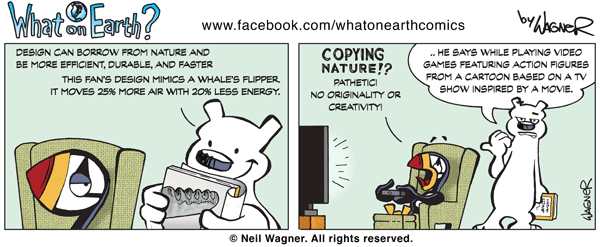
Technology from WhalePower Corporation was the inspiration for today's comic strip. The designs for WhalePower's fan blades were inspired by the bumps on humpback whale flippers which are well-suited to deal with fluid dynamics.
Clustering wind turbines close together does not seem like a good idea, but the California Institute of Technology's Center for Bioinspired Engineering looked to the spatial arrangements of schooling fish to position their vertical wind turbines. The results so far? Ten times the efficiency.
For a glimpse at more bioinspired designs that range from artificial muscles to a robot spider that nimbly locates disaster victims, take a look at these galleries from National Geographic and Treehugger.
So what's the moral of this story? Seek out efficient energy -- it's only natural.
Like "What on Earth?" on Facebook.
Become a Fan here at The Huffington Post.