
President-elect Obama's plan to put a million electric vehicles on the road in 10 years is doable and should be surpassed by its own momentum. As people discover the many advantages of electric vehicles (EVs), this momentum will build. Not only are these cars green and responsible, they also enhance National Security. From all we've been told about EVs we know a little. They are cleaner. We've heard about plugging them into our homes to recharge overnight. But most of us don't know much about electric cars yet.
The momentum of the Electric Vehicle Age will stem from enhanced performance, smoothness of acceleration, quietness, and superior control. The way an electric car can be tuned to behave a certain way for a certain driver allows for a whole new feeling in the driving experience. People just don't know how cool these cars are.
Existing designs can be manufactured as electric cars with no change to the tooling of the existing designs. Adapting kits are possible. Build electric versions on these existing tools to keep people working and get people interested in buying again. The technology to make these new electric vehicles exists today right here in this country.
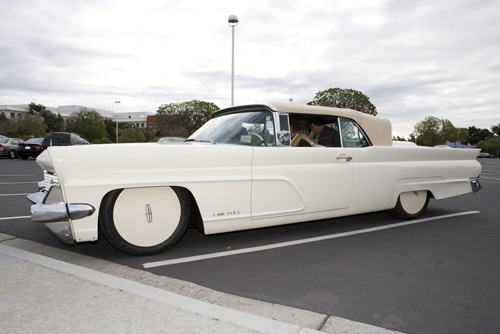
From Wichita, Kansas we get this report: A 1959 Lincoln Continental repowered to be a self charging electric vehicle by a small group of engineers and local services, is now achieving up to 65 mpg in informal tests. Work there continues. The goal of the project is to attain up to and beyond 100mpg for the biggest and heaviest car made in 1959. The car has been driven in California and Kansas and shown to over 15,000 people. In an audience of 12,000, one tenth of the people raised their hands when asked if they would like to have a car like that. That Lincoln represents a future for Detroit. It is the possibility of Big Clean cars that do not promote Global warming. Let's build them now, as well as economical small clean and green electric cars and let's put people to work. We already have the existing tooling and the facilities and manpower.
From Detroit we get this report:
We have devoted significant resources to this project: Over 200 engineers and 50 designers are working on the Volt alone, and another 400 are working on related subsystems and electric components. That's how important we think this is, and that's how much stock we place in the future of extended-range electric vehicles like the Chevy Volt. - Tony Posawatz, Vehicle Line Director - E-Flex Systems and the Chevy Volt, GeneralMotors Corp.
The GM, FORD and Chrysler CEOs then each boarded private personal business jets to be paid for by taxpayers money, and flew to Washington to ask tax-payers to give them a 25 billion dollar infusion to save hard working American's jobs. Have they changed direction but it's just too early for our senators and congress representatives to see it yet? I don't think so. Maybe introducing a new high-performance fossil fueled Shelby Mustang and jumping into a private jet to go to Washington for a bailout was not such a good idea.
Efficient technology can power the existing designs we have today.
We don't need a car that looks different with a new sunroof over the back seat creating an air conditioning challenge as a feature.
We don't need new tooling to start building electric cars now.
We need kits to adapt what we are currently making to today's demands.
We need new thinking from new leaders and we need new perspectives from unions.
Today the news is Hybrids. Everyone is making them. Some of these hybrids offer very poor mileage in the 20-30 mpg range. They may be already on their way out because of the inherent inefficiency of their design. An electric motor and an internal combustion engine both driving the wheels in one car may not be the most efficient approach. Forward thinkers are wondering about that inefficiency and working on ways to solve it. Plug-in kits are now available for Prius and Ford Escape, allowing these vehicles to plug in for a re-charge, increasing their efficiency and reducing their negative impact on the environment. Plug-in hybrid electric vehicles (PHEVs) look like the future, but are they the future?
There are huge limitations. The battery is the biggest. An average EV is only good for a short trip before it needs a charge. Maybe 40 miles or so is a good estimate. Some electric cars get a long range like 100 miles before they lose power and have to recharge. The Tesla (a super light sports car) goes over 150 miles on a charge. Two things that all basic EVs have in common is they are small in size and they have to stop and re-charge. If you run out of power you are down. Just like gas.
To re-charge, you need a power source. It may be your home, or it may be your parking garage at work. It might be a charging system that is privately owned and is a business enterprise (Better Place), or it may be a public utility service (PG&E). You may have a cable to plug in that identifies you so your account can be automatically charged. One thing is for sure. You need to re-charge. So you are going to be more conscious of your energy use.
Not every EV has to plug in. For some, it's optional. Cars like the Chevy Volt have an onboard generator to re-charge batteries or power the car. These cars are Self-Charging EVs (SCEVs). That means on long trips you use gasoline. A long trip is over about forty miles in a Volt, on level ground. When the battery starts to die, an onboard generator rescues it and powers the electric motor, while slowly recharging the battery. This sequence cycles on and off while you take a long trip. Mostly the generator is on... using gasoline, a fuel widely seen as a National Security disadvantage. The Volt generator will charge the batteries faster if the car is not moving, by using gasoline. On short trips, you won't even use the generator. You will go the first 40 miles on plug-in power. An average commute in the USA is about 35 miles.
Efficiency in the self-charging electric car is the big decider. If the efficiency of your charging system allows you to make electricity with less financial cost than buying it from the grid, then your car can power your house and turn the meter backwards to reduce or eliminate your electric bill. Potentially, you may even be able to sell electricity to the grid someday. That would be a good reason to buy a SCEV with a highly efficient self-charging system. These cars are mobile power plants.
Big electric cars are left out of the story so far by major manufacturers. They have made some very poor hybrid SUVS. SUVs, big sedans, pick-up trucks are all by the wayside. They have been relegated to dinosaur status. But don't count them out. A big Self-Charging SUV with a super efficient self-charging system would create enough power to support 6 homes. You could be part of a distributed power system by using the grid backwards, selling power back to your Utility Company. In this approach, power enters the grid from plugged-in vehicles, avoiding the loss found in the lines when power comes to you from a central Power Plant located miles away. Imagine a big electric car that earns you income.
But you just wanted a big electric car. You may be surprised to know why size is important. Big SCEVs, while taking big power to run, and requiring large battery banks and big electric motors, will undoubtedly be getting up to 100 mpg or more in the near future. A big developmental car, Lincvolt, seen at Lincvolt.com , is proving this technology. Big SCEVs may well be earning you money while you are charging the grid. They may be recharging with super efficient self-charging systems, and even using Domestic Green bio-diesel fuel, a fuel that does not contribute significantly to Global Warming. Big may be an unexpected Green alternative.
The Lincvolt:
Read More:
Read more opinion from HuffPost bloggers on the Detroit bailout
***SCROLL DOWN FOR VIDEO OF PALIN'S RESIGNATION SPEECH...
When UN Secretary-General Ban Ki Moon meets...
Naked tweeting: the next frontier in staged celebrity...
If it's a rainy weekend and you want to channel that summer feeling, you can rent...
***SCROLL DOWN FOR VIDEO OF PALIN'S RESIGNATION SPEECH...
I'm starting to believe that's a destination; the next step in life once you get...
When Michelle Obama created an organic vegetable garden on...
If President Obama is truly serious about changing the...
Bar Refaeli stars in a new black and white video floating around the internet. Set to music and with...
Missouri State Representative Cynthia Davis is one tough cookie. Last week...
Asked by Meredith Vieira on the "Today Show" if it...
I'm liveblogging the latest Iran election fallout. Email me with any news or thoughts, or follow me...
Fox News' Shepard Smith was having some trouble with a...
The U.S. economy lost 467,000 jobs in June as the...
WASHINGTON — Now it can be told: President Obama says one of the best-kept secrets at the...
WASHINGTON — Mississippi's still king of cellulite,...
CNN's Anderson Cooper reports on a frisky sea lion and the boat it apparently tried...
Want to reply to a comment? Hint: Click "Reply" at the bottom of the comment; after being approved your comment will appear directly underneath the comment you replied to
See Brian Ross's Profile
Neil:
The other thing that is going to have to happen is that someone is going to have to eat the bleeding edge costs of the technology. The premiums being charged on Hybrids eliminates incentives to move to green technology for many, especially when gas drops down under $3.00/gallon. For my thoughts on this, see "Too Much Green in Being Green" here at the Huffington Post: http://www.huffingtonpost.com/brian-ross/too-much-green-in-being-g_b_146533.html
For a couple of years now I have wanted to convert an old VW bus to electric just because it would be sooooo cool. A company in the Silcon Valley actually did this as an experiment and it was awesome--complete with surfboard rack. However, the cost was astronomical, not something I could even consider. But I would jump at the chance if it was borderline affordable, even with a moderate cost premium because of the fuel savings and the environmental statement makes average people start thinking.....
Two things are important to me -- cost, and is the car cute. I drive a Mini and was very excited when I was notified that they were looking for 500 people to test drive their new electric models for one year -- until I found out the lease was $850 a month! Ridiculous!
Put an electric Mini on the market for a reasonable price and they'll sell like hotcakes.
In The Obama Era we will see the Electromagnetic Car which will need almost no charge at all. Permanent powerful mini Magnets will provide Kinetic Energy to the wheels. An engine that can produce an endless motion based on Permanent Magnets, Batteries and some Gas.
The magnets literally create the energy indefinitely. That's how the sun works.
And the really cool thing about electric cars is, the electricity used to charge them always comes from clean pollution-free sources.
"Renewable resources (solar, wind, geothermal, hydroelectric, biomass, and waste) provided nearly 12 percent of the nation's electricity supply in 2003"
http://www.eia.doe.gov/cneaf/electricity/pub_summaries/renew_es.html
"As of April 2008, worldwide wind farm capacity was 100,000 megawatts (MW)"
http://www.worldwatch.org/node/5448?utm_campaign=vital_signs_online&utm_medium=email&utm_source=wind
Well, that is good news. And that is the only way electric cars are charged up.
Here's the tricky part: if we go to small, lightweight electric or other high tech solution, we will also need to drive differently than we do now. Maybe electric cars won't go over 60 mph and BMW-type drivers will have to give up their autobahn style of driving and frequent lane changes and start driving in a way that allows everyone to get where they're going not just themselves.
We do need more alternatives, and more long term thinking, but 3 key points:
1.) Big vehicles will always use more energy than smaller, lighter ones.
2.) Electricity does not come from a wall...it comes from fuel such as coal, oil, nuclear, wind, or hydro power.
3.) Electric vehicles have never been able to make money - people weren't generally willing/able to pay the higher cost. We either need public investment, or a tax on gas (or both) to make it viable.
Neil, you old Canadian born hippy. Everyrthing you said is true. But how do we get around the fact that the oil industry, who are heavily invested in the American car makers, will do everthing they can to sabotage electric in favor of gas. The easiest way to keep the people pumpin their product is to once again make gas the cheapest option. So when it starts lookin like Obama's gonna win, the price drops from 5 to 2 dollars a gallon and the cost of retooling loses it's attractiveness compared to the current price of the same old, same old. Let's face it, Neil, they've got us over a barrel.
Unfortunately the car dealers are slapping on anywhere from 5-10K on cars marked as hybrids.
Even if I was lucky enough to have the car last 15 years I would never recoup the $, and it's not like the electric will be free, or green.
As much as I want to go green not all of us have pockets as deep as Neil.
GEARHEADS 4 EV's, just what i'm thinkin!
The big 3 need to get on board with EV's & race for 100mpg consumer plug ins or go out the way of the dinosaur's...Long live Tesla and all the emmerging playaz but luxury is only for a small % of folks, we need to make this affordable to the workin man.
Lets convert all the gas huffers a great sign of ground up change while producing new EV's. We must come at these changes from all sides and update the existing commercial power grid if we are going to survive into the next century.
The tipping point is now!
Convert your current car or truck:
http://www.converdantvehicles.com/electric.html
Part 2:
Instead they shelved the program and destroyed ever last one of them?? WTF?? They could have owned the market in electric vehicles. Their market share could be like 70%, plus all the licensing fees to the other automakersŠNow, their hoping they can survive the yearŠ
What's happening to the big 3 should be a huge lesson on short term thinking and the quest for short term profits. I tend to believe that the management at all three firms are too short sighted to be able to help their firms from bankruptcy and any money we give them in a "bailout" will be wasted. I firmly believe that most of the upper management and Board of Directors belong in jail.
That said, as a kid growing up in the sixties and seventies, I really believed that by now we"d all be driving in quite, clean electric cars on the streets or in the air (why not: remember the Jetsons?) I"ve never understood why the big three have kept pushing the internal combustion engine the way they have; it"s long been known to be a dead end. Christ, the GM EV-1, the first modern production electric car went from 0-60 in 3.5 seconds. And that was just a first attempt and they didn't even develop the car to be fast. Name another American production car with those numbers. You can"tŠ Sure it didn"t have much of a range; remember "First attempt". It boggles the mind to think where we would be with 8 years of development on that car.
We need to connect the dots here. Use solar and geothermal to power the grid that most businesses and cities will use. Provide zero-interest, ten-year loans to home owners to convert their homes to solar power and get them OFF the user end of the grid. Sell the excess power back to the power company. Transition to totally-electric cars which plug into your solar-powered home system at night and recharge during the day using photo-voltaic cells imbedded in the roofs and windshields of the cars themselves. Deliberately park your car in the sunshine. The windshields will darken, the air conditioner will work in "park" mode to keep the interior cool, and the PV cells recharge the batteries. Your car will recharge on its own while you're working, and when you get home, the house system has fully recharged and you're ready to use your TV, stereo, microwave and air conditioner. The cycle repeats itself in perpetuity, FOR FREE.
Romantic nostalgia embodies the idea of a 'Big Electric Car.' And the concept is Americana ingenuity at its best. Car enthusiasts do not comprise a large segment of American society, but they are important as a link to our past.
Driving across America is a lost art. How many of today's generation have the patience to experience the small towns and big cities of our great Nation by driving the roads that run through or by-pass them? Think 'Highway 51 Revisited. ' Thunder Road. Curious? Plan a spontaneous road trip to find portions of Route 66. Travel Highway One.............as far as it goes. Roads across America connect us. If all we travel is the sky and the internet, and a hundred miles from home; we loose contact with each other. And understanding, compassion, and unity are by-passed.
I find Neil's ideas in this blog both charming and futuristic, as well as critical to retain that portion of our history that contains millions of Americans whose lives have been sustained by the car industry.
Long may you run!
Hey Neil, when can I get a ride in your car? I love it!!!!
You must be logged in to reply to this comment. Log in or