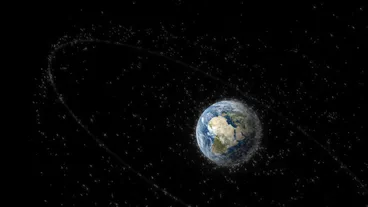
Could it be that our planet isn't typical at all? If so, then maybe life isn't typical either. On the other hand, if there are plenty of planets similar to Earth, we can reasonably hope for lots of cosmic company.
Let's watch the video and then discuss how you could use it to inspire and fascinate a student to think about scientific principles and material behavior.
It seems that the frequency of planets able to support life is roughly one percent. In other words, a billion or more such worlds exist in our galaxy alone. That's a lot of acreage, and it takes industrial-strength credulity to believe it's all bleakly barren.
It's that time of year again--a time of year space fans love! Those of you who saw my posts last year will remember that April 12th is Yuri's Night, t...
"When I first came to Santa Fe, it always snowed by Halloween and the ski area always opened by the end of November," observes Michael Wigley, a local skiing legend. "Now we are lucky if we have decent snow before Christmas.
This year Easter will be celebrated on March 31, but in 2014 it will occur on April 20. The reason has to do with the mismatch between the periodicity of the sun and the moon and the long history of human efforts to create a reliable and consistent calendar.
Living our 2-D lives on planet Earth, arguing over Sequestration and who has the remote, we tend to forget that the solar system is a cosmic shooting gallery. Comets serve as windows into the solar system's primitive past, and in 2013 we have two icy treats.
Until about five years ago, the moon was thought to be bone dry. However, the anhydrous view of the moon has been challenged by detections of water on the lunar surface and in rocks and soil returned by the Apollo missions.
If we can hear the constituents of the universe, we must remember that we, too, are part of this universe. The Earth emanates natural and manmade radio waves. What do we sound like?
The Space Shuttle's three main engines and two solid rocket boosters spewed fire and smoke, and their deafening noise roared in my ears during seven launches into space.
Hidden from our sight, betrayed by just an array of faint and feeble stars, there is a cosmos out there as full of unseen beauty as the most rich and abundant terrestrial ocean.
Honor Harger's presentation suggests that if we could only escape the acoustic buffer of our atmosphere and surmount the softening powers of distance, we would confront a universe throbbing with sound. Not exactly.
I've often wondered what it would sound like to be walking around on another world. It turns out, there's a few places not far from home where it might be possible to find out in the not-too-distant future.
In the past week, we have identified four mentor-mentee pairs who each represent a different STEM concentration to kick-off our program. We'll not only explore their specific topics of interest, but also what role education plays in the development of female STEM leaders, and what good mentors should know about aiding the next generation. Here are the topics we'll be exploring and the people with whom we will explore them.
I feel so stupid. I've been completely preoccupied with my neck, when the whole time, it was my face that's been up to no good.