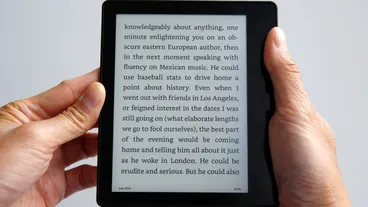
The Death of Print Doesn't Have to Mean the Death of Publishing
In a world of social networks, video games and mobile handsets that do everything imaginable, Americans have maintained their interest in reading.
Do you feel strongly enough about the impact of what you have to say that you can live with cutting down trees to make your book?
Everyone's clamoring about the rise of the Indie author. Couple that with blended printing and distribution channels and you've got a recipe for Indie author world domination...maybe.
As of December 7, short stories by Christopher Buckley, Edna O'Brien (and by January Curtis Sittenfeld, and presumably many others) are available on Kindle, courtesy of a deal with the Atlantic Monthly.
The hi-tech campaign to relocate books to Google and replace books with Kindles is, in its essence, a deportation of the literary culture to a kind of easily monitored concentration camp of ideas.
Publishers should trust customers. Most people are honest and well-intentioned. Let's educate them about their social obligation to financially support the author, publisher and retailer who helped bring them this book.
As Marshall McLuhan said, new media generally do not replace old media. For example, radio remained important even after television came to dominance...So, after we have networked digital books, will books be as ubiquitous and culturally important as radio?
Writers are artists, and artists are compelled to express themselves, even if only to an audience of one.
With an e-book, you can deface the reading area to your heart's content and then simply wipe the viewing screen clean with a damp cloth.
"Level 26: Dark Origins" is the first of it's kind, but it's just the beginning of a whole new species of hybrid books that may change the publishing landscape.
In the same way that iTunes liberated songs from the album format, books will no longer be solely linear.
Book publishing is not dying, it's evolving. How much energy and money can we save if we stop publishing hardcovers?
As we head at a fast clip into an unimaginable future, we need to keep a clear vision and a firm grip on what had meaning in the past. The desire to shape and share our stories is embedded in our DNA.
Just as many entrepreneurs no longer need venture capitalists to launch their companies, authors no longer need publishers to publish.
To truly open the future of books and reading, consumers must be freed from proprietary devices and formats. We owe it to those who came before us to bring access to as many as possible.
Suppose a well-stocked national digital library system existed for Americans of different ages, along with the means to encourage schoolchildren and others to use it.
2009 will go down in history as the year e-books went mainstream.
The day has come for publishers to offer a $4.00 book. Most books are too expensive. Compared to lower cost alternative media sources, books are becoming niche consumables like caviar.
By marketing the Kindle to me -- i.e. 'adults' who already read regularly -- publishing is merely doubling down on the biggest problem facing the industry: not enough people read books.
Self-publishing" doesn't cut it as a description of what "independent" book making will look like in the coming years. It's too limiting, and doesn't get anywhere near the exciting vision of a new, parallel, model for publishing as a whole.
According to the publishing industry, 50% of all books will be sold in eFormat by 2013. People want to know about the changes that are taking place, but don't know where to begin.