Like in Indonesia, the question of military reform in Egypt is complicated by public perception of the police and security forces, who are widely viewed as not only brutal but also incompetent and corrupt.
Egypt's economic policy has been in a virtual holding pattern since the end of last year and the government finds itself in exactly the same situation today as it was nearly six months ago: having to implement tough but unavoidable reforms in the face of deep political division and with elections just around the corner.
With the world's attention riveted on war-torn Syria, far too little attention has been focused on Egypt's economic woes and their long-term implications for the region.
The revolution here is barely two years old, and any visitor to Cairo with an interest in peoples' struggles (like me) will find plenty of opportunities to learn more.
Egyptian authorities have expanded the ban on fans attending matches to include international as well as domestic games in a bid to prevent violence that is likely to backfire and spark renewed incidents in a country that is reeling from economic decline.
With the revolution in Egypt, freedom can be misunderstood. Locals are learning that on a busy urban street, unbridled freedom can become a straitjacket for all.
It would be easy to blame the economic woes that now threaten to engulf Egypt on political uncertainty, corruption and bad policies, but in truth, Egypt's troubles have been a long time in the making.
Egypt's judiciary and security forces appear posed to crack down on militant, highly politicized and street battle-hardened soccer fans in a bid to ex...
For supporters of political reform in the Middle East, the contradictory postures of Samira Ibrahim -- the Egyptian feminist activist who publicly shared her hostile views of America, Jews and Israel -- is an opportunity to address prevalent hatreds and intolerance that endure in the "new" Egypt.
The fallout of last year's death of 72 soccer fans in a politically-loaded stadium brawl has brought the need for reform of Egypt's Mubarak-era law en...
Post-revolt Arab nations are experiencing tumultuous times. Underlying the volatility in Egypt and Tunisia as well as difficult transitions in Libya and Yemen is the increasing lack of confidence between Islamists and non-Islamist forces.
A series of soccer protests in the past week in anticipation of a ruling in the case of last year's brawl in a Port Said stadium in which 74 fans died has focused attention on the unaltered practices of Mubarak-era security forces as well as President Morsi's fragile relationship with the military.
Military troops are protecting factories and government offices on the ninth day of a general strike in the Suez Canal city of Port Said that has brought together two groups with working class roots.
We in the west know so little about Arab culture, custom and practices. We know about Ramadan. We know about governments in power. We know about Arab history -- to a point and clearly not enough. We understand that we need to know more.
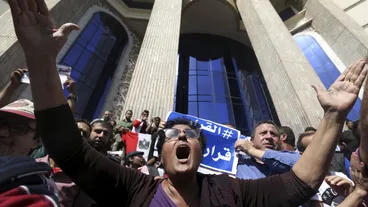
The two-year anniversary of Egypt's revolution has not been a happy one. Anti-government protests have once again swept through the country, and as activists have begun to resort to violence, President Mohamed Morsi has chosen to respond in kind.
The great dilemma facing Egypt today is not whether the Morsi government or democratic rule can long survive; it is whether Egypt itself can long survive.