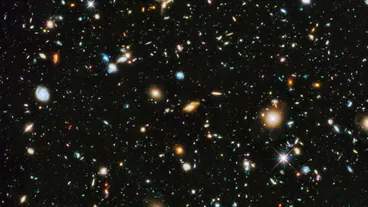
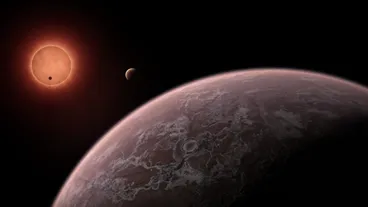
It seems that the frequency of planets able to support life is roughly one percent. In other words, a billion or more such worlds exist in our galaxy alone. That's a lot of acreage, and it takes industrial-strength credulity to believe it's all bleakly barren.
News reports on the discovery of "habitable" planets are highly misleading. What scientists define as habitable just means that conditions may exist that are adequate for life based on carbon chemistry, such as the generic type of life we have on Earth.
Imagine a world where the Sun doesn't shine -- ever. A place where there are nights but no days, and where the term "year" has no meaning. On such an unlit world, you'll never see anything in the sky brighter than the puny sparkle of the stars.
The question become particularly intriguing when we realize that astronomers now estimate that the Milky Way galaxy alone may harbor as many as 4.5 billion Earth-sized planets in the "habitable zones" around their host stars.
The paucity of impact-making announcements by female astronomers in general is dreadful. How can it be, that well over a century after the first women received PhDs in astronomy, women have failed to match their male peers in this and other aspects of STEM academia?
News like this -- that the galaxy is bristling with potential broadcast platforms -- will only embolden these go-go pioneers. Hand them 160 billion planets and what will they say? What they've been saying all along: They just have to be out there -- meaning them.
The last few years have been heady for planet hunters. First the hot Jupiters; then the will-o'-the-wisp Glieslings and their cousins; and the results from the Kepler mission, one of which is Kepler-22b.
After a starquake, says NASA's Dr. Jon Jenkins, "stars actually change their shape. This shape change causes an apparent change in brightness. As we study the brightness variations in time, we can essentially hear the songs of the stars."
Gliese 581 may be small as stars go, but it looms huge in the vision field of planetfinders.
The type of multiple-planet solar system we live in isn't oddball at all, but is as humdrum as hairpins. That would, of course, be good news for those who hope to find extraterrestrial life.
Planet hunting is an extremely demanding venture as opposed to mapping the stars. Planets are buried in the cosmic ocean filled by the waves of star light.
The Hubble Telescope Found Organic Gas on an Extrasolar Planet: I don't know whether or not this distant planet has life or not but, you know what they say, where there's organic gas, there's butt sex.