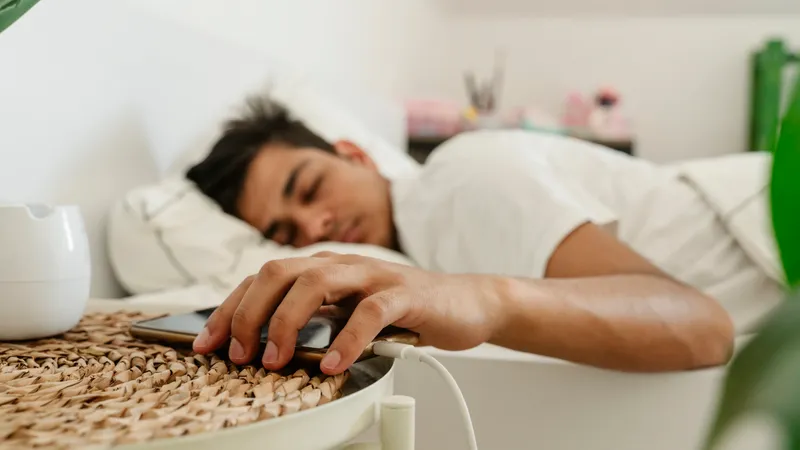
When you're experiencing stress, your impulse might be to power through, freak out, or stick your head in the sand. Bad habits such as overworking, smoking, or overeating can perpetuate the stress reaction. Here are some healthy tips on how to manage your stress before it manages you.
I'm noticing that my friends mean more to me than they ever did. My children are now my best friends. My husband is still the love of my life. My dogs make me laugh on even the worst day.
There's more news about complications that can arise from prescription sleep medication: Side effects from a common prescription sleep aid are sending increasing numbers of people to emergency departments.
Allow your dream journal to be a bridge to connect your nocturnal dreams with your real life... and ultimately with the life of your dreams.
This is the latest in a series of research breakthroughs that suggest melatonin plays an important role in metabolic functions and risk of diabetes.
Are you busy right now? Are you already behind on what you wanted to accomplish today? Or this week? Or this year? Are you hoping this will be a short post so you can get back to the million things on your to-do list that are breathing down your neck? Okay, I'll get on with it: Our culture is obsessed with time. This is our real deficit crisis, and one that, unlike the more commonly discussed deficit, is actually getting worse. In fact, researchers have given this crisis a name: "time famine." And feeling like you're experiencing a time famine has very real consequences, including increased stress and diminished satisfaction with your life. On the flip side, one can enjoy "time affluence," the feeling of having enough time, or even a surplus of time. So how about redefining success to include a third metric, beyond money and power -- time affluence, which will lead, without doubt, to greater well-being and deeper wisdom.
In general, restless legs syndrome (RLS) is not described as a painful condition. Rather it is often referred to as a "creepy-crawly" sensation, achiness, "unscratchable itch," "unpleasant tickle," "feeling of unrest," or "ants in the pants."
Can we do something to reverse the fear epidemic? Yes, we have two choices: either to remain at the mercy of our fears or to take control of our fears. Choosing to manage our fears is far easier than you might think.
On a scale of 1-10, how would you rate your bedroom as a sleep-friendly environment? Have you created a sacred space exclusively used for sleep, sex and self-care? If not, here are some practical tips I've learned to turn your sleep space into the sacred space of your dreams.
There's nothing quite as refreshing as a great night's sleep to help us recover from our day and restore our energy. When children have trouble sleeping, it impacts not only their sleep (and mood), but their weary parents'.
Teenagers in particular may be at risk of chronic partial sleep deprivation due to changes that occur in sleep as they go through puberty. Teenagers need to sleep about nine hours, and as they get older, they tend to sleep less.
The next time you feel your eyelids starting to droop, consider a power nap before reaching for more coffee. While it won't make up for a sleepless night, a nap can be the perfect prescription for late-afternoon fatigue.
We all know exercise is good for us. Good for our health, good for our waistlines, good for stress and for our clarity of mind. Exercise is also very -- very -- good for sleep.
The professional sports world appears to be continuing to turn more of its attention to what has been a much-overlooked issue: sleep. This time, it's the National Hockey League that is addressing sleep problems on several fronts.
Aromatherapy is one of the many enjoyable, safe and natural ways to relax your body for a good night's sleep. Rub a few drops of essential lavender oil on your feet before going to sleep.
#mc_embed_signup{background:#fff; clear:left; font:14px...
As a self-confessed nocturnal who can blame it on genetics, I proudly declare my solace from the quiet of the night. I love hearing the whir of the refrigerator in the kitchen and the hoot of the barn owl in our fields.
A 15-year-old boy came to the Stanford Sleep Center complaining of episodes of excessive sleepiness associated with disturbed behavior that started one year prior.
When you nestle yourself into bed, turn off the bedside lamp and close your eyes to your daytime reality, your "conscious self" goes to sleep. Meanwhile, your "dreaming self" slips out of the covers and tiptoes upstairs to the attic of your mind to explore the enchanted realm of dreams.