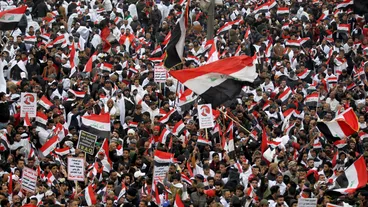
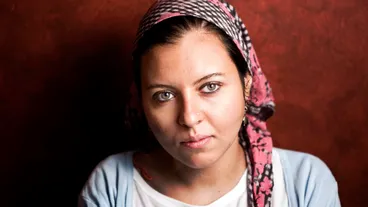
It has now been a year since the post-uprising period of the revolution began and the revolutionaries must take a good look at themselves. They do have an incredible amount to give to Egypt, but there are some lessons that must be learnt once and for all.
In this installment of Faith Complex, we interview journalist, feminist and Muslim activist Asra Nomani about the "Blue Bra Revolution," which was triggered by a YouTube video.
A few protest tents remain in the square but will they keep waiting there? Most protesters have gone home. However in their homes it seems many are waiting and certainly hoping for a better, freer and just Egypt.
In her new series, Sherin Guirguis draws inspiration from a photograph of Cairo during the recent Egyptian revolution.
While workers are consumed with immediate problems of economic instability and unemployment, labor activists struggle to find unity as organizations jostle for representation in the fractious post-Mubarak political landscape.
At some point in the future, Israel must make an effort to become an accepted resident of its own neighborhood, and a Syrian intervention would be the most logical place to start.
Almost exactly 100 years ago President Theodore Roosevelt spoke to the General Assembly of Cairo University. Egypt was then, as it is today, in political turmoil.
You wouldn't think handling a notebook or a camera could be a hazardous line of work. But according to the latest global Press Freedom Index, abuse and oppression of reporters has made journalism an increasingly risky job in many countries.
How can a functional democracy, one in which all people have a voice and the ability to influence and advocate on behalf of their interests, be implemented when women, an important part of this revolution and country, are being silenced in despicable ways?
Anyone rooting for Egyptians and the progress of their revolution was up against a nerve-racking week of news and analysis surrounding the one-year anniversary of the first coordinated protests at Tahrir Square.
I had been invited by the Ambassador, an invitation extended to the Egyptian American community, to a reception to celebrate the first anniversary of the 25th of January Egyptian Revolution.
The Egyptian peoples' revolution that began a year ago today must not be allowed to be hijacked by the military. The Egyptians, more than ever, need the support of the international community during this critical period, to achieve their goals.
A year after Egypt's feisty uprising challenged decades of autocratic rule, the most striking thing about the protesters still at Cairo's Tahrir Square is the plethora of eye-patches.
In recent months, a dynamic has emerged in Cairo where anti-SCAF protesters flock to their symbolic home, Tahrir, while pro-SCAF Egyptians fill up a square in the working class neighborhood of Abbasiya.
The United States and its allies, especially Israel, must accept the fact that in the wake of the Arab Spring, Islamic governments are likely to dominate the Arab political landscape.
This time may yet be remembered as India's own spring. If it fails to happen, then it really will take a Tahrir Square to shake up the establishment and deliver meaningful change to the Indian people.