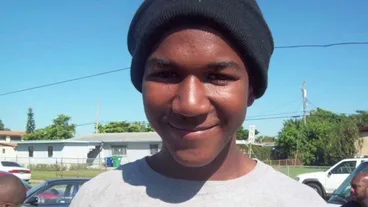
"Get over it and move on" is the most ridiculous of positions. Racism is not some tragic event to get over; it's the ongoing tragedy of cumulative experiences that shape how one sees the world.
It honors it more truthfully -- putting the experience of the people there above the experience of the flag. And, just as important, if we practice grieving the right thing, perhaps we'll learn to have the political will to do what we need to do to say "no" to violence of all stripes.
A giant portrait of Frederick Douglass stared down at the audience of about three hundred high school students who gathered in the Hofstra University student center to commemorate the 150th anniversary of the Emancipation Proclamation.
Prejudice can kill. George Zimmerman saw a young black male wearing a hoodie, and made a decision that reflected the dictionary definition of prejudi...
The belief that male "black teens" are inherently more likely to be criminals is ingrained in our society. It has seeped into our institutions in the form of racial profiling, and too often it poisons the judgment of those who are supposed to protect us.
In the early 1990s a small band of steel-booted, shiny-headed thugs decided it would be great sport to beat up pedestrians in San Diego's Hillcrest neighborhood, home to many of the city's gay and lesbian residents and business owners.
The state that was exhibit A for economic disaster two years ago is now experiencing a tremendous rebound thanks to Gov. Rick Scott's pro-growth policies. Washington should take a page -- no, several pages -- out of Scott's book.
I need to help him deconstruct the many mixed messages that abound about the black male as constructed through the white gaze -- in popular culture, in the media and in real life.
This week I spoke to City Council Member Robert Jackson on education funding in NY and the recent lawsuit to restore $250 million to the city school b...
In Till's day, a black person's "place" was in the field or in the back of the bus. If a black man was found "out of his place," he could be jailed or lynched. In Martin's day -- in our day -- a black person's "place" is in the ghetto. If he is found "out of his place," he may be treated with suspicion, frisked, arrested -- or worse.
For much of 2012 (and 2011 for that matter), we witnessed some of the most egregious efforts to disenfranchise minority, elderly, student and poor voters all across this country.
As Trayvon Martin's death comes back into the national consciousness, we should be mindful of the devastating potential of centuries of brainwashing, especially when combined with gun violence.
No matter how "rough and tough" I behaved on the mean streets of the nation's capital, I took solace in knowing that I'd be safe and sound in my Florida home. Until Trayvon Martin died.
The "post-racial America" is a fantasy land that doesn't exist. I want my son to grow up to be proud of his race and his culture as every child of any race should. Unfortunately, far too often, the connotation that the world has for the term "black" is not always a positive one.
While there are troubling undertones of racial suspicion and fear in Trayvon Martin's killing which must be addressed as justice is sought, the fact is that most Black young people murdered by guns are killed by Black shooters -- just as most White children and teens murdered by guns are killed by White shooters. Sadly the tragedies of Tucson, Aurora, Newtown and elsewhere made clear that none of us are safe anywhere or immune to the pervasive threat of gun violence. We are all in the same boat and must act together to stop the plague of violence. Gun safety laws that only apply in one city or state can't fully stop our national epidemic of gun proliferation and violence any better than we can stop a flu epidemic by vaccinating one family.
Political Director to Russell Simmons and co-president of GlobalGrind.com Michael Skolnik recently spoke with us about gun violence in America. After...