
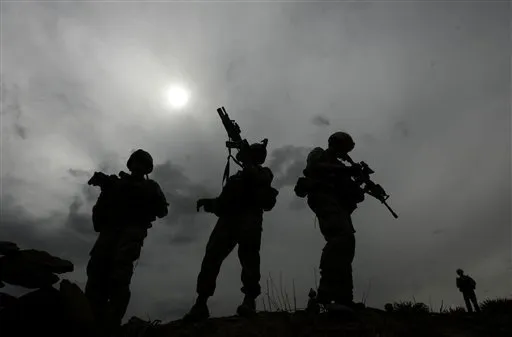
Watch the U.S. media and its coverage of the crisis in Haiti, and you get the impression that Washington is a benevolent power doing its utmost to help with emergency relief in the Caribbean island nation. But tune into al-Jazeera English or South American news network Telesur and you come away with a very different view. I was particularly struck by one hard hitting al-Jazeera report posted on You Tube which serves as a fitting antidote to the usual mainstream fare. The report is highly critical of the U.S., which according to the reporter has focused most of its energy on fostering stability and putting boots on the ground as opposed to rebuilding Haitian society.
It's not the first time that al-Jazeera has taken on the U.S. military. Indeed, the network fell afoul of American authorities as long as seven years ago during the invasion of Iraq. A news organization comprised of many editors, journalists, presenters and technical staff who had formerly worked with the BBC in London, al-Jazeera broadcast shockingly graphic pictures of dead and captured American soldiers.
When the network aired footage of the captured U.S. soldiers, then Defense Secretary Donald Rumsfeld accused al-Jazeera of violating the Geneva conventions. The network, however, was unrepentant. "Look who's talking about international law and regulations," said spokesperson Jihad Ballout. "We didn't make the pictures -- the pictures are there. It's a facet of the war. Our duty is to show the war from all angles," he added.
Yosri Fouda, al-Jazeera's bureau chief in London, chimed in. "I can see why American and British politicians and military leaders don't like us showing these pictures," he marked. "They show a side of the war that they don't want projected because it may affect public opinion in their country negatively. In these things, the western media is highly sanitized. You are not seeing what war, this war, is actually like."
During the short-lived war, al-Jazeera had correspondents posted around Iraq. While the U.S. mainstream media encouraged its own narrative of advancing and triumphant coalition forces, al-Jazeera broadcast horrific images of Iraqi victims of coalition bombing campaigns. One showed the head of a young child that had been split apart, reportedly in a coalition assault on Basra.
Perhaps, the U.S. military was literally gunning for al-Jazeera as a result of the network's controversial news coverage. During an American air raid and artillery barrage on Baghdad, U.S. forces killed at least one journalist including an al-Jazeera correspondent, Tariq Ayoub. The building was hit by two air-to-surface missiles. At the time, the reporter was standing on the roof of al-Jazeera's station doing a live broadcast.
U.S. military officials said they regretted the deaths of the journalists and claimed they did not know every place that journalists were operating. Al-Jazeera, however, declared that it had previously informed the Pentagon of the location of its Baghdad office. In fact, in a letter to the Pentagon, the Middle Eastern network gave the exact coordinates of its building.
It wasn't the first time that al-Jazeera had suffered at the hands of the U.S. military. During the invasion of Afghanistan, the network's Kabul office was destroyed by U.S. "smart" bombs two hours before the Northern Alliance took over the city. According to one report, President Bush may have even suggested that al-Jazeera offices in Qatar be bombed during a meeting with then Prime Minister Tony Blair.
Though al-Jazeera provided critical coverage of the U.S. military, the network has never become a mouthpiece for Arab regimes in the Middle East. Even as many Arabic TV stations (including Iraq's before the invasion) referred to the U.S. military as "forces of aggression," al-Jazeera opted for "invading forces." What's more, al-Jazeera conducted long interviews with Tony Blair, Condoleezza Rice, Donald Rumsfeld and even Ariel Sharon.
In addition, the network has gotten on the wrong side of several Arab governments and reporters have been banned or harassed in Egypt, Kuwait, Jordan and the Palestinian Authority. Al-Jazeera was criticized by Saudi Arabia and Bahrain reportedly accused the network of being pro-Zionist. As a result of the network's impartiality and independence, many Arabs have become subscribers as they believe al-Jazeera sees the world as they do.
In the wake of the tragedy in Haiti, al-Jazeera is now bringing its critical coverage to bear in the Caribbean. While the U.S. military operating in the island nation may not like it, commanders will have to put up with the same kind of close media scrutiny they were placed under in the Middle East. For the U.S. military however, the headache now runs deeper. In addition to al-Jazeera, commanders must now contend with Venezuelan media and Telesur.
Like al-Jazeera, which receives state funding from Qatar's government, Telesur or "Television of the South" also receives government support, specifically from leftist Latin American and Caribbean governments including Venezuela, Cuba, Argentina, Bolivia, Ecuador and Nicaragua. And, similarly to al-Jazeera, Telesur is a media enterprise designed to compete with traditional U.S. outlets such as CNN.
When Venezuelan president Hugo Chavez helped to found Telesur in 2005 as an affiliate of state TV Venezolana de Television, U.S. conservatives grew concerned. Connie Mack, a Republican Congressman from Florida, remarked that the new network was "patterned after al-Jazeera," and threatened to spread anti-U.S. ideas across Latin America.
When Telesur announced a content-sharing agreement with al-Jazeera in 2006, Mack went ballistic and declared that the decision was designed to create a "global television network for terrorists." Adding to conservatives' ire, Telesur signed an agreement with al-Jazeera whereby Latin personnel would receive training at the hands of the Middle Eastern network.
If al-Jazeera's trial by fire was Iraq, the crucial test for Telesur was Honduras in 2009. In the wake of the right wing coup d'etat which deposed democratically elected president Jose Manuel Zelaya, the Honduran army cut off Telesur's local broadcasts. However, the network's signal was still available on the internet and a local radio station occasionally picked up Telesur audio.
Adriana Sivori, Telesur's correspondent in Tegucigalpa, was in her hotel room speaking on the telephone to her network when 10 soldiers arrived with rifles drawn. The men unplugged Telesur's editing equipment in an effort to halt the network's coverage of protests in support of ousted president Zelaya.
When a soldier lightly slapped Sivori's hand so she would hang up, the journalist grew alarmed. "They're taking us prisoner at gunpoint," she remarked. Sivori, along with producer Maria Jose Diaz and cameraman Larry Sanchez, were taken to an immigration office in a military caravan. There, the authorities beat them and demanded to see their Honduran visas.
Shortly later, the journalists were released and the authorities warned Telesur journalists to cease transmitting images in support of Zelaya or face further detention. Defiantly however, Telesur continued to throw a lot of resources at the Honduras story. Indeed, at times during the first week after the coup Telesur was the only channel with a live feed. In a media scoop, Telesur even broadcast a live telephone interview with Zelaya from his Venezuelan plane when the ousted leader attempted to return to Tegucigalpa.
To be sure, Telesur's visibility increased as a result of its ground breaking Honduras coverage. However, what has given Telesur most credibility is the station's willingness to take on other controversial topics, some of which have rattled left-leaning South American governments. One of those issues is Haiti.
Like al-Jazeera, which has pursued independent journalism in the Middle East, Telesur went into Haiti and took a no-holds-barred approach. According to station manager Aram Aharonian, who I interviewed for my book Revolution! South America and the Rise of the New Left (Palgrave-Macmillan, 2008), Telesur's Haiti coverage proved controversial with the Chilean, Argentine, and Uruguayan governments.
One of the first stories that Telesur broadcast from the island nation concerned MINUSTAH, the United Nations' Stabilization Mission in Haiti. In the report, Haitians said that Latin American peace keeping soldiers deployed to Haiti were repressing the people.
Now, in the wake of the earthquake in Haiti, Telesur has joined al-Jazeera in providing critical coverage of events. Moving on from the MINUSTAH mission, Telesur has focused in laser-like on United States' misplaced priorities in the Caribbean island nation. While most Americans watch the mainstream media and bask in a wave of self-congratulation, Telesur has painted a darker picture of the U.S. response.
In one report for example, Telesur focused on U.S. policy towards Haitian migrants. According to the story, U.S. officials have drawn up plans to house the migrants at the U.S. naval base in Guantanamo instead of transferring them to the United States. Meanwhile, U.S. naval vessels including aircraft carrier USS Carl Vinson are prepared to intercept Haitian boats and repatriate the desperately needy if necessary.
In another story, Telesur reported on European Union unhappiness about the U.S. relief effort in Haiti. According to the report, the EU seeks more relief coordination and less of a foreign military presence in Haiti. Reed Lindsay, Telesur's correspondent in Haiti, remarks that it is the U.S. military which decides who goes in and out of the Port-au-Prince airport and what kinds of humanitarian aid gets through. According to Telesur reports, EU concerns are echoed by many Latin American governments who fear that the U.S. is using the crisis in Haiti to launch a military occupation.
Could the U.S. military be running out of patience with foreign media reporting, which has proven much less deferential to Washington when it comes to Haiti coverage? One recent report by Cuba's Prensa Latina is worth noting. According to the story, U.S. marines recently barred Venezolana de Television journalists from entering Haitian hospitals. At Haiti's central hospital, Haitians seeking to help their loved ones inside were reportedly mistreated. Those who tried to bring water and food to their relatives were unable to enter the hospital, as the marines stopped them from entering the facilities.
Al-Jazeera has always proven to be a thorn in the side of the U.S. military. Now, Washington must also contend with rising star, Telesur. In the coming days, as the relief effort proceeds in Haiti, relations between the Pentagon and these new media outlets could prove testy.
Nikolas Kozloff is the author of Revolution! South America and the Rise of the New Left (Palgrave-Macmillan, 2008). Visit his blog here.