
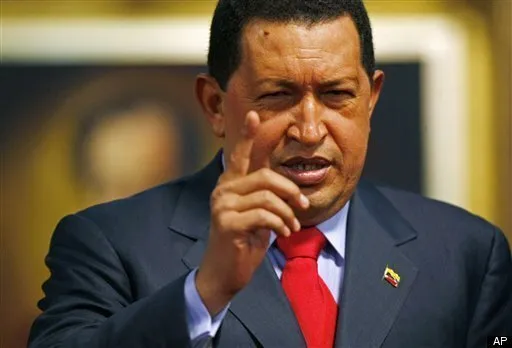
As more and more WikiLeaks cables are released, a true cloak and dagger picture of U.S. foreign policy is emerging. Take, for example, recent documents pertaining to Central America, where the Bush administration sought to bolster its regional allies in an effort to counteract the political influence of Venezuela. Alarmed by rising star Hugo Chávez, who was fast making ideological inroads within Washington's traditional sphere of influence, diplomats promised to collaborate on sensitive intelligence gathering in an effort to halt the region's dangerous shift to the left.
One cable dates to November, 2004 when the region's so-called "Pink Tide" was just getting underway. For five years, Chávez had been in power but in Central America the Bush administration could count on the support of a host of friendly client governments. Indeed, it would not be until several years later that leftists Daniel Ortega, Mauricio Funes and Manuel Zelaya would win the presidencies of Nicaragua, El Salvador and Honduras, respectively. Nevertheless, judging from the cables regional governments were already extremely wary of Chávez.
The tiny Central American nation of Costa Rica has long prided itself on its political independence and long-term stability. The country has no standing army, and during the height of U.S. counter-insurgency involvement in the region some twenty five years ago the San José government played a key role in drawing up a Central American peace plan. More often than not, however, Costa Rica has proven to be a willing partner in Washington's wider geopolitical designs. Indeed, the 2004 cable reveals intelligence collaboration at the highest levels.
Chávez and Washington Spar in Central America
The cable, which is marked "secret" relates to a meeting between former Costa Rican president Abel Pacheco and U.S. ambassador to Brazil John Danilovich. During a Pacheco visit to Brasilia, the Costa Rican made a point of dining with the American diplomat. Elected in 2002, conservative Pacheco had ingratiated himself in Washington by pushing free-market reforms. Confiding in Danilovich, the Costa Rican remarked that he was concerned about Hugo Chávez's intelligence gathering activities in Central America. According to Danilovich, the Costa Rican government was "surveilling the activities of the Venezuelan cultural attaché in San José."
The attaché was believed to be an intelligence officer who was "meeting secretly with labor union officials, and has brought 200,000 USD into Costa Rica to pay labor activists to stage 'provocations,' perhaps during the upcoming Ibero-American summit in Costa Rica." The summit, which would bring many important hemispheric leaders to Costa Rica, would shortly take place in San José. Alarmed by alleged Venezuelan spying, Pacheco asked Danilovich if the U.S. could provide needed intelligence on the matter. Though the cable does not elaborate on wider U.S.-Costa Rican political ties and likely joint intelligence operations, the document states that Danilovich promised to refer Pacheco's request to higher authorities.
In the event, Pacecho needn't have worried about being upstaged at the Ibero-American summit. Just days before the San José meeting, a terrorist attack resulted in the untimely death of Venezuelan prosecutor Danilo Anderson, an official who had been actively investigating opposition figures involved in an April, 2002 coup attempt which briefly unseated Chávez from power. In a communiqué, the Venezuelan government announced that the Anderson case "was not isolated" as Caracas had already withstood numerous efforts aimed at destabilizing the government. As a result of the Anderson attack and rising instability, Chávez cancelled his visit to Costa Rica.
What's Behind the Cable? The Danilovich cable, though brief, raises a number of questions about Costa Rica and the country's place within the wider geopolitical milieu. Though it may seem surprising that San José would be involved in such high-level cloak and dagger diplomacy, trouble had been brewing between Costa Rica and Venezuela for some time. Far from acting as a casual observer, Costa Rica took a keen interest in political developments in Venezuela and may have sided with anti-Chávez forces.
In 2002-3, Chávez was put on the defensive, first by a military coup d'etat which nearly toppled the government and later by a 63-day lock out which nearly crippled the nation's oil industry and caused severe economic damage. A key figure during the lockout was Carlos Ortega, president of the the country's largest labor union, the Venezuelan Workers' Confederation or CTV. When authorities called for Ortega's arrest, charging him with rebellion, conspiracy, treason and inciting delinquency, the union man sought refuge in the Costa Rican embassy in Caracas.
Though officials allowed for Ortega's safe passage out of Venezuela, several months later Chávez ratcheted up the rhetoric by accusing Ortega and Costa Rica of conspiring against his government. As proof of his allegations, Chávez offered up tapes of a supposed telephone conversation between Ortega and Venezuelan opposition figures in which plans for a "civil rebellion" were discussed. On his radio show, Aló, Presidente!, Chávez claimed that Costa Rica was "supporting the presence in San José of these coup plotters, giving them support, security and resources."
Responding to the incendiary charges, Pacheco denied that any members of his government had conspired against Venezuela. "I can assure Chávez that the policy of the Costa Rican government is non-intervention in the internal affairs of any country," Pacheco remarked. Throughout its history, the Costa Rican added, Costa Rica had welcomed foreign exiles but only under the strict condition that they would abstain from subversive political activities relating to their countries of origin. Chávez, however, was unconvinced by Pacheco's public diplomacy and hinted that Venezuela might stop selling oil to Costa Rica at preferential rates if the San José government failed to clamp down on political conspiracies designed to unseat him from power.
Costa Rica: Not So Neutral?
In light of Chávez's volatile accusations, it is not surprising that Costa Rica felt paranoid about Venezuelan intelligence operations and sought out Washington's counsel. WikiLeaks cables hint at this ongoing spying which took place against a backdrop of barely concealed tensions. By 2005, now two years after the Ortega affair, Chávez was in a much better political position. Having beaten back his opposition, the Venezuelan president was now something of a leftist cause célèbre and had extended his geopolitical influence throughout the region.
As a more conservative-leaning country, Costa Rica was now embroiled in wider political tensions sweeping through Latin America. Seeking to portray himself as something of a neutral peacemaker, Pacheco tried to mediate between Mexico and Venezuela during a diplomatic spat. Blasting Mexico, Chávez had earlier called President Vicente Fox "a puppy dog" of the United States. The Mexican leader, Chávez added, was given to "kneeling down" before Washington. Looking macho before the television cameras, Chávez intoned "don't mess with me, mister."
As both countries withdrew their respective ambassadors, Pacheco called for both Fox and Chávez to be civil. Taking the moral high ground, Pacheco declared that it was hardly a propitious moment for the two leaders to divide Latin America, adding that Chávez and Fox should give each other a "fraternal hug." A couple of months later, Pacheco was at it again, calling for Chávez and Bush to sit down and to try to "understand each other." The Costa Rican was prompted to intervene after Chávez said the world opposed Bush and Washington's "imperialist and genocidal war in Iraq." A voice of reason in the middle of ideological extremes, Pacheco asked plaintively "who benefits from this fight?"
In more recent years Costa Rica has, if anything, become even more allied to Washington. In May, 2006 Óscar Arias succeeded Pacheco as president. A veritable grandfather of Costa Rican politics, Arias proved to be no great admirer of Fidel Castro or Hugo Chávez. In the summer of 2009, when Honduran President and Chávez ally Manuel Zelaya was removed in a military coup d'etat and a new de facto regime installed, tensions ran high between Venezuela and Costa Rica. When Arias attempted to mediate the Honduran imbroglio, Chávez charged that the Costa Rican president was attempting to set a crafty trap. The de facto coup government in Tegucigalpa, Chávez declared, should never have been granted recognition or invited to the negotiation table in the first place.
As more leftist governments have taken power in Central America, Costa Rica has made some controversial political choices. Laura Chinchilla, an Arias protégé who took over the reins of power in 2010, has invited the U.S. Navy to deploy to Costa Rican waters, an unprecedented buildup which goes against the small Central American nation's anti-militarist history. With Costa Rica pursuing closer ties to Washington, the country's reputation as a neutral mediator has come into doubt. Just how much intelligence collaboration existed between San José and successive U.S. administrations? Did Costa Rica undertake specific moves to halt Chávez's geopolitical advance in Central America? Hopefully, further WikiLeaks disclosures will give us insight into these matters.Nikolas Kozloff is the author of Revolution! South America and the Rise of the New Left (Palgrave, 2008) and No Rain in the Amazon: How South America's Climate Change Affects the Entire Planet (Palgrave, 2010). Visit his website, www.nikolaskozloff.com.