By Damiano Beltrami
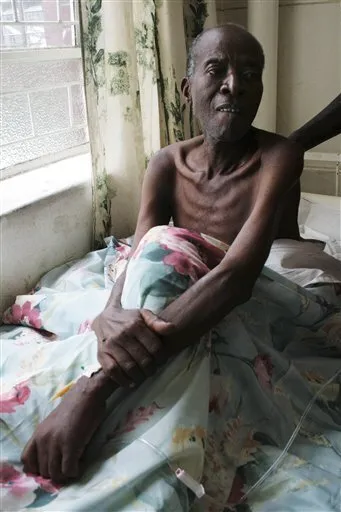
When the American doctor Richard Sollom went into a Zimbabwean hospital outside of the capital city Harare last December, an auditorium-size room was crammed with patients affected by cholera. A few minutes later, frantically waving his arms a slim man introduced himself.
"Are you looking for a doctor?," he said with a laugh. "There are no doctors here. I am a nurse, I am running the place".
Sollom asked this man -- who wanted to remain anonymous for fear of reprisal -- about supplies, in particular surgical gloves and other protective wear.
"Well, I keep one pair at my house," Sollom reported the nurse as saying. "It was just a proud possession, because there are so few, that he kept his one pair of latex gloves in his home. The only thing they had well stocked in his hospital was condoms."
The ferocious cholera epidemic, spread by water contaminated with human excrement, has killed more than 4,000 people across Zimbabwe since last August. But according to experts like Sollom, a doctor of an emergency delegation sent to Zimbabwe by the medical non-profit organization Physicians for Human Rights, this is the symptom of a worse illness, the collapse of a long-admired health system that only a few years ago was regarded as one of the most efficient in Africa.
The Physicians for Human Rights report spells out that the most basic functions of a government - clean water, sanitation and health care delivery - have collapsed in Zimbabwe. Hospitals are shutting down, like the organs of a dehydrated cholera victim. The health system had been spiraling downward for a decade, but it has deteriorated alarmingly since President Robert Mugabe's defeat in the 2008 presidential elections. Morgan Tsvangirai, leader of the Movement for Democratic Change, won the majority vote, but was pulled out of the subsequent runoff vote because of violence against his supporters.
"Public health clinics are quite dilapidated," said Sollom at a recent UN press conference in New York. "There is no electricity, no clean water, no supplies."
In addition to the widely reported cholera epidemic, the report highlights increases in maternal mortality, growing malnutrition, unchecked tuberculosis, outbreaks of anthrax and, above all, disruption in HIV/AIDS treatment.
According to the report, 400 people die of AIDS every day in Zimbabwe. But now the situation is growing worse for people who have advanced cases of AIDS. They need a combination of drugs -- but because of a breakdown in the country's drug distribution system, the supplies are irregular and people are given whatever is available.
"This is a very dangerous practice," said Prof. Chris Beyrer, director of the Center for Public Heath and Human Rights at the Johns Hopkins Bloomberg School of Public Health. "This way you quickly develop resistance to these drugs; then they don't work for you. But also if you were to transmit that resistant virus to another person, these drugs wouldn't work for them right at the start."
This dynamic undermines any retroviral-drug program and spirals into a larger issue, Professor Beyrer said.
"In the last two years, more than three million Zimbabweans fled the country, and for the most part are now in South Africa, the most AIDS-affected country on the planet," Professor Beyrer added. "In this region, drug-resistant HIV could really be an enormous problem."
What makes the situation worse is that in Zimbabwe few doctors are left. Hospitals run by young nurses are not an exception. They are almost the norm.
"People have left at all levels of society, especially from the educated, leadership levels," said Peter Godwin, a Zimbabwean author who wrote the 2007 book 'When a Crocodile Eats the Sun: A Memoir of Africa'. "A person's level of tolerance is directly related to your ability to leave. So if you've got a medical degree and lots of experience as a doctor and you have a number of job offers on your desk, you got pretty low tolerance for bad government. You don't have to put up with that dysfunction, you have a choice, you can leave."
The collapse of Zimbabwe's health system has created a humanitarian crisisin a country where people are already suffering from a crippling hyperinflation (a percentage of 8 followed by 18 zeros last December) and severe food, fuel and foreign currency shortages.
Morgan Tsvangirai was finally sworn-in as prime minister of a unity government on February 11 -- thanks to a political deal brokered by the South African Development Community -- while the octogenarian President Robert Mugabe maintained the post he had held since independence from Britain in 1980. Since then, however, little has changed.
In a 2008 report, the UN Development Program (UNDP) estimated that about $5 billion would be required to kick-start the economy and consequently rebuild the health system. But an unpleasant reality is dawning on Zimbabwe's inclusive government: Those able to give money for the country's reconstruction just do not have it.
The country's main donors -- the United States and the European Union -- have adopted a wait-and-see approach before releasing any funds for economic reconstruction.