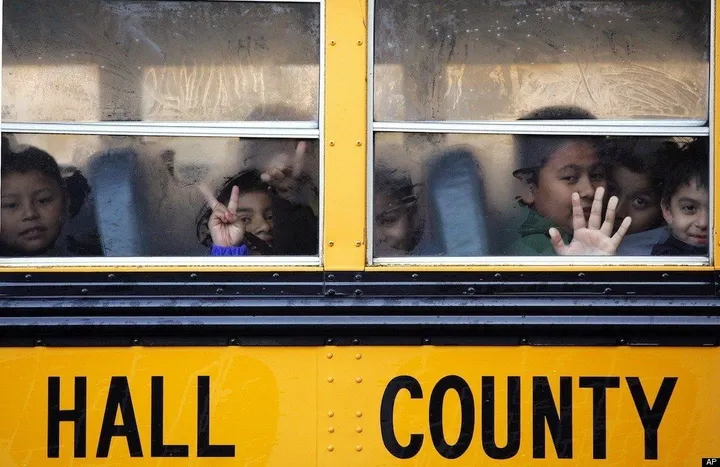
Miguel arrives late, usually, if at all. He brings just himself, not a notebook or pencil. He listens, sometimes closing his eyes or laying his head on his arms. At the end of class, he smiles and says goodbye. He looks like Harry Belafonte.
One day, I ask him what I can do to help him get some work done. Seventh grade can be hard, especially when you should be in ninth. He can raise up the desk with his knees.
"Nothing," he says.
"Let me know," I tell him. "See you tomorrow."
"Maybe."
I decided to teach English this past fall. I am a writer and thought that I could share a little knowledge where it was needed most. I am a loon about words, don't like to see them compromised. I read the dictionary. I could do some good.
So, I took a job at a middle school where about 90 percent of the kids qualify for free breakfast and lunch. That is how "poverty" is calibrated, in pancakes. All but a few students are Hispanic, and most arrive each morning by bus, eight-hour refugees from gangs and drugs and upset. Their mothers, if they are at home, don't let them outside after school. They know whom to avoid, by the color of the bandanas.
Before many of these kids sit in front of my blackboard, they have had a day. They have had 13 years. They are in no shape to learn about pronouns. Write about a time when your family did something funny, I instruct them.
"I can't," one girl whispers in my ear. "My dad does drugs."
"Can you write about that?"
"No."
"A sibling?"
"He sold my phone to buy pills."
I think that Michael Bloomberg could put an air conditioning repair man in the chancellor's seat. Or a neuroscientist. Or, frankly, a university president. It doesn't much matter, and here is why: They do not know Miguel. Or Maria. They are just too far away. They do not know that these kids' survival, right now, is not derived from brilliant test scores or good grades, even. Or, the allocation of money from one place to another.
Today, if my students find their way to Room 146 with some peace, they are a success. If they make it into the building without a security guard hollering at them because their shirts are untucked, they are a success. If an assistant principal doesn't suspend them because their ID cards aren't hanging on their necks, well, it has been a marvelous school experience. If they can forget for 50 minutes that their brothers are in jail for selling cocaine at an elementary school, they are doing okay.
This public school district is not terribly different from other large urban machines, where kids are passed along without proper skills, ex-cops parade detention-goers through the campus like a prison work gang, and poorly paid teachers learn on Tuesday what a flawed curriculum says they need to teach on Wednesday, maybe.
Of course, administrators will have you think the place is Choate Rosemary Hall, what with "Pre-AP" classes (entrance criteria: compatible scheduling, not academic ability) and college posters plastered on corridor walls. Work hard, go to Princeton. Dally amongst the Ivy. Aspiration is good, except when the goal is so utterly unreachable. Then, it is a tease, a reminder that the cycle is not nearly broken, that only 43 percent of students will graduate from high school, that repeat teenage pregnancy in this city is the highest in the country, that kids are not allowed to take home textbooks because the principal believes they won't come back.
In order to fix the schools, as is the common parlance, the Bloombergs and Blacks need to fix the kids. First. But this would require a tectonic shift in philosophy, from penal to uplifting, from frenetic to calm, from dictate to reality. For there to be any hope for true achievement, these kids need to feel safe, respected and secure before prepositional phrases and periodic tables can penetrate their bodies and brains. They need social workers and psychologists in every classroom, and teachers who resist screaming at children even when administrators tell them to. They need longer classes and fewer subjects each day. They need physical exercise, even if they can't afford the $10 for the mandatory check-up. The need hugs and cookies, yes, at 13. They need people to listen when they are told, finally, that their father was killed in a drug deal, not a car crash.
Then, perhaps, they can learn to write a paragraph. Or dream about a place like Princeton.
After three weeks on the job, I am demoted. I wouldn't change failing grades to passing ones, and I asked a few too many questions, I suspect. My 64 students are stripped from me, sent to crowded classrooms, instead. Now I teach 23 kids all day, a few at a time. They feel lucky. The other ones come back to visit in between classes, in a hurry, because Officer Riley's on their heels.
One day, Miguel stops by. "Have you ever seen a dead man?" he asks me, just like that. "I have, with his throat..." he says, slicing his hand cross his neck.
Miguel collapses into a beach chair by the window. He tells me that his father is on the run, that he hasn't seen him for almost a year. He says people drive by his house and yell out the window that they are going to kill him.
"I can't sleep. I have nightmares."
A few weeks later, he visits again. He says his mother is quitting her job so they can move away, far away. He seems relieved. I hope that they actually go.
"Stay inside your house until then," I tell him. "And when you get where you're going, do your work. It will give you your life."
He said he would try.