Fervent debate about the barrier between Mexico and the United States promises to keep enlivening the primary season and the general election to follow. Unless Congressman ("It would end up fencing us in") Paul carries the nomination, such a physical divide is central to all GOP platforms on immigration policy and by extension national defense. Likewise, the Obama administration has kept up work on the fence at what's estimated at $21 million per mile (and that's across the easy bits in geographical terms). Along with accelerated deportations, this administration has been giving way to the more abstract exigencies of a virtual fence in line with the administration's overall drone-driven drift on all military tactics in this era of perpetual terrorist warfare. It has not renounced some pathway towards topographical separation.
The defined threat now is not only the job-seeking Mexicans and their southern neighbors but the potentiality of a gateway for Islamic terrorists to enter the country, aided by sympathetic drug lords. (Why these drug lords would want to help enfeeble the nation that constitutes its insatiable marketplace for illegal drugs is for others to ponder.)
In his 'Danged Fencecampaign ad of 2010, John McCain revealed how much the fence issue appeals to core voters, and how tackling the issue all but ensures a candidate's place in political discourse, even with a growing Latino vote. The recent GOP primary debates prove it, along with stump speeches like Cain's latest I-wasn't -joking-after-all call for a lethal electrified version of it. Stay tuned for more to come.
The estimated $30 billion expense of such a capital commitment for the remaining 1400 mile-stretch fence at a time of debt-spawned cost cutting, combined with the expenses of future maintenance and staff manpower, guarantees a perpetual public burden. The hand of the federal government at its heaviest would spread further across several states historically skeptical of exactly that. With a deteriorating 19th- and 20th-century infrastructure and its evident ties to the overall national well-being, it is a colossal investment in something for which history offers little evidence of lasting results.
Such walls have come to describe weakness, both real and symbolic, followed by lassitude and contempt, (at least in the industrial and post-industrial nation states of the last two centuries.)
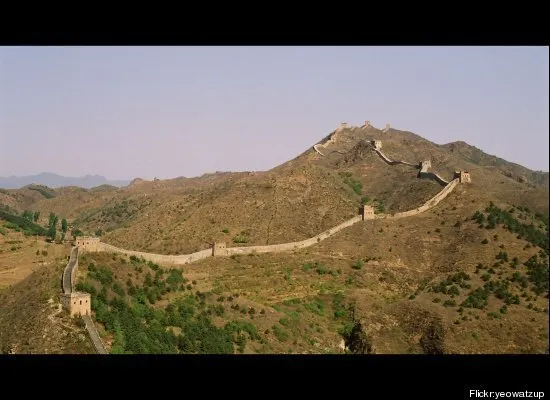
In fact, the whole historic record of ancient walled frontiers takes up little shelf space indeed. In chronological order of construction, there are just a few examples: China's Great Wall, begun in the seventh century BCE and booming in the third century BCE; The Great Wall of Gorgan or Red Snake, probably begun around the same time, and protecting the Sassanian Empire of Northeastern Iran in its stretch from the Caspian Sea to the Pishkamar Mountains; the Classical Roman stone and turf lines at the edges of the Roman Empire between Germania and 2nd century Britannia, most notably in modern evidence at the Walls of Antonine and Hadrian; the Anastasian Wall of the 5th century, dividing Europe from Asia along the frontier of Thrace from the Black Sea to the Marmara Seas; and the Cheolli Jangseong, an 11th-century defensive wall separating vestiges of the then-shifting Korean/Chinese frontier.
And of those, precisely two hold sway in the collective contemporary imagination: Hadrian's, measuring 73 miles, and China's Great, spanning about 4,000 miles. This is, if you are keeping track, about 1,500 miles short of the U.S.-Canadian border, but far greater than the roughly 2,000 miles delineating Mexico form California, Arizona, New Mexico, and Texas. In both cases they were built as military defenses against rival tribes combined in the case of Hadrian of colonizers deciding to call it a territorial day as per logistical and administrative limitations.
And while withstanding the test of time in the long relative sweeps of pre-modern civilization, neither wall was foolproof. The longer they stood, the less effective, until at last they gave way along with those who built them.
The elegant brick-and-stone might associated with the Great Wall was achieved during the Ming Dynasty in the wake of nearly one thousand years of gradual embellishment, caused in part by continual breeching. This is where the issue of ongoing manpower comes in: in China's case, traitors and bribe takers. A wall is as good as those tending it; thanks to a single a turncoat general, the Manchu got through in the mid-17th century and headed for Beijing, where they set up shop for an ensuing three hundred years.
Hadrian's, meanwhile, went up from 122 AD to likely 130 AD, and while it helps with modern tourism and appeals to those who appreciate mankind's great monuments, in its own time historians contend that besides serving as a symbolic expression of imperial might, it probably helped more with the collection of taxes then as an actual defense, especially as commerce was porous and the threat minimal from sparse and fractured northern tribes.
Modern history and its ever-accelerating benchmarks (due in part to barrier-breaking advances in technology and communication) have brought more frontier walls, yet ones enduring less and less time; resulting, without exception, in measures of complacency, rage, and social unrest among those on both sides of the barrier in question.
Their cheap provisional pre-cast ugliness blights the landscape, almost begging people and events to topple them and for history to judge them with ultimate dismay. They don't even look like they're meant to last. And they seem unlikely to do so in generations ahead.
Three examples among several from the last 100 years tell the story: The Maginot Line, the Berlin Wall (the best known stretch of two Cold War-era Germanies' entire Innerdeutsche Grenze, aka The Iron Curtain), and, most recently, the Israel West Bank barrier, conceived by the Israelis to separate the Palestinian people. Two down, one still under way. Two failed, one sowing dissent and resentment in a brutal topographical gash across lands contested since 1967 and 45-years of failed negotiation. The Maginot Line enlivens historian Anthony Kemp's adage "generals always fight the last war, especially if they have won it" and proved a delusional defensive chimera .
The imperial Soviet barriers and its Berlin Wall spelled economic collapse on the backs of deadened souls and became the symbol of polemic victory. "Mr. Gorbachev tear down this wall" made manifest. These walls were for the first time in history built as a prison - a defense against liberating offense or indigenous upheaval. They were a grotesque enlargement of the concentration camp ideal built to lock people in place until they died. From a design perspective, it was form following function in toxic quintessential communion that in historic retrospect foretold its own doom.
In Israel, it is another system of design-free concrete slabs that some fear maintains a Pyrrhic postponement of a true lasting peace; security, temporal might, and tactical determination together runs the inadvertent risk of revealing fear.
Whatever one's view of the U.S.-Mexico border fence, it represents a new purpose for a wall -- one based on economic division between nations bound by a free trade pact. It acts to exclude labor from jobs often unwanted or unacceptable (at least up until 2009), incommensurate with the higher social standards of an indigenous population. It also adds uncertainty to the competitive markets that Americans have come to expect and which in turn drives the consumer economy, aka low-wage labor as a backbone of prosperity for those both with it and aspiring to it. While portrayed as a blockade to public benefit freeloaders, the availability of work running up to the Great Recession is what spawned the illegal immigration that now places the ongoing wall debate in play. While today associated crime adds a more traditional defensive overlay, economics remain the most solid of its foundations.
Before the United States chooses to redouble this expensive capital and operating commitment, it is worth examining this remarkably compact history of wall defenses and to put this clarifying filter to work in judging its prospective merits over time.
Does symbolism spawn efficacy? Even among those most supportive, a look to history with an attendant cost benefit analysis is called for.