
iPhone app iPad app Android phone app Android tablet app More

Featuring fresh takes and real-time analysis from HuffPost's signature lineup of contributors
Paul Stamets

GET UPDATES FROM Paul Stamets
 

Place Mushrooms in Sunlight to Get Your Vitamin D: Part One

Posted: 07/02/2012 9:33 am

Vitamin D is an essential vitamin that boosts the immune system and plays vital roles in human metabolism. Did you know that tasty mushrooms are one source for vitamin D, and that you can naturally multiply their levels by exposing them to sunlight?
2012-06-28-mushrooms1.jpg


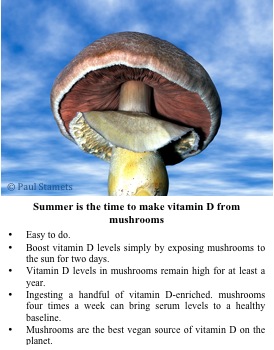
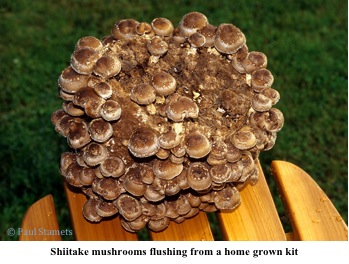
We evolved living in more sunlight than today. We make our own vitamin D when sunlight hits our skin cells. Many people living in the northern hemisphere, however, suffer from lower levels of vitamin D during the fall, winter and spring. Fortunately, you can make your own supply of vitamin D-enriched mushrooms by simply exposing them to sunlight. You can sun-dry or UV-zap store-bought or homegrown shiitake, maitake, button, and many other mushroom species. My personal preference is home grown organic shiitake. The high vitamin D levels generated will last for more than a year. Surprisingly, even sliced and dried mushrooms -- including wild ones picked the year before -- will soar in vitamin D when placed outdoors under the sun. Now, the summer time, from June until September, is the best seasonal window for people in northern latitudes to make vitamin D-enriched mushrooms!

Many physicians view low levels of vitamin D as a serious medical pre-condition. In extreme cases, vitamin D deficiencies can cause diseases such as rickets. Insidious diseases, such as cancer, are immune-mitigated. Without adequate vitamin D levels, your immune system can get impaired. This is why cancer patients are often prescribed high daily doses of vitamin D, up to 4,000-10,000 International Units (IU), compared to the FDA recommended Daily Value (DV) dose of 400 IU for adults over 50 years in age. Please consult your physician before taking such large doses (1 IU is equal to 40 micrograms).

2012-06-28-mushrooms2.jpg


New recommendations from the Institute of Medicine, a branch of the National Academy of Sciences, increase the dosage to 600 IU per day for people up to age 70, and 800 IU for those over 70. Many naturopaths and physicians suggest ingesting at least 1,000 IU/day. A 2012 report in the Journal of Clinical Endocrinology & Metabolism combined the results of eight clinical studies and showed that older people taking 1,000 IU of vitamin D, in combination with 1,000 mg of calcium, for three years had a 7 percent reduced death rate (Rejnmark, 2012). When not ingesting vitamin D mushrooms, and especially when traveling, I take a 1,000 IU wild sockeye salmon vitamin D3/omega-3 product (VitalChoice -- www.vitalchoice.com) several times a week, or daily when I remember.

The commercially-common sources of vitamin D are vitamin D3 (cholecalciferol) that comes from sheep's wool (lanolin), pigskins, and some oily fish (mackerel, sardines, anchovies, herring, trout, and salmon). Mushrooms and animal skins create vitamin D when exposed to sunlight. Mushrooms are rich in the vitamin D precursor ergosterol, which ultraviolet B (between wavelengths of 290 nm to 315 nm) converts to ergocalciferols, also called provitamin D2. Mammal epidermis has cholecalciferol, which ultraviolet light converts to D3.

Which is better, vitamin D3 or D2? The New England Journal of Medicine published an exhaustive article comparing the metabolic pathways of vitamin D2 and vitamin D3 (Holick, 2007). Our enzymes convert both D vitamins into 25-hydroxyvitamin D, and then into the active form of 1,25-dihydroxyvitamin D in our kidneys. This form of vitamin D can bind to receptors in various tissues around the body for use. One advantage of vitamin D3 is its longevity after ingestion -- staying in the bloodstream for weeks compared to days for vitamin D2. However, for people taking vitamin D supplements several times a week, there seems to be no significant advantage in taking one form or the other.
2012-06-28-mushrooms3.jpg


Moreover, eating mushrooms packed with vitamin D2 confers many other health benefits. Mushrooms have many helpful nutrients, including beta glucans for immune enhancement, ergothioneines for antioxidative potentiation, nerve growth stimulators for helping brain function, and antimicrobial compounds for limiting viruses. I will write more about this in the future on The Huffington Post.

While making your own vitamin D3 from sheep or pigskins may be possible, it is rather gruesome and technically difficult. Consuming vitamin D3 from fish is not an option for vegetarians. Vitamin D from mushrooms is not only vegan and vegetarian friendly, but you can prepare your own by exposing mushrooms to the summer sun. Mushrooms grown indoors have very little vitamin D but reserve great potential for hyper-producing it.

Here is a simple experiment we did one summer afternoon in Kamilche Point, Wash. We compared several forms of organically-grown shiitake mushrooms, which had starting levels of 100 IU/100 grams. We compared the vitamin D levels of three sets of mushrooms, all from the same crop. The first was grown and dried indoors. The second set was dried outdoors in the sunlight with their gills facing down. The third set of mushrooms was dried outdoors in the sunlight with their gills facing upward for full sun exposure. The most vitamin D was found in shiitake dried with gills up that were exposed to sunlight for two days, six hours per day. The vitamin D levels in these mushrooms soared from 100 IU/100 grams to nearly 46,000 IU/100 grams (see chart). Their stems, though, produced very little vitamin D, only about 900 IU. Notably, vitamin D levels dropped on the third day, probably due to overexposure to UV.

Most interesting to me is that when we tested our mushrooms nearly a year after exposure, they preserved significant amounts of vitamin D2. I suspect values are much higher initially, gradually falling in time, consistent with reports by other researchers. This means that you can capture vitamin D in mushrooms and have a ready source of this important vitamin -- and delicious mushrooms -- through the fall, winter, and spring.

Part Two coming soon!

For more by Paul Stamets, click here.

For more on natural health, click here.


FOLLOW HEALTHY LIVING
Vitamin D is an essential vitamin that boosts the immune system and plays vital roles in human metabolism. Did you know that tasty mushrooms are one source for vitamin D, and that you can naturally mu...
 
 
  • Comments
  • 33
  • Pending Comments
  • 0
  • View FAQ
Comments are closed for this entry
View All
Favorites
Recency  | 
Popularity
08:18 AM on 07/15/2012
I wrote about Vitamin D and mushrooms in my book Mycophilia and met a few of the scientists who studied the phenomena at the University of Pennsylvania. There is a history of scientific and industrial interest in this subject. Indeed, as many as a dozen American companies are producing or planning to produce Vitamin D enhanced mushroom products, including the California giant, Monterey Mushrooms. Dole, the world’s largest producer and marketer of fresh fruit and vegetables, is now selling whole and sliced portobellos that have been exposed to UV light/simulated sunlight to the full daily nutritional requirement—which won them a Good Housekeeping award as one of the top ten innovative products of 2009. A few sources: “Vitamin D deficiency treated by consuming UVB-irradiated mushrooms” by Andrew Ozzard et al (British Journal of General Practice (2008) 58(554):644-645). “Ultraviolet irradiation increased Vitamin D2 content in edible mushrooms” by Jeng-Leun Mau, Pei-Ru Chen, and Joan-Hwa Yang (Journal of Agricultural and Food Chemistry (1998) 46(12): 5269-5272), “Vitamin D2 formation from post-harvest UV-B treatment of mushrooms (Agaricus bisporus) and retention during storage” by John S. Roberts, A. Telchert, and T.H. McHugh (Journal of Agricultural and Food Chemistry (2008) 56(12): 4541-4544), “Vitamin D2 enrichment in fresh mushrooms using pulsed UV light” by M D Kalaras and Robert B. Beelman (Department of Food Science, Penn State University 2008 http://www.xenoncorp.com/Images/VitaminDEnrichment.pdf)
photo
HUFFPOST SUPER USER
Cyrus Trance
America is not a theocracy.
07:19 PM on 07/06/2012
Just take a vit D3 supplement, they are dirt cheap and you will know exactly how much you are getting.
OverseasVet
stuck in a 3rd world country called texas
02:05 AM on 07/05/2012
There is no scientific support to suggest people, even in the Northern Hemisphere in winter do not have adequate vitamin D levels. There is no science supporting the notion that vitamin D has any effect on health beyond bone health. It is sad to see the University of Arizona Medical School no longer teaches sound scientific principles. For the truth seek out the Institute of Medicines report on Vitamin D and calcium. It is well referenced with peer reviewed journals.
photo
HUFFPOST SUPER USER
Cyrus Trance
America is not a theocracy.
07:25 PM on 07/06/2012
"There is no scientific support to suggest people, even in the Northern Hemisphere in winter do not have adequate vitamin D levels. There is no science supporting the notion that vitamin D has any effect on health beyond bone health."

What is sad Is you lack of knowledge.

http://www.laurapower.com/page24.html

http://www.drbriffa.com/2006/11/29/how-vitamin-d-deficiency-in-winter-poses-hazards-for-our-health-and-what-to-do-about-it/

http://www.vitamindcouncil.org/health-conditions/

There are literally hundreds of studies that dispute your claims.
photo
HUFFPOST SUPER USER
Cyrus Trance
America is not a theocracy.
09:11 PM on 07/06/2012
Nonsense, there are literally hundreds of studies that show the vit D strengthens the immune system, protects from collegian diseases, cancers and other diseases.

There are also hundreds of studies that show that vit D levels are lower during the winter months and in varying climates.
HUFFPOST SUPER USER
seajewel
08:55 PM on 07/04/2012
Please don't take a calcium supplement that has been dug up out of the ground such as from limescale folks! Bad calcium is known for causing nano-bacteria and hardens soft tissues. Imagine what hard water does to your faucet, it's quite similar. I have to refrain from buying calcium supplements that are not plant based to keep my back pain/scar tissue from forming.

Otherwise I love Paul Stamets work!! This is a great idea and one I intend to try asap.
photo
HUFFPOST SUPER USER
Cyrus Trance
America is not a theocracy.
07:27 PM on 07/06/2012
Lol.............another expert with zero science or medical background.

Where do you get such silly notions?
HUFFPOST SUPER USER
seajewel
02:22 AM on 07/07/2012
Science and several of my doctors....silly. Now go play since you have nothing to offer this discussion.
06:07 PM on 07/03/2012
I had a very low level of vitamin D. I took tons of D2 because I am vegan and had read that D3 is more effective than D2. The D2 didn't help much at all. I tried a new one I heard of that is vegan and is D3. I got amazing results. The funny thing is it is from mushrooms. Although in this article it's said that using mushrooms gets you D2. I have no clue but this stuff was amazing for me. It Natures Plus, Source of Life Garden D3. Somebody told me though that they heard it is not D3 like they say but D2. Either way, as I said it worked for me.
photo
HUFFPOST SUPER USER
Bjay0421
Live the Golden Rule
03:07 PM on 07/03/2012
I found this article very informative.
When doctors were trying to diagnose my problems with tiredness, etc., they found that I was very deficient in Vitamin D.
I wish they had realized it earlier, but they didn't. So I now take a daily supplement of Vit. D3, 2000iu. Tests show I still am low after four months of taking it daily.
I also have fibromyalgia. A recent study that I read found links between this and a Vitamin D deficiency. I can't help but wonder if I would not have 'fibro', if they had found my defiency sooner...
12:15 AM on 07/04/2012
I, too, am suffering from exhaustion and also have fibro. I will go on Thursday (tomorrow's the 4th of July) and pick up some high-potency Vitamin D tablets. I will also ask my doctor to check my levels when I go next week for bloodwork. (He can just add it on to the other tests, I think.) Anyway, I don't have the best diet, although living in Southern AZ I get PLENTY of sun exposure. But, it probably can't hurt to get some extra Vitamin D. I will ask my doctor how much I could safely take. Anyway, thanks for sharing. I would do ANYTHING to overcome the exhaustion I've been having for the past year or so!
OverseasVet
stuck in a 3rd world country called texas
02:41 AM on 07/05/2012
Vitamine D deficiency is over diagnosed simply because there is no standard laboratory reference values. The Institute of Medicine which reviewed current literature recommends 20 ng/ml. This study (http://www.ncbi.nlm.nih.gov/pubmed/21384747) suggests no link between fibromyalgia and vitamin D using the correct levels. There is an Arabian study suggesting a correlation but they use higher levels of vitamin D to define deficiency. There is a Canadian paper suggesting low vitamin D is a factor but not only do they define deficiency at a very high level of vitamin D, they demonstrate lack of knowledge of physiology by suggesting low vitamin D causes increases in parathyroid hormone (PTH). PTH is regulated by serum calcium. With only one paper using the proper levels of vitamin D there is not enough evidence to say anything about the relationship. This paper does a better job of literature review than me: http://www.ncbi.nlm.nih.gov/pubmed/21894281
photo
HUFFPOST SUPER USER
Cyrus Trance
America is not a theocracy.
05:01 PM on 07/07/2012
"Vitamine D deficiency is over diagnosed simply because there is no standard laboratory reference values."

Wrong.

NORMAL - 25-Hydroxyvitamin D lab Values
20-56 ng/ml
12:24 PM on 07/03/2012
Eat healthy.

Get proper exercise and sleep.

Reduce fat, salt and sugar in your diet.

The obesity epidemic is bad for your health and bad for your wallet. It will cost you in higher health care costs for doctor visits and medicines.
photo
starztruck4u
To be, rather than seem to be.
11:37 AM on 07/03/2012
I thought mushrooms were a fungi and not a "veggie".
photo
HUFFPOST SUPER USER
nikki717
War...what is it good for?
12:56 AM on 07/03/2012
I eat mushrooms several times weekly. I will put a few in the sun....can't hurt.
photo
IndyvoterRob
Proud NRA Member
05:23 PM on 07/02/2012
I just take a vitamin d supplement.

Easier.
photo
jf12
When I saw her I marveled greatly.
03:40 PM on 07/02/2012
Correct me if I'm wrong, but I think UV irraditation changes ergosterol into viosterol, which then requires active biochemical processes to become D2. Exposing fresh moist mushrooms to bright sunlight has to be much more productive than using dried.
photo
HUFFPOST SUPER USER
StephenJK
All your consciousness are belong to us
06:17 AM on 07/03/2012
"Exposing fresh moist mushrooms to bright sunlight has to be much more productive than using dried."

Makes sense...
03:25 PM on 07/02/2012
Great article. Very interesting. have never heard of this before. Of course living in sounthern Nevada, we worry more about getting too much vitamin D from the sun than from too little.

Marielaina Perrone DDS
http://www.drperrone.com/blog
This user has chosen to opt out of the Badges program
photo
03:15 PM on 07/02/2012
fermented cod liver oil and high butterfat oil have huge amounts of vitamin D. to find *real* fish oils with *real* vitamin D go check out the weston a price foundation.
12:19 AM on 07/04/2012
What is 'fermented' cod liver oil? It sounds toxic.
HUFFPOST SUPER USER
seajewel
08:52 PM on 07/04/2012
It is toxic. Weston Price based his research comparing the Standard American Diet to eating extremely high amounts of natural animal products. Totally ignorant of many alternatives.
This user has chosen to opt out of the Badges program
photo
11:54 AM on 07/02/2012
great news, had concerns over vit D, love mushrooms, made a mushroom escabeche over the weekend which will last for days, must put all my mushrooms in the window not the fridge from now on, escabeche could become my new tasty supplement.