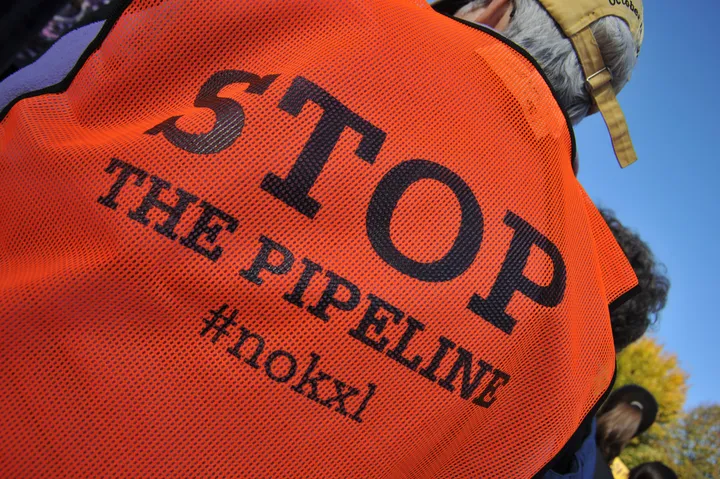
The Wall Street Journal's editorial Friday on President Obama's decision to delay the Keystone XL pipeline contains bad data and omits pertinent information that hurts its argument.
Since policy decisions need to be based on facts and not rhetoric to be successful, let's go through these one by one.
1) The Journal says building the pipeline would create 20,000 jobs. My article on the controversy in this week's issue of Bloomberg Businessweek notes TransCanada CEO Russ Girling's use of this figure in his conference call with investors on November 1.
But TransCanada's own data supplied to the State Department says 2,500-4,650 jobs would be created.
I've closely followed the Keystone XL debate for months, and one thing I noticed was that supporters' figures on job creation rose as objection to the pipeline intensified. At one point the number 200,000 was bandied about; it was supposed to include the indirect job-creating effects of the pipeline over 100 years -- even though its intended lifespan is only 50 years -- and came from a study TransCanada commissioned.
An indirect effect on jobs the pipeline would have, which the Journal omits, is a rise in gas prices with job-killing results. Girling told me on the conference call, "If you bring more supply into a marketplace, all other things being equal, the only direction prices can go is down. Obviously if we supply another million barrels a day of oil to the United States, we'll see prices go down."
However, the difference in the prices of two types of oil traded, West Texas Intermediate and North Sea Brent, is currently at or near a record high. It's because of the tremendous recent increase in the amount of oil produced in Canada and North Dakota. With the current transport infrastructure, that oil can't get out of the Midwest; there's a glut of it stuck at storage depots in Cushing OK, which is depressing the price of WTI relative to Brent.
That's exactly why TransCanada wants to build Keystone XL: to provide an artery for that oil to move south from Cushing to refineries in Texas, which can handle the type of crude produced in Alberta.
The result will be an end to the over-supply in the Midwest, which will raise prices in the primary region now supplied by Cushing.
TransCanada itself told Canada's National Energy Board just that: The cost of heavy crude in the Midwest will increase, it said, as a result of the narrowing of the WTI-Brent spread, by as much as $2 to $4 billion annually for a period of several years.
The Cornell Global Labor Institute estimates [pdf] a 10-to-20 cent per gallon increase in the price of gas as a result. "These additional costs," it says, "will suppress other spending and will therefore cost jobs." (TransCanada disputes the accuracy of Cornell's report.)
2) The Journal writes, "[The Dept. of] State produced multivolume environmental impact statements that concluded the pipeline would have 'no significant impacts' on the environment. That should have ended the matter."
Funny how editorial writers usually so quick to lambast big government as ineffective suddenly take its word as gold when it makes decisions they agree with. Contrary to the Journal's unquestioning acceptance of the EIS's, during State's environmental review of Keystone XL it became clear that just because an environmental impact statement is performed doesn't mean the impact on the environment has been assessed.
CEO Girling said on the conference call, in response to a question I posed, that the pipeline was subject to "by far the most exhaustive and detailed analysis ever conducted of a crude oil pipeline in the United States," and supporters like to say that the length of the process -- three years -- indicated how thorough State had been.
In fact, the opposite is true: The reason it took so long is that State kept messing it up. The EPA, which for obvious reasons has considerably more experience in conducting and assessing environmental reviews than does the State Dept., gave the first EIS its lowest possible rating, and the second review received just one grade up from that -- twice forcing State back to the drawing board.
When I asked him about the third, "final" EIS, released in August, Bill McKibben, the founder of the climate-change group 350.org and scholar-in-residence at Middlebury College who's been a leading voice of opposition to the pipeline, said, "I've graded enough blue books to know when people are avoiding the main question." The EIS, he said, was a "masterpiece of environmental obfuscation" that didn't even address the pipeline's potential effects on greenhouse gas emissions, as the EPA had instructed it to.
3) "Politicians [who opposed the project's route through Nebraska] seem to have no problem with some 25,000 miles of pipeline that already crisscross the Ogallala aquifer [which underlies much of the state]," writes the Journal.
That might have to do with the fact that only one of them carries tar-sands oil and the benzene that the increasingly-common form of it usually contains (benzene spreads after oil stops moving), as Keystone XL would have, and none go through the most ecologically-sensitive part of the Ogallala -- Nebraska's Sandhills, where the pipe would have been sitting in the aquifer, exposing residents to benzene exposure in the event of a spill, according to two University of Nebraska scientists I spoke to.
Moreover, Nebraska politicians, just like politicians and policy makers everywhere, know that it's much harder to stop something through policy before it starts than to undo a policy once enacted. Ethanol and oil-exploration subsidies are two examples. Another is the tax-free status of Internet retailing.
And most importantly, saying we shouldn't oppose something now because we didn't oppose it before is a recipe for moral calcification. I wonder if the Journal's editorial writers would take this attitude toward slavery, or female suffrage, or many of the other issues on which the better angels of our nature have triumphed over time?
3) So that I can't be accused of doing what I describe the Journal as doing, I will point out that there is probably some truth to its implication that alternative methods of getting the oil Keystone XL would have carried to market may have higher greenhouse gas emissions than pipeline transport. (That was the finding of a credible report I read in the course of my research for Bloomberg Businessweek.)
But it may not matter. The unlikely coalition of ranchers and greens, Nebraska and Hollywood, has considerably raised the profile of tar-sands production, which is environmentally destructive locally and has higher greenhouse gas emissions than conventional oil. Opposition to increased transport in Montana (which borders Alberta) is considerable, and local and regional aboriginal populations in Canada have shown strong opposition to oil-sands development and transport through areas over which they enjoy sovereignty.
Environmentalists on the left and property-rights advocates on the right scored a major victory with Pres. Obama's decision Thursday. (Greens, who've been increasingly isolated politically, could learn a lesson from the experience and try to form more, similar coalitions, emphasizing that environmentalism is conservative.) The goal in opposing KXL, McKibben told me, was "to keep as much carbon in the ground as we can." The Sierra Club has had some success along these lines: Its "Beyond Coal" campaign pressured the EPA to effectively halt licensing of new coal plants, and helped convince large utilities, such as Los Angeles's Department of Water and Power, to switch from coal to power sources that emit less (or zero) carbon dioxide.
It might work. Jackie Forrest, oil-sands analyst at energy consulting firm IHS-CERA whom I interviewed for my piece, said that "if oil sands doesn't get a new market outlet by 2015, it's going to saturate the markets it can get into. So we will see production growth stall."