Reading any article based on statistics is a lesson in interpretation, and the latest global temperature statistics provide an opportunity for some differing opinions on the topic of the climate: While the United States had an exceptionally warm winter (fourth warmest) and global temperatures remained above average in February, global land areas were the coolest since 1994.
In other words, just as cold winter in the U.S. during the previous two years did not mean that it was cold globally, a warm U.S. winter this year didn't mean that it was warm globally. Determinations about global temperature trends need to be made based on global data, not the data in one part of the world.
The warmth in the U.S. in the winter (December through February) was exceptional, and it's a trend that has continued in earnest in March. However, the extreme cold affecting large portions of Europe from late January into February tempered the overall statistics, especially those for land surface temperatures.
The combined global land and sea surface temperature was 0.67 degrees (Fahrenheit) above the 20th century average, which is simultaneously the 22nd warmest February on record (since 1880) and the coolest February since 2008. The combined average land temperature was 0.68 degrees (F) above the 20th century average, which is simultaneously the 37th warmest February on record and the coolest since 1994.
The combined land and sea surface temperature is the most important since that gives the best overall indication of the global temperatures, and it remains above average. However, it may be surprising to those of us living in the currently warm U.S. weather to learn that land surface temperatures were the coolest they've been in nearly 20 years in February.
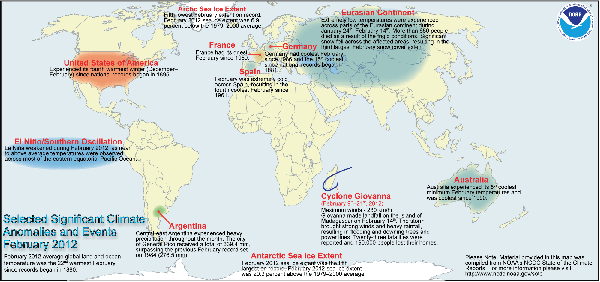
No matter what we think of the individual statistics, it's clear that February was a month of extremes. Temperatures across the Midwest, Northeast, and mid-Atlantic regions of the United States were exceptionally warm, averaging nearly 8 degrees above the 20th century average. Meanwhile, on the Eurasian continent, an estimated 650 people were killed by extreme winter conditions, including record cold and record snowfall.
Other highlights included France the driest February since 1859 in France, the coldest February since 1959 in Germany, and a Madagascar cyclone (another name for hurricane) that killed 23 and left 190,000 people homeless. Also, Australia experience their 8th coolest February (late summer Down Under) on record.
The Arctic had the fifth lowest extent of sea ice on record, while the Antarctic had the fifth largest extent of sea ice on record.
http://tinyurl.com/7r7edc2
This is why you can't trust climate quacks, they deny science.
Please, look up the meaning of the term "statistical trend."
An understanding of averages is part of grade school curriculum and I'm at a loss to explain how you could possibly be confused on that point. .
A good way of looking at the whole globe is to look at the NOAA animation over the last 7 days here:-
http://www.esrl.noaa.gov/psd/map/images/fnl/sfctmpmer_01a.fnl.anim.html
We hear that the aquifers are being drained all over the world. Where does that water disappear to? Could that explain the rise in the oceans?
The surface of the earth is 3/4 water.
Ocean temps are at 2000 year highs.
http://www.columbia.edu/~mhs119/Temperature/T_moreFigs/
Global warming is confined to the land, and isn't distributed evenly. The Arctic has had significantly greater warming than anywhere else.
You can't trust the climate quacks. They never provide evidence and make stuff up.
I've plotted the trends every 2 years from 1998, only the trend from 2008 shows any warming.
http://tinyurl.com/7r7edc2
You claim that sea ice extent is diminishing:-
http://nsidc.org/data/seaice_index/images/daily_images/N_stddev_timeseries.png
Arctic sea ice extent is clearly increasing and back in the normal range.
You are arguing that a pumpkin smashed on the sidewalk has gained mass because it is spread out over a larger area.
I guess we can take this as proof that CO2 isn't all that bad after all.
I guess it's time for those lazy alarmist scientists to actually do some real science (i.e. WORK) and figure out what is really happening with our climate.
Could it be the trillions of tons of water that we pump out of the ground every year? Could THAT have an impact on climate?
Naaahhhh. Trillions of tons of water vapor can't possibly do anything to our climate. It has to be a trace, insignificant gas called CO2 that really does nothing other than allow bloated politicians to scream about raising our taxes.
Yup. CO2. The devil gas.
Try getting your science from scientists and not shills for the fossil fuels industry.
This is why you can't trust climate quacks, their story shifts dependent on what they want to persuade a gullible audience.
Being the coolest out of a collection of hot weather years doesn't mean it is cold. Thanks for the attempt at relativism HP.
Did you know it was a lot colder than in 1998? Wow not we have both sides of the story it's getting cooler.
LMFAO!!!
Not at all. In order for the course of global warming to turn cool, we would have to have a statistically significant reversal of the trend. Deniers like to pretend that a few years after a particularly warm year is cooling, but that is wrong-headed. It is like a poor poker player who confuses losing less with warming.
As is your mixed-up mush.
This is why we call people like you deniers. It's not an insult, it's perfectly descriptive of the way you deny facts.
http://www.ncdc.noaa.gov/sotc/service/global/global-land-ocean-mntp-anom/201001-201012.gif
"the climate goes in cycles. just like has been for millions of years."
Since the only information on past climates on that time scale comes from scientists, and since you don't believe scientists, you have no idea what the climate did in the past. So why are you pretending that you do?
"global warming believers try to focus on only parts of the world."
Yeah, that's why we call it "global".
"thats not good science"
No offense, but your post doesn't suggest that you're the kind of person who's qualified to judge what constitutes good science.
I hope some good discussion comes from this, not just rants and religious feuds!
One main question I had is regarding why sea ice in the Antarctic continues to remain healthy and thick year-round while the Arctic sea ice crumbles...there are very few scientific studies on this and none of which are conclusive...any ideas on whats up with that? All I can surmise is a strengthening of the Antarctic current, but how does it still remain so stable and cold?
Here's a good, if technical, discussion of GRACE's Antarctic results as of 2006: http://ecologiesurleweb.free.fr/docs/Docs_infos/Warming/2006-Science-Velicogna.pdf
Here's something a little lighter and more recent (but a little more ominous.): http://www.nasa.gov/topics/earth/features/20100108_Is_Antarctica_Melting.html
Gosh, if scientists know nothing, then how did they arrive at the 4.5 billion year age of Earth?
That trend is positive, and the trend from 78 to present is even steeper, i.e. accelerating
The combined land and sea temperatures made this the coolest February since 2008 (ancient times!), but looking at the land temperatures alone, it was the coolest February since 1994.
These bits of data will undoubtedly fuel some important climate change debate. I can hardly wait.
http://www.accuweather.com/en/us/elkin-nc/28621/february-weather/2228276
http://www.accuweather.com/en/us/elkin-nc/28621/march-weather/2228276
Temps are running well above average for the month of March in Berlin Germany.
http://www.accuweather.com/en/de/berlin/23823/february-weather/1034548?monyr=2/1/2012
http://www.accuweather.com/en/de/berlin/23823/march-weather/1034548?monyr=3/1/2012
I did not make an argument in support of or against global warming. I am suggesting that March temp. averages may be elevated.
You mean, like you do with the polar ice sheets below?