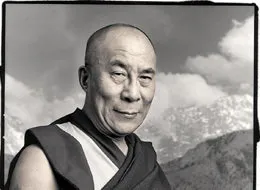
In the lotus-strewn wake of the Dalai Lama's recent North American
tour, anybody who is a somebody (and frankly, these days who isn't?) will have a how-I-met-the-Dalai-Lama story to tell. At the slightest
instigation or with none at all, Catholic, Jew, atheist, they'll
regale you with their encounter, eyes misting over. Often they turn out
to be 30-second meetings in an elevator or hotel lobby. Even the
shortest exchange takes on Greater Meaning -- such is the profundity of
his presence and his ability to be so present with whomever he meets.
I listen politely to such stories. Then I struggle with my ego: should
I trump theirs and tell mine? My ego usually wins, as it will here,
because my meeting with him was so touching and revealing.
I had scored a one-on-one 90-minute interview with the 14th Dalai Lama,
largely -- OK, solely -- because I was writing about the growing
popularity of Buddhism for one of his favorite magazines, National
Geographic.
I was to meet him in Dharamsala, India, headquarters of the Tibet
Government in Exile since 1959. His secretary
recommended I ask questions that were not the run-of-the-mill sort he
has fielded for some 50 years and who knows how many lifetimes. In
preparation, I read his autobiography, My Land and My People. It begins: "I was born in a small village called Taktser, in the
northeast of Tibet, on the fifth day of the fifth month of the Wood Hog Year of the Tibetan calendar -- that is, the year 1935."
I stopped reading after the first paragraph, fixated on that village of
his birth. This would be my unique angle. I convinced the Geographic to
send me to Taktser, so that I could open the conversation with
something like, "So I just happened to be in your old neighborhood,
Holiness..." It might have been the most expensive icebreaker in
Geographic history. The village, it turns out, is one of the most
humble I have ever seen. Dirt paths, tiny mud houses set against a
cliff, not a Starbucks in sight.
At the top of a hill, I found the house where Lhamo Dhondrub was born and from which he was taken at age four to begin his life as a future Dalai Lama. Rebuilt in 1986 as a
monastery, the structure is now administered by the Chinese Government,
a superficial gesture to make Tibetans believe the Chinese actually
care about them and their leader. The Chinese government's clear
discomfort (to put it mildly) with the attention showered on him in the
United States two weeks ago more accurately reflects their position.
Inside, I met the Dalai Lama's nephew, Gongbu Tashi, a man of 58 who
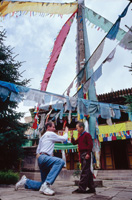
the Chinese government pays to maintain the monastery. (That's me in the photo above with Gongbu's grandson and the Dalai
Lama's great-grandnephew in the courtyard of the monastery teaching him
the Way of the High Five.)He told me more
and more Westerners make the long pilgrimage to this now historic site.
After he showed me around, we stood outside the monastery, overlooking
the magnificent rolling green mountains of the Kunlun Range. My tape
recorder running, I suggested he send his uncle a message that I
promised to deliver personally. "What would you tell him right now?" I
asked, putting the recorder to his mouth. He started: "Uncle, every day
we are waiting and hoping and expecting you. You are my uncle and you
are getting older and it's time for you to come home."
It was such a poignant moment because it was such a futile and
implausible hope.
Six weeks later, tape in hand, I arrived at McLeod Ganj, the section of
Dharamsala where the Tibetan Parliament, monks' school and Dalai Lama's
offices are located. I was ushered through several security checks and
then sat in a waiting room, nervous as hell. In all my preparation, I
had not studied or even bothered to ask about the protocols involved
upon meeting a Tibetan lama, much less the highest ranking lama. I knew
that one should not touch a lama. So I decided I would just bow with
palms together at my chest. But as I approached him, he extended his
hand, Western style. The Dalai Lama -- the 14th reincarnation of the
Buddha of Compassion, recipient of the Nobel Prize and now the
Congressional Gold Medal, revered as an enlightened being -- took my
hand and shook it robustly. After several shakes, I tried to withdraw
my hand, working on the assumption there must be a protocol I was
equally unaware of that dictated when to let go. But much to my
surprise and delight, he tightened his grip.
Sure, I thought, keep my hand -- forever. Then he led me, his right
hand still holding my right hand, across a long hall to where we would
sit. I decided I would hold on until he let go. We must have held hands
walking side by side like that for close to two minutes. It completely
disarmed me -- as a man, as a journalist, as a human being -- and at
the same time it made me feel completely embraced. It was asexual but
it stimulated, or perhaps awakened, a place deep in my soul I knew
existed only theoretically. But now that place felt palpable. Somehow
his calm made me feel calm, as though he was giving me a hand-to-hand
tranquility transfusion.
The man had me at hello.
As soon as we sat down, I pulled out my recorder, explaining I had been
to Tatkser and had brought him a taped message from his nephew, Gongbu
Tashi. His eyes lit up. As he listened to the three-minute section I'd
cued up, this almost fatherly look crossed his face. This time it was
his own eyes misting over.
"Every day they are thinking that way," he said. Then he went silent.
I told him when I first saw the village, I thought, "How amazing that
from such humble beginnings a man would rise to such world renown."
"Does it ever amaze you too?" I asked.
"Yes," he said. "If you look back, a person from very small village
eventually reaches Lhasa with the name of Dalai Lama. So then in the
last few decades the Tibetan nation's interest is somehow very
connected with that village boy." He laughed his signature laugh -- an
endless, uninhibited giggle -- as though the ludicrous randomness of
his own life had just struck him.
I held the tape recorder up to his mouth as he laughed. Nowadays when
life seems ludicrous and random -- and frankly, these days when doesn't
it? -- I replay the Dalai Lama's laugh track. I don't know; it seems to
help.