The essential promise of a consumer society is that virtually all satisfaction can be purchased. This promise runs so deep in us that we've come to take our identity from our capacity to purchase: I shop, therefore I am. The dependency on shopping is not just about things, it includes the belief that what is fulfilling or needed in life can be bought -- from happiness to healing; from love to laughter; from raising a child to caring for someone.
In our effort to find satisfaction in consumption, we're converted from citizens to consumers. The implications are profound. Consider the impact on just two parts of our lives: the family and the community.
Families have lost much of their function; communities have become incompetent. The family is no longer the primary unit that raises a child, sustains health, cares for the vulnerable, and assures economic security. What's more, we are disconnected from our neighbors and isolated from our communities. Hence, community and neighborhood are no longer competent -- competence is the capacity of the place where we live to be useful to us, to support us in creating those things that are best produced in a connected community.
Competent communities support the capacity of a family to fulfill its functions. They provide a safety net for the care of a child, attention and connection for the vulnerable, economic survival for the household, and the social tools that sustain health.
In a consumer society, these functions are removed from family and community and provided by the marketplace; they are designed to be purchased. We now depend on systems to provide our basic functions. For example: we expect the school, coaches, agencies and sitters to raise our children. We expect doctors to keep us healthy. We believe in better living though chemistry. We think that youth, a flat stomach, a strong heart, even sexual desire are all purchasable.
Consuming has its attractions, but for true citizens it is not the point or provider of the good life. We know how to do without. Make ends meet. Make do. We do this together. We take care of our own. There are no foster kids, only grandmothers and cousins. These are beliefs of people who live in a competent community, who live in a way they have chosen and who experience a more satisfied life. They are less dependent on the material culture and its requirements and call. They do not work in systems nor reap the benefits of them. They think they have enough; their mindset is abundance, not scarcity. Their families have a function, and they have the power to provide.
The way to the good life is the way of a competent community recognizing its abundance. We see that if we are to be the creators of our future, we must become citizens, not consumers. Consumers are dependent on the creations of the market; and in the end, they produce nothing much but waste. Citizens are those who choose to create the life, the neighborhood, the world from their own gifts and the gifts of others. It is the shift from consumer to citizen that will restore vital functions to the family and the neighborhood and reconstruct the competence of communities -- all of which come under assault in a consumer culture.
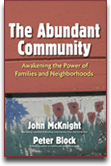
Adapted from The Abundant Community: Awakening the Power of Families and Neighborhoods. A version of this post appeared in Leadership Excellence, June 2010.
John McKnight is author of The Careless Society. Peter Block is founder of Designed Learning. They are coauthors of The Abundant Community (Berrett-Koehler). www.abundantcommunity.com