Barack Obama will be addressing the U.S. Conference of Mayors at the group's annual meeting on June 21 in Miami. John McCain is likely to be a no-show; he hasn't accepted the group's invitation. On the face of it, it appears that the two presidential candidates recognize the reality that urban voters tend to vote for Democrats. For Obama to beat McCain, he not only needs to match or exceed John Kerry's 54% margin in cities in 2004, he also needs to increase the urban voter turnout, especially in key swing states. Equally important, he needs to improve on Kerry's 47% showing among suburban voters, who account for about half of all voters nationwide.
The changing economics and demographics of suburbia give Obama a good chance to win the swing suburban voters. That's because, increasingly, the challenges facing suburbs are the same ones facing cities. In this election year, suburban voters -- working class and middle-class residents of both older suburbs and outer exurbs -- are up for grabs. Neither Democrats nor Republicans have a lock on suburbanites, in large part because they are now as economically, racially, and ideologically diverse as the rest of America.
In fact, as a report issued this week by the Brookings Institution, "MetroPolicy," explains, the fate of cities and suburbs are increasingly intertwined. The 1950s "Leave it to Beaver" stereotype of American suburbia -- the white middle class family with the working dad who commutes to and from the city, the stay-at-home mom, with two kids who attend well-funded schools -- is no longer true, if it ever was.
In the last two decades, the lines between cities and suburbs have blurred. The mayors and residents of many suburbs, like their city counterparts, are dealing with similar problems -- not only poverty, homelessness, crime, and underfunded schools, but also rising gas prices, traffic congestion and pollution, accelerating foreclosures and abandoned homes, crumbling infrastructure, widening wage inequality, escalating health care and food costs, a wave a new immigrants, and the export of jobs to China and Mexico.
Suburbanites are not immune to the mega-trends and policy disasters that challenge the country. We face a new Gilded Age -- a frenzy of corporate mergers, widening economic disparities, and deteriorating social conditions. America today has the biggest concentration of income and wealth since 1928. Meanwhile, the American Dream -- the ability to buy a home, pay for college tuition and health insurance, take a yearly vacation, and save for retirement-has become increasingly elusive. A growing number of working families are in debt, while the number facing foreclosure has spiraled. American workers face declining job security as companies downsize, move overseas, and shift more jobs to part-time workers. The cost of basic necessities is rising faster than incomes. These problems are certainly not confined to big cities.
But America has yet to come to grips with what the Brookings report calls MetroAmerica. More than 80% of all Americans live in metropolitan areas -- 65% in the largest 100 of them - which include central cities, older suburbs, and former small towns gobbled up by metro sprawl. These 100 metros account for two-thirds of the nation's jobs and three-quarters of its economic output. Most of the nation's major universities, medical centers, research enterprises, museums, and skilled workforce are located in these metro areas.
These metro areas are the engines of the nation's economic prosperity, but we treat them like used cars ready to be junked. As the Brookings report reveals, we have failed to re-tune the engine to address the nation's new challenges. Our federal policies are out of sync with the reality of MetroAmerica, ignoring its centrality to our national well-being. According to the report, "Washington is often absent when it should be present" and "Washington is too often present when it ought to be absent."
For example, alone among the world's major nations, the U.S. has no national energy policy to deal with the harmful consequences of global warning, our over-dependence on cars, our ridiculous low level of spending on public transit, and our failure to invest in research to develop more energy-efficient industries, jobs and housing. Led by Seattle Mayor Greg Nickels, more than 500 U.S. cities have signed an agreement to help reduce energy consumption, but they need leadership from Washington to truly address the problems of greenhouse gases, global warming, and the dangerous health consequences of pollution from cars, factories, and ports. The federal government must put resources behind what the Apollo Alliance (a coalition of business, labor, environmental, and community groups) is calling for -- significant investment to put millions of Americans to work in a new generation of well-paid "green" jobs, and clean energy products and services, to reduce our dependence on foreign oil and cut carbon emissions.
The U.S. also stands alone, and behind, other nations in our approach to education and job training. In most affluent countries, the national government provides most of the funding for schools and job training. In contrast, the U.S. forces local and state governments to address these problems. This results in wide disparities in per-student spending between wealthy states and suburbs and their poorer counterparts, which handicaps millions of young people from reaching their full potential. No wonder we're decades behind other nations in terms of training the 21st century workforce to compete the global economy.
Likewise, in other wealthy nations, national governments take major responsibility for funding public transportation, public safety, parks, housing, social services, and infrastructure, while encouraging localities to cooperate and innovate in administering these key functions of government.
The U.S. does it backwards. Washington typically requires cities to deal with issues such as homeland security, clean air and water, and schools, without providing the necessary funding. (The No Child Left Behind act, which requires local school districts to raise student test scores but doesn't provide the funding needed to hire more teachers, is an obvious example). Cities have to tax residents and businesses to raise the billions of dollars a year to comply with these unfunded mandates. Not surprisingly, our bridges, water systems, dams, and highways, as well as many school buildings, are crumbling, symbolized by the levies in New Orleans that left the city defenseless in the wake of Katrina, and the Minneapolis bridge that collapsed last August, killing 13 people.
Similarly, immigration policy is supposed to be a federal responsibility. But because immigrants wind up living in America's cities and suburbs, it is local governments that are compelled to deal with housing and educating them. Washington provides no "help" except to send federal agents to workplaces looking for illegal immigrants.
Federal tax and highway policies promote costly, energy-wasteful sprawl, which encourages developers and companies to invest in the urban fringes while allowing existing buildings and infrastructure in cities and older suburbs to deteriorate. Federal transportation policy is mostly about building, and repairing, highways, rather than funding public transit and requiring automakers to make energy-efficient cars. Making matters worse, American cities and suburbs are forced to compete against each other for private investment and jobs, from shopping malls and office parks, to Wal-Marts, and sports franchises, which undermines the fiscal health of cities and suburbs alike.
Equally absurd, the U.S. has the most fragmented crazy-quilt of local governments. Within just the 100 largest metropolitan areas, there are 9,000 layers of government -- municipalities, school districts, counties, water districts, park districts, and others -- making it almost impossible to coordinate.
Unlike other major countries, we have no federal policies that encourage, must less require, regional planning. We permit private industry and local governments to determine where housing will be built, and where jobs will be located, without thinking about -- or planning for --how people will get to and from where they live, work, attend school, and shop. As gasoline approaches $5 per gallon, we can't continue to operate this way.
No other major industrial nation has allowed the level of sheer destitution that we have in the United States. We accept as "normal" levels of poverty, hunger, crime and homelessness that would cause national alarm in Canada, Western Europe or Australia.
The U.S. has many serious problems that are disproportionately located in cities and older suburbs, but these are national problems. A good example is the current mortgage meltdown -- caused by the greedy practices of banks and mortgage companies and the failure of the federal government to regulate the financial services industry. According to a report by the U.S. Conference of Mayors, the weak housing market, and the large inventory of unsold homes, will reduce home values by $1.2 trillion in 2008 alone. About half of that decline is attributable to the sharp increase in foreclosures. In January, the city of Baltimore sued Wells Fargo Bank for targeting minority neighborhoods for predatory loans leading to high foreclosure rates, costing the city millions of dollars in lost tax revenues, added fire and police costs, court administrative costs, and social programs to maintain healthy neighborhoods.
But Baltimore, nor any of the many other cities and suburbs facing a wave of foreclosures and abandoned homes, can't fix these problems on its own. This is why we have a federal government. But a few weeks ago, most of the Republicans in Congress voted against a bill, sponsored by Rep. Barney Frank of Massachusetts, to strengthen regulations on banks and brokers and to provide relief to families at risk of losing their homes. Obama endorsed the Democrats' proposal, while McCain remained conspicuously silent.
The Brookings report reveals that metro areas differ in terms of their productivity, wage inequality, and carbon emissions, but these differences are due to factors mostly outside the control of local governments. To guarantee that metro areas are profit centers for the U.S. economy, we need the federal government - including our candidates for president and Congress -- to make a commitment to be their partner. The federal government needs to invest in the metro-based industries, research centers, universities, and workforce that are the engines of prosperity. Washington also needs to provide more funding for public transit, mixed-income housing, public schools, universal health care, child care, and cleaning up urban brownfields and reducing urban pollution that results in high rates of asthma and other diseases, especially among children.
A good example is the earned-income tax credit (EITC), a wage supplement for the working poor. It effectively lifts millions of families out of poverty, with slightly more living in inner-ring suburbs than in cities. The additional income to these low-wage families helps improve local economic conditions, since the poor spend almost all of their money on necessities in local private businesses. Washington could also reward cities and suburbs that work cooperatively to promote job growth, mixed-income housing, and sensible transportation policies on a regional basis rather than competing with each other.
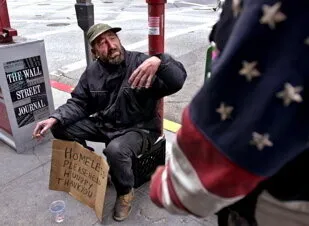
For years, the symbol of America's attitude toward cities has been the tin cup. We viewed cities like beggars -- hungry, homeless, and broke -- and considered "urban policy" a form of charity. But, based on the Brookings report findings, perhaps the new symbol should be a boat, sailing on the dangerous waters of the 21st century global economy. It doesn't matter if you're sitting in the urban or the suburban section of the vessel; if it springs a leak, everyone will drown. But if they work together to fix it, all the passengers will not only survive, but thrive.
Peter Dreier is E.P. Clapp Distinguished Professor of Politics and director of the Urban & Environmental Policy program at Occidental College. He is coauthor of Place Matters: Metropolitics for the 21st Century.