iPhone app iPad app Android phone app Android tablet app More

Featuring fresh takes and real-time analysis from HuffPost's signature lineup of contributors
Peter H. Gleick

Peter H. Gleick

Posted: November 29, 2010 06:08 PM

Fiji Water, one of the world's most well-promoted brands of bottled water, is also one of the most secretive and private. Owned by Lynda and Stewart Resnick, the increasingly controversial Southern California billionaires, Fiji Water is a symbol of both the bad and the good in the world of bottled water. "Bad" because the massive energy cost and plastic waste produced by shipping bottled water thousands of miles from the island of Fiji to markets in the United States and around the world, and because of their interactions with the unelected military regime in Fiji, which came to power in a coup in 2006. The country has been under martial law since 2009. "Good" because of the benefits the company claims to offer in the way of jobs and other economic returns to local communities in Fiji, and because of their much publicized claims to be "carbon negative" - a claim, by the way, that cannot be independently verified with information provided publicly by the company.

Despite their efforts to keep a low profile, however, Fiji Water is in the news, in a big way.

This week, Fiji Water threatened to close their water bottling plant in Fiji in a game of high-stakes industrial chicken. Why? Not because they object to the military regime or the unelected government or the martial law. But because the government of Fiji announced that they intend to increase the business tax on bottled water from F$0.003 per liter (a third of a Fiji cent) to F$0.15 per liter (15 Fiji cents). This is the second time this chain of events has unfolded: a previous effort to increase the tax on bottled water also led to a threat to close the Fiji Water plant, and the government backed down. Fiji Water bottles around 3.5 million liters of water each month for sale (at a typical list price of $3-4 per liter, or $7 in a hotel room recently -- see the picture) mostly in affluent U.S. markets. Current Fiji water taxes generate only F$0.5 million annually, but the proposed increase would raise this to over F$22 million. The company can certainly afford to pay something more. For comparison, the trade journal Brandweek put Fiji Water's 2008 marketing budget at US$10 million.
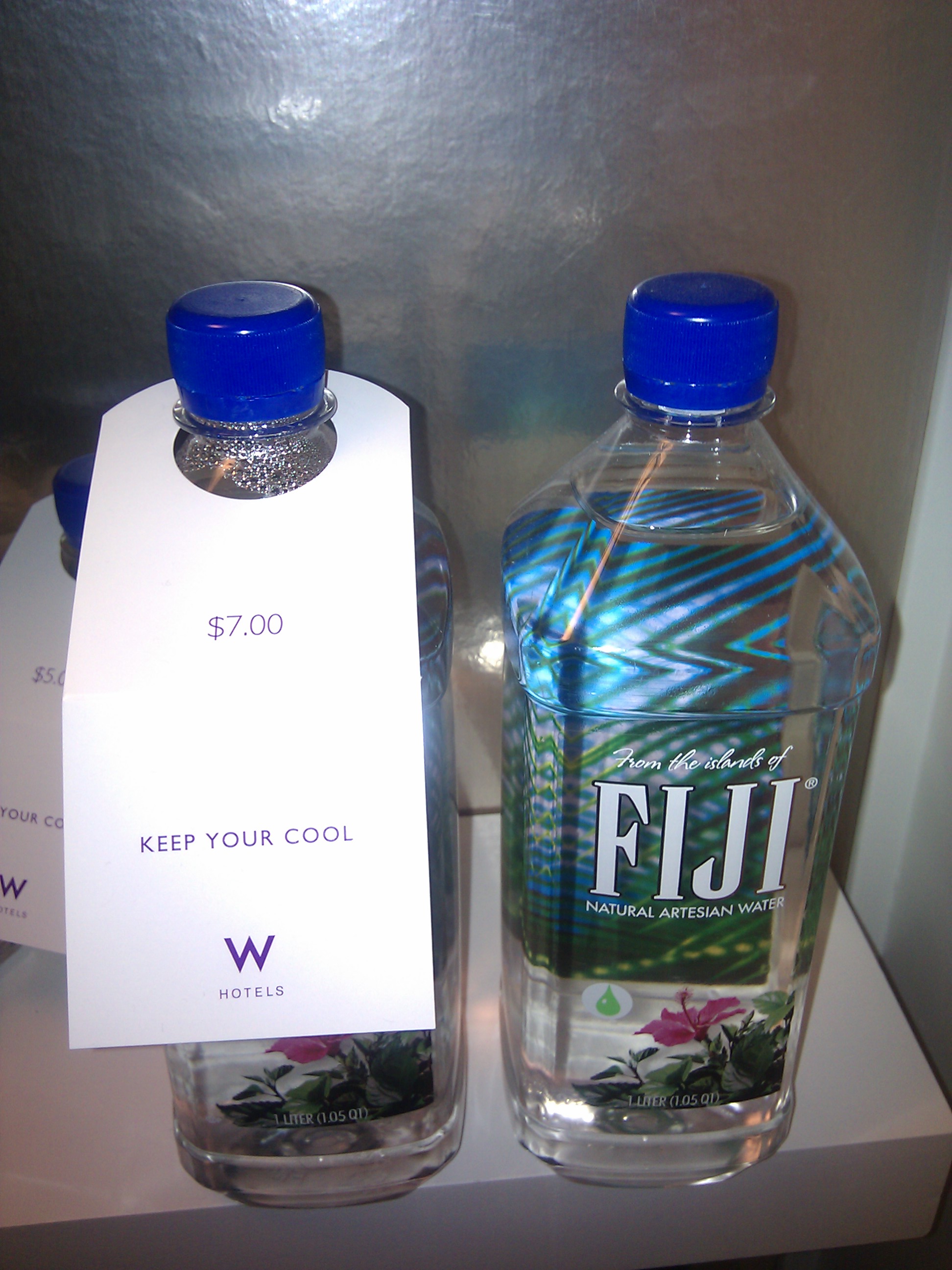
2010-11-30-IMG_20100818_173720.jpg

According to the Fijian Prime Minister, Fiji Water has enjoyed a huge corporate tax holiday for over a decade, paying less than a million dollars in total corporate tax over the past two years, despite earning hundreds of millions in revenue from sales of product. The government of Fiji also accuses the company of manipulating the way the value of water exports is computed to minimize their tax payments. In a war of numbers, the company in turn argues that it provides lots of jobs, 20 percent of Fiji's exports and 3 per cent of its gross domestic product. Fiji Water is certainly an important economic actor on the island, and it has recently been criticized for tolerating Bainimarama's military regime and for hiring a company with close military ties to provide security for its water facilities.

The dispute highlights several questions for bottled water producers and Fiji Water in particular. Should they continue to do business in a country with a military dictatorship, where local communities have little or no say in how local resources are exploited? Does their presence and economic strength in the country help prop up Fiji's government? How can the company claim to be socially responsible when they operate businesses in regions where political instability, government corruption, and a lack of transparency are prevalent, like Fiji.

Another problem is that private companies rarely pay any significant royalty or taxes for extracting public resources and privatizing them. Fiji Water and other companies regularly claim that important benefits accrue to local communities, such as jobs, but the economic disparity between corporate revenue and local returns is beginning to cause social disruptions and disputes in some regions. A recent Nestle Waters proposal to build a large bottling plant in McCloud, California foundered for many reasons, but one was that Nestle offered to pay the community a measly 8 cents for every thousand gallons of water it took ($0.00008 per gallon).

Finally, the dispute highlights another fundamental question: why on Earth would anyone pay $3 or $4 (or more) for a bottle of Fiji water - literally thousands of times more for water that is not any better than other water available from our own local communities? And don't try to argue with me that it is better in some magical way - almost all U.S. tap water is just as good tasting, better regulated and monitored, and far, far cheaper, as I've described in Bottled and Sold: The Story Behind Our Obsession with Bottled Water. And if you simply can't bring yourself to drink your tap water, there are local brands of bottled water that are also better, with far fewer social, political, and economic liabilities than drinking water shipped thousands of miles from a country with an undemocratic government installed by military coup.

The company, meanwhile, has announced they still hope to work out a satisfactory arrangement with the government. I'll bet they do. But maybe it's time to wean ourselves from the bottle. I'm getting a bad taste in my mouth.


Follow Peter H. Gleick on Twitter: www.twitter.com/PeterGleick


  • Comments
  • 11
  • Pending Comments
  • 0
  • View FAQ
Comments are closed for this entry
View All
Bloggers
Recency  | 
Popularity
photo
HUFFPOST BLOGGER
Peter H. Gleick
Hydroclimatologist, President, Pacific Institute
12:59 PM on 12/02/2010
UPDATE 2: Actually, the news now suggests that the company agreed to pay the full 15 Fiji cents tax. Anyone know for sure?
03:44 PM on 11/30/2010
I work at Nestle Waters North America and would like to say that Mr. Gleick is correct that we’re no longer pursuing a bottling plant in McCloud, California, but is incorrect about the reasons why not. After reviewing our business needs for Northern California, we determined our plant in Sacramento was sufficient to serve our customers. While there is no doubt our proposed project was controversial and some community members thought our contract should have included a higher rate for water, this was not a factor in deciding to have a plant in Sacramento. For the record, the water rate we would have paid under our initial contract with the town was agreed upon by locally elected leaders, and was not only higher than the average cost of water in California, but was 200 times the household equivalent rate in that community. Jane Lazgin
photo
HUFFPOST BLOGGER
Peter H. Gleick
Hydroclimatologist, President, Pacific Institute
11:50 AM on 11/30/2010
UPDATE: Apparently, the company has already (as I guessed in my last paragraph above) cut a deal with the junta, to pay 8 (Fiji) cents per liter, and they've already reopened the plant. Provides a glimpse of how much profit they really make, to be able to so easily swallow a 25 times increase in the royalty (from a third of a cent per liter)...
HUFFPOST SUPER USER
Lance Manling
12:40 PM on 11/30/2010
Heaven forbid should a company turn a profit. Typical corporation.
HUFFPOST SUPER USER
Lance Manling
10:45 AM on 11/30/2010
why on Earth would anyone pay $3 or $4 (or more) for a bottle of Fiji water - literally thousands of times more for water that is not any better than other water available from our own local communities?-Fuji water does taste better (at least in my opinion).
photo
Idean Salehyan
Associate Professor of Political Science, Universi
09:45 AM on 11/30/2010
There are two issues here: first, I completely agree that it is senseless to buy imported water from half way around the world when there are local alternatives that are just as good. Bottled water has been an environmental nightmare.

Second, I disagree that we shouldn't do business with companies that operate in authoritarian regimes. Yes, if the company actively aids the regime in human rights abuse and repression, there is a problem. But, boycotting any goods from countries with less than perfect human rights records simply leaves the domestic population without jobs and worse off than they were before. I can't speak specifically to Fiji Water's record, but a blanket statement like we should not do "businesses in regions where political instability, government corruption, and a lack of transparency," would deprive millions of poor people of an income. Their jobs may not meet our standards for an adequate livelihood, but the alternative is unemployment and squalor.
08:43 PM on 11/29/2010
Thank you very much for this article. Please visit our project on water rights of India entitled the Holiwater Project. We would be grateful to have you at our upcoming forum in June of 2011. http://www.sociarts.com/category/productions-campaigns/holiwater-project. Best wishes, Bita Shafipour
This user has chosen to opt out of the Badges program
photo
gingershot
One man, one vote, from the river to the sea
11:09 AM on 11/30/2010
Is there a better/ more direct link for this info?-

//Mission Statement:
Holiwater is a multimedia performance of video and live music that documents the decline of water at the Ganges River of India
07:40 PM on 11/29/2010
Peter I bet the companies out and a chinese company moves in. I doubt the people of fiji will end up getting a better deal. However the government will get a partner happy to pay and support a one china friendly central government who could care a less about any impacts with social issues not being a marketing requirement at home.

You can only play chicken if the other party has something to lose. And china has been giving Fiji the full court wooing from the west routine while we have been ramping up pressure due to the coup.
photo
HUFFPOST BLOGGER
Peter H. Gleick
Hydroclimatologist, President, Pacific Institute
07:54 PM on 11/29/2010
Could be... Can they call it "Fiji Water" and sell it in the same bottles? Probably not, and the company has always depended on the luxury market here. Thanks for your comment.
12:59 AM on 11/30/2010
much as the brittish put in treaties with nations that only scotch from scotland will be referred to as scotch i don't se why fiji couldn't strike a similar deal with china, and their billion consumer market. Who is the company going to sue china the government of fiji. Heck china would probably like standing up for the cultural identity of a small nation win or lose.

The budding environmental consciousness in china is very similar to the market that water bottlers profiteered off in the US.

There is definitely a large and growing chinese luxury market as well.