Forbes, which regularly publishes biased, misleading, and distorted opinion pieces on climate issues, has just published a remarkable one by Patrick Michaels. Michaels is well known for his regular misleading statements about climate. And while his statements are mostly worth ignoring, this one contains a particularly remarkable combination of errors and falsehoods. He accuses a variety of other people (including Justin Gillis of the New York Times) of misrepresenting data on food production and climate risks while simultaneously doing exactly that.
In this case, his misstatements are easily checked (though not, apparently, by Forbes fact-checkers) by actually looking up the real data on world food production. Here are Michaels' most grossly misleading or simply false statements:
False Statement #1. Michaels says:
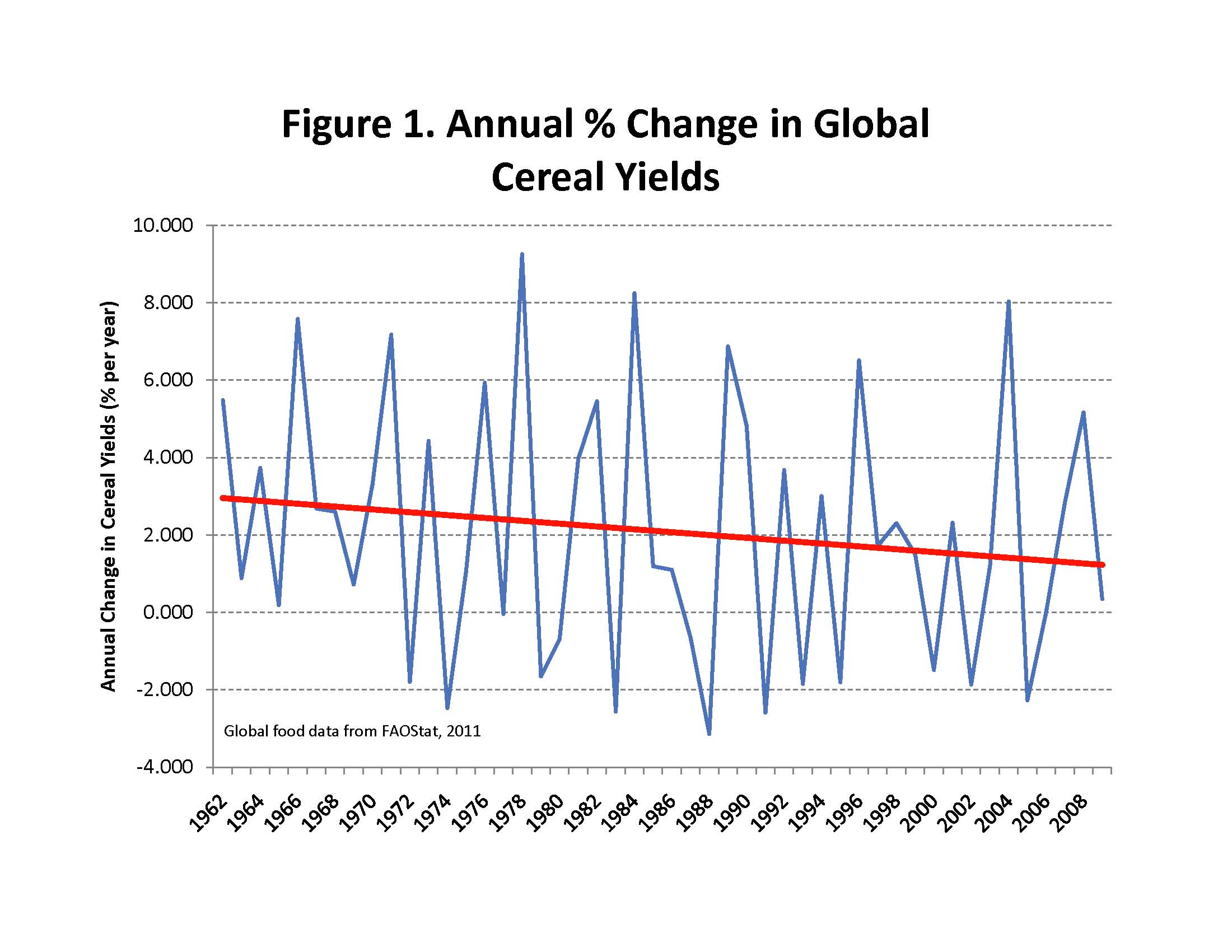
Gillis claims that "[t]he rapid growth in farm output that defined the late 20th century has slowed" because of global warming. His own figures show this is wrong. The increasing trend in world crop yields from 1960 to 1980 is exactly the same as from 1980 to 2010. [Emphasis added.]
Did Michaels think no one would actually look at the data? Gillis is right and Michaels is wrong. Crop yields are certainly increasing, on average, as we do better and better with technology. But the trends are in the wrong direction. Very simply, from 1960 to the present, yield increases have been slowing (exactly as Gillis notes), even accounting for year-to-year variation. Figure 1 below shows both the year-to-year variability due to weather and other factors, and the declining long-term trend in yields of all cereal crops combined (rice, wheat, corn, barley, oats, rye, etc.) from around 3% per year to around 1% per year. And to be specific about Michaels' claim? From 1960 to 1980, global cereal yields grew an average of 2.5% per year, but from 1980 to 2010, they only grew 1.7% per year. These are not "exactly the same." And it is not good news.
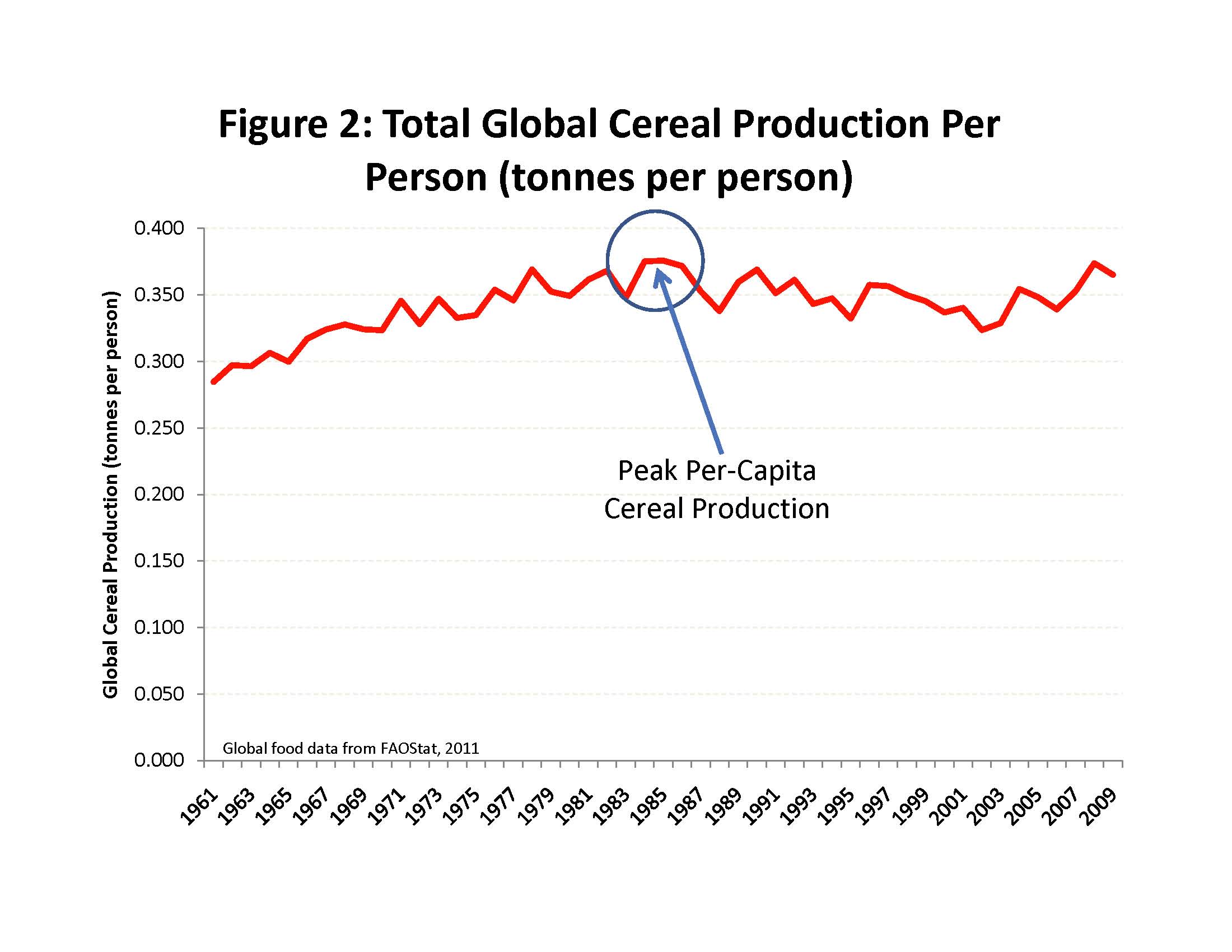
False Statement #2. Michaels states: "And per capita grain production is rising, not falling."
In this case, Michaels does not provide any year. Rising between when and when? In fact, per-capita grain production has been flat for decades (see Figure 2) as increases in production have been countered by increases in population. Indeed, in 2008, per-capita grain production was around 374 kilograms per person (and it dropped a bit in 2009, the last year for which global data are available). But the peak in per-capita grain production was 1984 and 1985 -- more than a quarter century ago. Figure 2 shows all the data from 1961. The reality is that per-capita grain production is essentially flat, not rising as Michaels claims, as the globe desperately tries to increase production to keep up with population growth.
Finally, the heart of Michaels' Forbes piece seems to be that climate change will be good for food production, not bad. In his op-ed, under the title "Facts," Michaels says the following:
Facts: Global surface temperature rose about three-fourths of a degree Celsius in the 20th century. U.S. corn yields quintupled. Life expectancy doubled. People got fat. Global warming didn't cause all of this, but increased atmospheric carbon dioxide directly stimulated plant growth. Further, greenhouse warming takes place more in the winter, which lengthens growing seasons. With adequate water, plants then fix and yield more carbohydrate. [Emphasis added.]
Here, Michaels is saying that the warming of the past century was largely responsible (even if it "didn't cause all") for increases in U.S. corn yields, life expectancy, and people's well-being (which is presumably what he means when he says "People got fat."). This isn't "fact." It is the grossest speculation and in contradiction to actual science on food and agriculture, which strongly suggests that climate changes will only make it harder and harder to bridge the already massive gap in feeding the world's population. The World Food Programme's estimates that 925 million people today go to bed hungry -- more than the combined population of the U.S., Canada, and the entire European Union. And his throwaway assumption, "with adequate water," is also a massive leap of faith, given that much of our current agricultural production already relies on unsustainable overpumping of groundwater.
Truthful statement, but not in the way Michaels means it: "I continue to be amazed at how little the facts are checked on global warming, even when writing for the so-called newspapers of record."
Well, this statement is certainly true. Alas, it applies to Michaels and Forbes.
Follow Peter H. Gleick on Twitter: www.twitter.com/PeterGleick
my last issue: http://www.economist.com/node/188181
http://www.dailymail.com/news/article1082559/theGMgenocide. Written by Andrew Malone.
and
http:// www.vimeo.com/24518549 a short documentary by Lauren Winchester for the BBC.
I used to teach persuasion at a major business school and regularly used a Forbes "charticle" as an assignment for students to find the logical and factual errors. It was always an eye-opening experience for the students.
Figure 1: You've chosen to focus on the percentage change in growth. Perhaps Michaels is focusing on the change in production LEVELS. Seemingly, you are looking at different derivatives of the same function: Both are mathematically correct, and neither is objectively "better" than the other.
Figure 2: There seems to be a slight increase in cereal per-capita production (maybe on the order of 0.01 tons per year or so). I think you can make the argument that the trend is relatively flat, though. Even so, this per-capita production, which means that total yield is indeed growing to pace with population growth.
topgunna: "Perhaps Michaels is focusing on the change in production LEVELS. Seemingly, you are looking at different derivatives of the same function: Both are mathematically correct..."
That was not the case Michaels tried to make.
That is a lie, or gross incompetence on Michaels' part. In fact, the figures show that Gillis is exactly right. “The rapid growth in farm output that defined the late 20th century has slowed.” Michaels explicitly claims it has not slowed. He is absolutely, indisputably wrong.
“The rapid growth in farm output that defined the late 20th century has slowed.”
All the talk of "We're killing the planet" a) isn't true and b) doesn't resonate with most people, as most people are selfish & short sighted. "We're killing OURSELVES" is more accurate & more likely to reach people.
These discussions never show a graph of the number of starving babies in Asia as of 1811, and as of 2011. Can anyone provide this information?
I am talking about the fact that starvation is going on in Asia and Africa,
There was much less starvation before all the "aid" was given to "backwards" people.
Agricultural production increases arithmetically, population increases geometrically.
Thomas Malthus.
http://www.independent.co.uk/news/science/world-population-forecast-to-peak-before-2100-664281.html
Thank you.
That was a good article. The problem is what kind of society would there be with twice as many people as we have now.
There is a classic population study, which you can find in Wikipedia. Just Google
"Calhoun Rat Study"
Also some living populations grow until they exhaust their environment, and then collapse,
Of course humans have the ability to make themselves extinct long before they actually exhaust their environment.
All the hoopla about the Green Revolution does not change that fact.
His 1798 treatise is available on-line for free in PDF format.
I have no doubt that Forbes is biased, but when it comes to agriculture this website has been know to be more than just a little biased against modern technology used in agriculture. In fact, many articles are just pure anti-modern agriculture propaganda.
This website is solidly antiGMO and publishes very questionable data from sources who have political agendas and who aren't scientists. HPost promotes obsolete ag practices that make the Amish look modern by comparison (in fact most Amish do now use GMO).
So why should I trust any whining about "biased" claims coming from HPost?
Assumption of bias in this case is simply a platform for you to expound your radical ideology.
Many wonderful varieties of produce are a product careful selective breeding or just chance. I once was in possession of very rare variety of apple tree called Blue Ridge King. The BRK could grow in poor soil, withstand temps of 107 degrees and no rain for six weeks and bear fruit effortlessly in said conditions.
www.offthegridmpls.blogspot.com
But obviously the answer is not to backwards to the pre-1950's farming methods that this HPost promotes. I trust absolutely nothing from this website anymore when it comes to food production. HPost now has such a anti-technology reputation that it can never recover from it...ever.
Where in this article did Peter Gleick promote, or even talk about, pre-1950's farming methods? Please focus on the article being discussed and stop pushing your personal agenda.
Michael's has form as a misrepresenter of AGW. A good discussion of his misrepresentation of the models is here:
http://www.logicalscience.com/skeptics/patMichaels.html