iPhone app iPad app Android phone app Android tablet app More

Featuring fresh takes and real-time analysis from HuffPost's signature lineup of contributors
Peter S. Goodman

GET UPDATES FROM Peter S. Goodman
 

Uber-Rich Porn

Posted: 09/24/2012 10:39 am

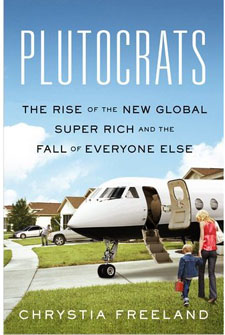
Plutocrats: The Rise of the New Global Super-Rich and the Fall of Everyone Else
By Chrystia Freeland
The Penguin Press
336 pages


______________________


Back in the quaint times of the previous economic age--the era before private jets and Manhattan socialites struggling to subsist on mere tens of millions of dollars a year--rich people generally understood that they were rich primarily by dint of lucky happenstance. Most had been born into well-endowed families, ensuring their lasting material comfort, and they tended to accept an accompanying social responsibility: They were expected to share some of the spoils with the less fortunate via public works. Those who did not abide risked the wrath of the populist mob or the tax collector.

This loose social compact endured more or less as the industrial revolution delivered a Gilded Age. It lasted into the 20th century, as the masters of industry grasped that their new mass-produced wares--from automobiles to kitchen appliances--needed no less than a mass market, and that required a prospering middle class.

But this traditional accommodation between the economic classes is today all but inoperative. An emerging global elite is increasingly intent on amassing more than ever while writing the rules to ensure they hang on to as much as they can. This is the fundamental takeaway from Chrystia Freeland's important new book, Plutocrats: The Rise of the New Global Super-Rich and the Fall of Everyone Else.

Freeland, global editor-at-large for Reuters, argues that the old order in which the rewards of capitalism were distributed progressively through taxation and lasting public works has been supplanted by a winner-takes-all marketplace, one that has driven economic inequality to alarming extremes. The ultimate haves -- not merely the 1 percent, but the .1 percent -- have grown so powerful that they threaten to capture the organs of government, wielding authority in pursuit of their own financial interests, at the expense of opportunities for us non-billionaires.

Much of the story behind this concentration of wealth is familiar. Globalization has placed the best and brightest kids in New York in direct competition with their counterparts in New Delhi, creating new opportunities and new pitfalls. Roaring economic growth in China, India and other emerging markets has produced a fresh crop of billionaires. The spread of technology has accelerated globalization while rendering many jobs vulnerable to automation, pitting the interests of cost-cutting corporate overseers against those of ordinary workers.

But the key insight in Freeland's book -- an expansion of a widely read magazine article she penned last year in The Atlantic -- is how these forces of change have become so potent that they have managed to sow angst even under the roofs of mere multi-millionaires cognizant that billionaires now rule.

Faced with new opportunity twinned with widening inequality, nearly everyone worries about their hold on their station. Even the occupants of the lower rungs of the 1 percent feel insecure, making them disinclined to split their winnings to finance government services needed only by those who have, to their minds, failed to master the game. (In an age in which $25,000-a-year preschool seems a prerequisite for Harvard and lucrative careers ever after, who wants to pay taxes to finance public school for other people's children?)

In Freeland's telling, one crucial factor distinguishes today's uber-rich from their forebears: They carry a striking sense of entitlement, seeing themselves as people who have constructed their own fortunes, as opposed to aristocrats who inherited their affluence. Freeland calls them the "working rich," and she makes clear that this is indeed how they see themselves. Given their self conceptions as rugged individualists whose wealth reflects not the accident of birth but their own pluck and savvy, they are of little mind to share their rightful winnings with anyone else -- especially not with losers who failed to erect their own fortunes, or government bureaucrats sustained by taxing other people's loot.

Freeland seems a tad infatuated with these supposedly swashbuckling capitalists. She celebrates the Russian and Chinese oligarchs whose commercial empires were hived off from the old Communist state sector in a process that looked more like looting than free enterprise. She devotes similar treatment to Carlos Slim, the Mexican magnate who manipulated the privatization of the national telecommunications infrastructure to yield his own lucrative chokehold over the market--one that has kept prices extraordinarily high, to the detriment of small business.

"Even today's rent-seeking plutocrats work for a living," she writes. "Carlos Slim or the Russian oligarchs owe their fortunes to rents they captured themselves, not to estates conquered by distant ancestors." She adds: "The bulk of their wealth is generally the fruit of hustle, intelligence, and a lot of luck. They are not aristocrats, by and large, but rather economic meritocrats, preoccupied not only with consuming wealth but also with creating it."
2012-09-24-51zk4RrZWsL._SL500_SS500_.jpg
Freeland is a bit too inclined to accept at face value the assertions of the fabulously rich, apparently confident in her ability to sort out speech served up in the service of commercial interest from genuine sentiment. In discussing the philanthropic efforts of billionaires, for example, she tells us that the Koch brothers -- famous financiers of right-wing campaigns -- "have pushed for less government regulation of industry, including state efforts to protect the environment." This, she explains, reflects their innermost convictions. "They are lifelong libertarians who are genuinely skeptical about climate change. They also happen to own a company whose assets include oil refineries, oil pipelines and lumber mills." Quelle coincidence!

But if Freeland's charitable inclinations toward the super-wealthy are the price of admission to the ball, she does indeed bring back some decent snapshots, giving us what feels like an intimate glimpse into the daily calculations of people whose annual incomes reach ten digits.

She introduces us to Holly Peterson, daughter of Pete Peterson, a founding partner of the private equity firm Blackstone, who harvested nearly $2 billion in his company's IPO. Here we get a glimpse at the home economics of Manhattan's Upper East Side:

"A lot of people under forty years old are making, like, $20 million or $30 million a year in these hedge funds, and they don't know what to do with it," Peterson says, before relating a conversation at a dinner party. "They started saying, if you're going to buy all this stuff, life starts getting really expensive... and if you're going to have four houses, and you're going to run the four houses, it's like you start spending some money." When a guest mentions that $20 million a year ends up nearly halved by taxes, everyone at the table nods in agreement.

Freeland's book is full of this sort of uber-rich porn: hedge funders complaining about how hard they work, how much they fly, how they never see their children.

Yet despite the promise of the book's subtitle, she devotes scant ink to assessing the prospects for "everyone else," leaving us wondering how we might earn our way as more of the wealth slides toward people who already have so much.

This story originally appeared in the Literary Issue of Huffington, available for free in the iTunes App store now.


Follow Peter S. Goodman on Twitter: www.twitter.com/petersgoodman

FOLLOW BUSINESS
 
 
  • Comments
  • 538
  • Pending Comments
  • 0
  • View FAQ
Comments are closed for this entry
View All
Favorites
Recency  | 
Popularity
Page: 1 2 3 4 5  Next ›  Last »  (9 total)
photo
coyotetrickster
A good book is a good friend.
08:40 PM on 09/30/2012
The hate toward the working poor and people in need is overwhelming. Apparently poor people are lazy, deceitful, and need to be punished because they are poor. Some people think that poor people (especially minorities) ruined the economy with their free government money. They need to look at the dishonest wealthy wall street bankers and the expensive wars we are involved in. “If a free society cannot help the many who are poor, it cannot save the few who are rich.” John F. Kennedy
Wib
Liberal former Marine who loves fly fishing and is
08:06 PM on 09/25/2012
Back when I was a child, in the 1940s and 50s, I finished high school in 1963 and went to war in 1965, I used to hang around a sporting goods store on my walk to my grandmother's after school when I didn't have football or baseball practice, and even then sometimes. I learned a lot in that store, from how to repair fishing rods -- skills which later helped me be able to build my own fishing rods, I haven't bought a ready made rod since I bought a Wright McGill fly rod at the Camp Lejeune BX in 1965 -- to tying flies. There also were a great many other small businesses in my hometown, even small clothing department stores. Sears Roebuck and JC Penney were the only real chains in clothing back then. Today, that is all gone and we have Wal-Mart and its clones, Dick's Sporting Goods and Academy, no where for a young person to hang out and learn how to build rods, tie flies, reload ammo, etc. or any of the other things kids used to be able to do hanging out at small businesses. They aren't even allowed to "hang out" at businesses anymore. All I remember went by the way when Congress and the courts allowed the reconcentration of wealth and resulting monopoly, destroying those old mom and pop businesses that were so friendly and centers of learning. I wish someone of intelligence and learning would write about that.
photo
HUFFPOST SUPER USER
Stewart Goss
Evil requires the sanction of the victim -Ayn Rand
04:50 PM on 09/25/2012
Usual confusion over corporatism and the free market. Liberals bash capitalism but they are really bashing govt. corruption that favors the wealthy.
photo
HUFFPOST SUPER USER
Stewart Goss
Evil requires the sanction of the victim -Ayn Rand
04:45 PM on 09/25/2012
Several important points that the author misses:

1. Big government helps the rich, small government helps everyone.
2. My wealth isn't created at your expense (old marxist myth).
3. Income inequality is a sign of a healthy economy.
4. All monopolies are created by government, there is no such thing as a monopoly in a free economy.
06:03 PM on 09/25/2012
2. Romney's was.
07:36 PM on 09/30/2012
2. Wealth can be created at other's expense. Or maybe I'm not understanding slavery correctly? This is a quote on international poverty, where any country could be headed.
"Those countries [third world] will need help, though, because they seem to be caught in a trap. They earn enough to end poverty. Dr. Sumner estimates it would cost them between 1 per cent and 2 per cent of GDP to eliminate the worst of it. (This is what these states typically spend on their militaries.)"
http://www.theglobeandmail.com/commentary/the-poor-aint-what-they-used-to-be/article4575748/

3. Maybe income inequality is a sign of a healthy economy or maybe not. But income inequality makes a society as a whole more miserable.
http://www.livescience.com/14638-income-inequality-costing-americans-happiness.html

4. Really? Don't you mean there is no such thing as a monopoly in a REGULATED free economy. Might be why De Beers isn't around the states and Microsoft had to to all those legal gymnastics in the 90s.
photo
Si1ver1ock
the bread of wickedness, the wine of violence
04:10 PM on 09/25/2012
The playing field is tilted to far in favor of the rich. We want to tilt it back in our favor.
photo
HUFFPOST SUPER USER
Stewart Goss
Evil requires the sanction of the victim -Ayn Rand
04:46 PM on 09/25/2012
Then why do you elect politicians who can redistribute wealth? You are abetting the crime.
photo
Si1ver1ock
the bread of wickedness, the wine of violence
05:14 PM on 09/25/2012
TAX WALL STREET NOW!!!!!
photo
HUFFPOST SUPER USER
Wayne Caswell
Consumer Advocate & Founder of Modern Health Talk
03:53 PM on 09/25/2012
Examples of uber-rich porn include the palacial sports stadiums, performing arts centers, and Formula One race tracks that are funded by taxpayers but priced to be enjoyed only by the rich and, in the case of sky boxes, the uber-rich.
photo
HUFFPOST SUPER USER
Larry Mutter
03:47 PM on 09/25/2012
What is interesting here is the concept of "work"With the explained rational ,mobsters are" working".There is no such thing as making it entirely on your own,and the Russian Oligarchs like a lot of wealthy had the advantage of starting a little further up the road in the great race.
02:47 PM on 09/25/2012
Your communist manifesto falls short. The rich in America include many first generation success stories. For Steve Jobs to Bill Gates, the American dream is alive and well. The rich already pay most of the federal income taxes (70% is paid by the top 10%). The problem is the entitlement mentality, where so many people think they are owed everything in life. Government regulations that stifle the ability of small businesses to grow are another huge problem. If we stop looking at others success with greed and go back to planning our own path to prosperity, we can regain our lead in the world. This is clearly not possible if Obama is allowed four more years.
photo
HUFFPOST SUPER USER
Wayne Caswell
Consumer Advocate & Founder of Modern Health Talk
04:00 PM on 09/25/2012
And what of corporate entitlement, like Walmart and other big "employers" who want municipal incentives in exchange for opening offices there? The Big Box stores have a place, but they displace smaller businesses that give towns character and surely shouldn't be given government incentives to do so.
photo
HUFFPOST SUPER USER
Stewart Goss
Evil requires the sanction of the victim -Ayn Rand
04:47 PM on 09/25/2012
That is the fault of government, not Walmart.

You take your tax deductions don't you?
04:27 PM on 09/25/2012
Krazy.
HUFFPOST SUPER USER
linmarco
02:43 PM on 09/25/2012
The rich, those in the 1%, are in a true sense not the problem. It is their surrogates in the 99% that present the danger. They are like house slaves looking out for the interests of their masters and continuously speak up for the interests of the 1%. I might add their numbers aren't small. Like house slaves, whom the masters cared nothing for, the 1% loathes and despises them just as much as they do the bulk of the 99 % . I might add practically every planned slave revolt was thwarted after being reported by house slaves thinking it would help them receive manumission. So it goes.
This user has chosen to opt out of the Badges program
12:50 PM on 09/25/2012
Jeff Faux's latest book:

"The Servant Economy: Where America’s Elite is Sending the Middle Class"

"Americans are in denial. Voters tell pollsters that while America may be in trouble, they and their kids will somehow be okay. Jeff Faux’s provocative new book explains why

they will not. For three decades before the financial crash of 2008, real wages for most Americans were stagnant. But they could maintain their living standards by borrowing.

That cushion is now deflated. The U.S. can no longer fulfill the dreams 0f Wall Street, the Pentagon, and the Middle Class. At least one dream must die. Despite partisan differences, both political parties have agreed to sacrifice the people. An economic recovery will eventually create more jobs, predicts Faux, but most will no longer pay a middle class salary. On our present track, real incomes by 2024 will be dramatically lower than they are today.

Our much-touted service economy will become a “servant” economy. Debt-laden 20-something college graduates will become 30- and 40-somethings, still juggling dead-end jobs. Personal dignity will go the way of decent pay. Life at work for most Americans will return to what it was before the New Deal – insecure, underpaid and subject to the daily humiliations of an economy managed to benefit of the rich and powerful..."
This user has chosen to opt out of the Badges program
06:37 PM on 09/25/2012
Here's a link to the article:

http://jefffaux.com/?page_id=299
The Servant Economy | Jeff Faux Official Website

Mr. Faux was on BookTV recently:

http://www.w.booktv.org/Program/13699/The+Servant+Economy+Where+Americas+Elite+is+Sending+the+Middle+Class.aspx
Economics - "The Servant Economy: Where America's Elite is Sending the Middle Class" - Book TV

"Jeff Faux, founding president of the Economic Policy Institute, predicts a dark future for the middle class in the U.S. Says that by the mid-2020s, American workers will see a significant decrease in their incomes and have less opportunities for employment as service jobs move overseas. Hosted by AFL-CIO in Washington, DC. "

That's what BIG Money wants, and it's created a tsunami of bribes known as campaign contributions that has inundated the political landscape to achieve that goal.
12:43 PM on 09/25/2012
What defines super Rich 20 or 200 million? Just wondering what most people reading this think.
This user has chosen to opt out of the Badges program
photo
02:48 PM on 09/25/2012
More money than the GDP of Belize.
photo
Si1ver1ock
the bread of wickedness, the wine of violence
04:28 PM on 09/25/2012
It varies.

Look here: http://www.youtube.com/watch?v=cKKHSAE1gIs
HUFFPOST SUPER USER
PaxEterna
10:47 AM on 09/25/2012
The reason the right fears "socialism" is that it would level the playing field, and take away their power monopoly over the rest of us.
photo
HUFFPOST SUPER USER
spinotter11
Spinning through life and trying to understand it.
11:29 AM on 09/25/2012
Yes, and that's the same reason they fear and hate Obama, because he gave us the hope, at least for a moment or two, that he might be the one to point us to a fairer and more just society.
This user has chosen to opt out of the Badges program
photo
02:49 PM on 09/25/2012
Time to win this and then Occupy the Democratic Party.
photo
HUFFPOST SUPER USER
Stewart Goss
Evil requires the sanction of the victim -Ayn Rand
04:48 PM on 09/25/2012
Socialism doesn't level the playing field, it stacks the deck. Only capitalism levels the field, because everyone is equal under the law. In Socialism our rights are dependent on the whims of politicians.
This user has chosen to opt out of the Badges program
12:55 AM on 09/26/2012
The Rule of Law is dead. Exhibit A:

From "Wachovia's Drug Habit - Bloomberg.com"

"...The bank didn’t react quickly enough to the prosecutors’ requests and failed to hire enough investigators, the U.S. Treasury Department said in March. After a 22-month investigation, the Justice Department on March 12 charged Wachovia with violating the Bank Secrecy Act by failing to run an effective anti-money-laundering program.

Five days later, Wells Fargo promised in a Miami federal courtroom to revamp its detection systems. Wachovia’s new owner paid $160 million in fines and penalties, less than 2 percent of its $12.3 billion profit in 2009.

[snip]

‘No Capacity to Regulate’

Large banks are protected from indictments by a variant of the too-big-to-fail theory.

Indicting a big bank could trigger a mad dash by investors to dump shares and cause panic in financial markets, says Jack Blum, a U.S. Senate investigator for 14 years and a consultant to international banks and brokerage firms on money laundering.

The theory is like a get-out-of-jail-free card for big banks, Blum says.

“There’s no capacity to regulate or punish them because they’re too big to be threatened with failure,” Blum says. “They seem to be willing to do anything that improves their bottom line, until they’re caught...”
This user has chosen to opt out of the Badges program
photo
SocratesSiddhartha
"Poverty is the worst form of violence." Gandhi
10:29 AM on 09/25/2012
"profit is unpaid labor" Marx
photo
HUFFPOST SUPER USER
montestruc
War is the health of the state--Randolph Bourne
11:32 AM on 09/26/2012
Marx's "labor theory of value" is been proven as bunk both by extremely bloody experiments in the former USSR, China, Cambodia and so on, and by rigorous analysis.

http://www.econlib.org/library/Enc/Marxism.html

"The labor theory of value is a major pillar of traditional Marxian economics, which is evident in Marx’s masterpiece, Capital (1867). The theory’s basic claim is simple: the value of a commodity can be objectively measured by the average number of labor hours required to produce that commodity.

If a pair of shoes usually takes twice as long to produce as a pair of pants, for example, then shoes are twice as valuable as pants. In the long run, the competitive price of shoes will be twice the price of pants, regardless of the value of the physical inputs.

Although the labor theory of value is demonstrably false,"
This user has chosen to opt out of the Badges program
photo
SocratesSiddhartha
"Poverty is the worst form of violence." Gandhi
03:54 PM on 09/26/2012
Of course your ENTIRE premise is wrong, but I bet you're used to that.

The "law of value" is often equated with the "labour theory of value" but this is strictly speaking an error, for five reasons.[3]

The law of value only states a general regulative principle about the necessary and inevitable relationship between the trading values of commodities, and the socially average labour-time required to supply them.
The labour theory of value in economics aims to explain how that determination actually works, what kinds of causal relationships are involved, how the law of value interacts with other economic laws, etc.
This user has chosen to opt out of the Badges program
photo
SocratesSiddhartha
"Poverty is the worst form of violence." Gandhi
03:56 PM on 09/26/2012
For Marx himself, the "labour theory of value" referred only to the theory of value upheld by some of the classical political economists from William Petty to David Ricardo, who regarded human labour as the real substance of product value. For most of the 19th century, some kind of labour theory of value was still being assumed by most of the leading political economists, even if they quibbled about the exact details of the theory or combined it with other principles of value. When Marx affirmed that labour is the real substance of economic value, he wasn't saying anything new.
Marx's own value theory is not a theory of all value, but only of the value-system involved in commodity production and commodity trade. He did not deal systematically with the housing market, specific labour markets, the trade in stocks, currency and securities, consumer spending and public finance. He did not really intend to create "a new theory of value", but to sift critically through the existing theories of political economy to create a new theory of "capital".
Marx never referred to his own theory as a "labour theory of value"; his own critique of the political economists was, that they all failed to explain satisfactorily how the determination of product-value by labour-time actually worked - they assumed it, but they did not explain it consistently (see below).
CactusTom
My New Novel
10:11 AM on 09/25/2012
The hard truth is that mid Twentieth Century America with its huge middle-class bubble was an outlier. Traditionally social structures have always been in the shape of a pyramid, with a very few super wealthy at the top, a few fairly comfortable in the middle and mostly serfs as the broad base. Social unrest is always the greatest when there is a spike in the NEW poor as is the case today in America. Occupy Wall Street was the first wave of the new poor reaction. The collapse of the Romney campaign will signal the second wave. The question remains will modern social communication work to permanently alter society's traditional pyramidal structure or simply magnify it?
HUFFPOST SUPER USER
PaxEterna
10:46 AM on 09/25/2012
We have to cultivate a renewed and deeper understanding of what it means to have a democracy. If we put democratic principles at the top, not free-enterprise ones, then we will not stray too far away from the more nobler instincts of humankind: the greatest good for the greatest number. sadly, we have put materialism ahead of all other values. No matter how much the right wants to celebrate their so-called religious tenets, it is all about sanctioning the greed of the few and mostly white.
photo
HUFFPOST SUPER USER
Stewart Goss
Evil requires the sanction of the victim -Ayn Rand
04:49 PM on 09/25/2012
There is no such thing as the "greater good", everyone has a different idea of what it is and it violates the right of the individual.
HUFFPOST SUPER USER
J David Auner
09:50 AM on 09/25/2012
Overdue discussion. The only quibble I have with the above review is the assertion about corporations and rich right wingers taking over the government. There seems to be almost no part of the government which is not already owned completely by the rich. Silence through the new "terrorist" concepts should be next. Third party candidates are marginalized, Obama seems bought, and Romney is clearly promoting the greedy plutocrats. As my mother says, "How are you going to cheer them up today?" Peace.