- BIG NEWS:
- Health
- |
- The Balanced Life
- |
- Unitasking
- |
- Hanukkah
- |
New data show an unmistakable trend: American women are having more kids. The total fertility rate (TFR) is the number of children a woman will bear over her lifetime if current rates persist. Roughly speaking, averaging about 2.1 children or more is necessary for a population to grow (without taking migration into account). This measure is now at its highest level since 1971, when it was 2.27. In every year since 1971 the number has been below 2.10, until now. The final revision for 2006 births shows a TFR of 2.10.
Why is this happening?
One thing that doesn't explain the trend is immigration. It is true that Latinas have higher fertility rates than the other major race/ethnic groups, and they are more likely to have larger families. But fertility rates have been rising for Whites and Blacks as well.
Could it be more women having more children, because "three is the new two"? That's part of the story. Third births are at their highest level since 1990, and fourth births are at their highest level since 1980 (as far back as the table goes). But first birth rates - the rate at which women have their first child - also jumped, so that's not the whole story.
Another answer is higher birth rates among teenagers. After 14 straight years of decline, the teen birth rate jumped 3% in 2006 (affecting all groups except Asians). That helped bring down the average age of women having their first child, which dropped for the first time since the CDC started counting (it is now 25 years old).
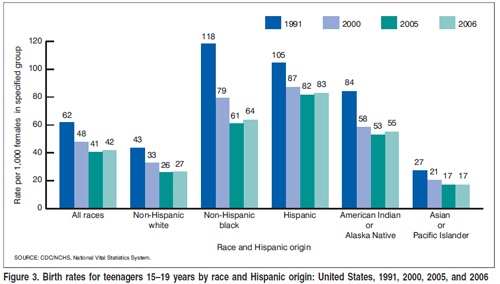
Source: National Center for Health Statistics.
So teen and early births are part of the story. But birth rates increased for women of all ages, so it's not the whole story.
Another answer is single women. The birth rate among unmarried women is up 16% since 2002, and the rate has more than doubled since 1975. That's not just because there are more single women. Unmarried women in every age group (except teenagers) were more likely to have children in 2006 than ever before (at least back to 1970).
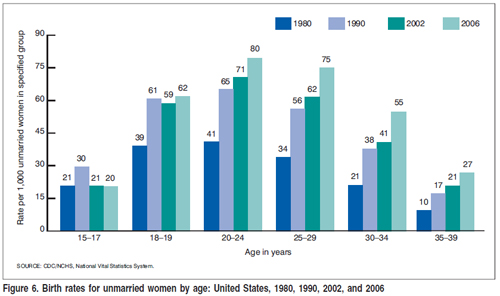
Source: National Center for Health Statistics.
And when you separate out married from unmarried women's births, you see that although fertility rates for both groups are up in the last 10 years or so, it is unmarried women whose rates have increased the most since 1980.
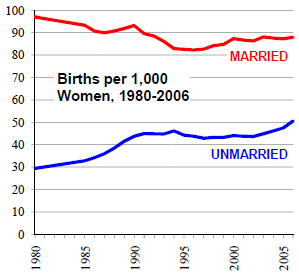
Source: Cohen chart from NCHS data.
As a result, the fraction of all children born to unmarried women is at its highest level ever, 38.5%, more than double what it was in 1980. (Some of these women are living with unmarried partners, but that's not recorded in these data.)
I have previously written about the stall in progress toward gender equality, which includes more traditional attitudes about gender relations and roles. In light of that trend, this is my suggestion for why we see more children, and more children born to unmarried women:
More Americans are embracing "neo-traditional" attitudes in some respects -- especially by embracing motherhood as a highly prized cultural value, including the so-called intensive parenting. Even if the declining employment rates for women don't reflect general support for "opting out," the cultural elevation of women who choose to stay home with their kids is palpable. This is why we see more 3- and 4-child families in the middle class.
On the other hand, one norm that is not coming back is the taboo against unmarried parenthood. That cat appears to be out of the bag, so that unmarried women are relatively free to pursue their motherhood dreams, as chronicled in recent books about both poor women (Promises I Can Keep) and middle class women (Single by Chance, Mothers by Choice).
All of this means that, rather than being on the "decline," the American family as an institution is on the move, and the diversity of its forms is a hallmark of the current era.
Want to reply to a comment? Hint: Click "Reply" at the bottom of the comment; after being approved your comment will appear directly underneath the comment you replied to
IMO we should all be having more sex and less babies.
I'm sorry that was way over generalized - and not really right. No one should say what we "all should" do
Could it be Gen Xers as parents? Perhaps they want to create the big, loving family that they never had? Gen Xers were the "latchkey" kids. And they're also, understandibly, the most protective generation of parents that we've had in decades.
"More Americans are embracing "neo-traditional" attitudes in some respects -- especially by embracing motherhood as a highly prized cultural value, including the so-called intensive parenting. "
Well, that is rather gilding the lily, I'm afraid. The actual dirty truth is that our population is aging and women are selfishly choosing to have babies out of wedlock for purely emotional reasons as their biological clocks begin to tick and not because of any idealism about motherhood. Single motherhood, in its usual form, where the father is largely absent in the child's life, increases the likelihood that the child will use drugs and end up in poverty and jail. That is a big risk for a feel good decision.
Just as the mortgage crisis was in part due to the financial industry working the public's capacity for self delusion, so it is that these kids are being born out of wedlock.
So, when things get better, refinance the kids is it ?
So you don't support the idea of women of all ages and lifestyles freely choosing whether or not to have babies?
This is actually really interesting. For one thing, I wonder if the rise in teenage birth rates doesn't have to do with the push towards abstinence only programs of sex ed. While social stigma is not a GOOD thing necessarily, it serves a social purpose and that, I think, is that it discourages young women from having children as teenagers. This is not to say that all women have who children as teenagers are problematic, but I think that there are many unanswered questions about the lives these children will lead, particularly if born into poorer homes.
I also wonder if after years of single child households lots of those single children aren't saying "Hey, I think I want to have a big family." Now anecdotal evidence is not good evidence, but it occurs to me that I have had several friends have conversations with me about how they want big families because they always felt like their friends who had big families had happier, better homes than they did. It's possible that these people are thinking in a more open way about bigger families because they're offsetting for the 'faults' of their parents generation. It happens in a lot of other ways, doesn't it? Kids reared in too-strict families give their own kids lots of leeway, and those kids feel like their parents weren't "parental" enough, so they try to do the opposite with their own kids.
HuffPost's Pick
I am curious about whether people on the left think single motherhood is a positive or a negative (or somewhere in-between).
IMO, the rise in teen pregnancy is not positive. I am glad the stigma toward teen/unmarried pregnant women is gone. Yet, I do not think we should embrace it among teenagers. When one is in the supermarket checkout line, one can see all of the magazines covered in stories about stars that are pregnant. Yes, this includes teens now, too. However, I do not think it is just the pregnant teens that effect the teen girls in our society. I think that maybe it is *all* the pregnancy coverage. In other words, our celebrity rags gush over pregnant women. It is great to be pregnant if you want to be, I am not saying that we just dismiss it. Yet when we celebrate it to the point that there are many pregnancy stories covering the magazine covers, I think that for some teen girls, this opens them up to it. They see the rewards, the attention. Of course there must be other factors as well. I am just saying this might be one of them.
it might have something to do with the "sex sells" attitude, mixed in with abstinence-only education. mixed signals much?
That, and all those commercials late at night for All Natural Extenze might have something to do with it.
See Philip N. Cohen's Profile
I agree with lisa12345. Research shows that teen motherhood does seem to have negative consequences on schooling and employment for the mothers. But I don't think this has to be the case. The costs of motherhood arise from the distribution of care responsibility and labor. Who takes care of the kids? I think the negative consequences come from these burdens falling on the mothers. For a progressive economist's view on this, consider the book, Valuing Children: Rethinking the Economics of the Family, by Nancy Folbre (2008).
"embracing motherhood as a highly prized cultural value, including the so-called intensive parenting. "
I've never understood this thinking at all.
Just watch TLC with The Duggars and Jon and Kate + 8 = an environmental disaster. That channel seems to be all large family shows.
AZ, I hear you. I was raised to think that motherhood wasn't really important. But today I'm a 43 year old mom of girls ages 4 and 16 mths. When I look back, I see nothing I could have done could be MORE important than doing my best to raise smart, healthy, wonderful girls who will one day help make this world a better place. In the 70's, every one looked to teachers, books and their authors, celebrities, or friends, for influences. Boring, old, average moms were out of favor. But you know what? People can't get to the moon if there aren't moms and dads somewhere raising astronauts. Doctors and artists aren't born in vacuums. On the contrary, indifferent parenting breeds mental and societal distress. So I'm determined to be the best parent I can be. When people think there are better things to do than parent a child, we see the results in psychiatrist's offices and at night on Nancy Grace. I'm glad people are coming to think parenting is important. It's about time. It's hard work, but somebody has to do it. Now, let's start putting in the effort needed to do it right.
You must be logged in to comment. Log in or connect with