- BIG NEWS:
- Barack Obama
- |
- Joe Lieberman
- |
- Sarah Palin
- |
- GOP
- |
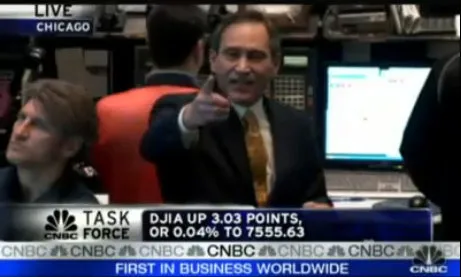
Rick Santelli's rant on the floor of the Chicago Board of Trade has been repeated ad nauseum on You Tube and cable TV, and the effect lingers. His self-righteous outburst directed at down-on- their-luck foreclosed home buyers amounts to what the late sociologist William Ryan termed "blaming the victim" or more specifically ''justifying inequality by finding defects in the victims of inequality.'' Unfortunately, quite a few people -at least according to a recent Rasmussen poll--seem to agree with Santelli. The poll last month found that fifty-five percent (55%) of American adults "say the federal government would be rewarding bad behavior by providing mortgage subsidies to financially troubled homeowners."
Santelli's smug imprecation is much more than a punitive response to President Barack Obama's efforts to help people who got in over their heads trying to stake a claim to The American Dream. The Santelli, Rush Limbaugh, and hate-talk radio screed is directed at a whole category of people whom they regard as "undeserving". This ideology of contempt toward urban-working-class people is a rehash of the Reagan-era enmity toward food stamp recipients, the unskilled, the black unemployed and "welfare queens", as the 40th President of the United States liked to put it.
Such individuals are often grouped together singularly and anonymously by conservative demagogues. But if a face and name were placed on some of the millions of down-on-their-luck individuals, would those among us who might feel as Santelli does broaden our points of view? Would we consider some--whom we may have written off in the past as "undeserving"-- worthy of our collective empathy? I offer three examples on the eve of our modern Depression:
Felipe Jesus Perez:
Farm worker Felipe Jesus Perez wants his three young children to go to college one day. So to encourage them, he takes them to a local library once a week in California's San Joaquin Valley. He doesn't want to see them working the farms that he labored on for two decades. Perez lost his job in the fields in 2003 after his foot and tendons were crushed in a cotton harvester. He uses a cane to get around the tiny town of Firebaugh in Fresno County, which ranks dead last on the American Human Development Index. With a smile on his face Perez told me he's still willing and ready to work. But there are no jobs. An estimated 30 percent of the county's agricultural laborers toil only seasonally, and the last few seasons--arid, hot and dusty--have been a disaster. The family lives on fruit and vegetables plucked from a tiny plot of land made available by the local government. They receive some federal assistance as well. So do many other men and women in the Central Valley. Some worked sunset to sunrise to pay mortgage payments but still lost their homes. They are now excoriated by the Santelli's of the world for "not playing by the rules". Exactly whose rules? And does that mean that people like Felipe Jesus Perez do not deserve a home of their own?
Molly Secours:
Molly Secours is a freelance writer and filmmaker living in Nashville. She is barely middle-class but not exactly poor. A year and a half ago she was diagnosed with uterine cancer and spent much of 2008 in chemotherapy and radiation. During that time she never missed a single mortgage payment.
But now she's two months behind and is being threatened with foreclosure by First Franklin Loan Services, which raised her interest to nearly 10 percent. Link
She told me that she's more than willing to pay the mortgage, but the bank executives have been unwilling to consider changing the terms of the loan. First Franklin is a subsidiary of Bank of America, which, of course, is the beneficiary of a massive taxpayer bailout and that now owns Merrill Lynch, the company that awarded its top executives $3.6 billion in bonuses just before the merger with B of A.
Secours, who has spent years documenting homelessness and other social problems in Nashville, last week sent an open letter to President Obama seeking his intervention. Link
A man with no name and no home:
His body was found at the bottom of an elevator shaft in a warehouse in Detroit, a city that has become a metaphor for misery. The caller to The Detroit News said that the only visible part of his body was his feet, sticking out of a block of ice "like Popsicle sticks". Link
No one knew his name but a lot of people in subsequent phone calls to area radio stations knew at least one person who had either become homeless or was on the verge of losing their home due to foreclosures, joblessness, illness or a combination of all the above. Many callers reflected on the symbolism of the building where the man was found. The Roosevelt Warehouse, according to the newspaper, was used by the Detroit Public Schools as a book repository. Reporter Charlie LeDuff described it this way "the warehouse burned in 1987 and caused something of a scandal as thousands of books, scissors, footballs and crayons were left to rot while Detroit schoolchildren - some of the poorest children in the country - went without supplies." It is easy to surmise that the man found at the bottom of the elevator shaft encased in ice; a man with a name after all (it was Johnny),was once a student in a city where education, unemployment, foreclosures and homelessness abound; a man whose ultimate learning experience was that no one thought he was worthy enough to care.
We Americans pride ourselves on the ability to move from one station in life to another; to move from renter to home owner, from poor to middle class, from barely-educated to a PhD. And all of those things are still possible. But as economist Paul Krugman has made clear in his studies on social mobility and as Malcolm Gladwell explains in his most recent book "Outlier", getting from point A to point B is often a matter of coming from a solidly middle-class background, owning a home, having the right connections and lots of cash and just plain luck. Those items fall outside of the realm of merit.
That brings us back to Rick Santelli. Central to the discussion about "rewarding bad behavior" is the issue of meritocracy or the notion of "who is worthy." Take for example former Home Depot CEO turned Chrysler CEO, Robert Nardelli. Nardelli received more than $200 million in severance payments and other executive compensation from Home Depot. He left the company in bad shape but was quickly hired by Chrysler. At the number three U.S. auto maker he has done little short of seeking a tax-payer bailout to turn things around. Yet, he would be viewed by many as worthy by virtue of his station in life. There are multiple examples that should make us re-examine the whole notion of meritocracy. Perhaps the most egregious is Bank of America's $3.6 billion rewards to Merrill Lynch's executives who presided over the financial services firm's dramatic demise. For the record, $3.6 billion would provide 120,500 jobs paying $30,000 per year to farm workers in the Central Valley or would pay for 200,000 homes in Detroit, where the average house is worth only eighteen thousand dollars or would pay for the care of thousands of people who are losing the roofs over their heads due to catastrophic illnesses.
Merit is a concept that is fraught with contradictions: On one hand Americans cite it as the only legitimate measure of achievement. Yet many of the most privileged Americans work overtime to avoid paying estate taxes, which would impose limits on the millions of dollars left to their children, among them some who may not have performed a days worth of work.
Meanwhile, too many of us continue to demonize hard-working people in our nation who were advised to "pull themselves up by the bootstraps", buy homes and advance through life. It has not worked out well for Felipe Jesus Perez, Molly Secours and a man in Detroit, who had no name and no home, but who, nevertheless, was worthy.
Want to reply to a comment? Hint: Click "Reply" at the bottom of the comment; after being approved your comment will appear directly underneath the comment you replied to
Thank you, Mr. Martin for writing that.
Santelli, on the other hand, is probably sees his bread as buttered by the very wealthy who stand to lose some of their excess wealth with the new rules being set up by the Demos. So, of course, they can only keep their wealth by the divide and conquer tactic that has seen better days, it's been used so much by the Republicans. It's too bad that they just don't get it. You can fool some of the people . . .
I think that painting the people who are going underwater with one brush stroke is an ingenious way of distracting us from the greed of the financial marketeers who have been steering this ship straight into an iceberg. The working young folk who accepted what they were offered are the victims here, along with those who live modestly, who were also victimized. Let us not forget that the American People have always relied on banks to run the books with a high degree of ethics, and that today we see the results of those banks who were not run by ethical people. Those people must be named and they must pay the price, not their victims!
He needs to come to reality of life...
and see what past administration did...
LEWIS should resign...
Meritocracy is a very dangerous idea, creation a notion of the deserving poor. It can be used by the elite to justify their position as the elite by saying they are there because they deserve to be there, thus ignoring inherited privlidge and the unequal distribution on, among other things, wealth and opportunity is society.
This is a great article by Michael Young, the man who coined the term meritocracy back in the 1950s (but he never meant it to be a good thing). The article does focus on the UK, but the ideas and criticisms of meritocracy are universal.
http://www.guardian.co.uk/politics/2001/jun/29/comment
Phillip--awesome post my friend
It's ironic to note that the term "meritocracy" was invented by a British nobleman.
it was actually inveted by a british social democrat called Michael Young, who coined the phraise in an essay arguing against what we now call meritocracy.
Read this article by Young.
http://www.guardian.co.uk/politics/2001/jun/29/comment
a little focused on the UK, but its criticisms of meritocratic government and rule are universally valid.
Tony Blair gave Michael Young a life (non-hereditary) title and a seat in the House of Lords for his work for the Labour Party. His son Toby had some interesting observations on how the British class system actually guilt-trips the rich into helping the poor, while the American class system has you believing you earned your slot at the top even if it was one of your ancestors who clawed his way to it.
Too many real people are being bashed up by the meltdown for easy victimhood generalizations by the likes of "wall street" Santelli. On the other hand it's tempting to make perpetrator generalizations when those lucky "Masters of the Universe" steal their fill of bailouts and bonuses while their conservative allies want to deny redress to victims.
To the comments about all those undeserving irresponsible homeowners: the Administration has pretty much addressed the moral hazard side of things by limiting the benefits only to people who've been on their very, very best behavior. In fact, the program is probably not quite inclusive enough to bolster the bigger picture.
Very good point. It seems to me that too often "meritocracy" is a code for "reward the ruthless, punish the compassionate." Sure, it seems fine to give greater reward to a highly competent mechanic than to barely or incompetent ones; likewise for plumbers, pilots, etc.
However, many jobs, especially ones in management and finance, seem to see merit in terms of ruthlessness, the willingness to maximize profits no matter who gets hurt. In competition for promotion, the more ruthless of two equally-qualified mechanics is more likely to get promoted since putting the customer ahead of profit can interfere with maximizing profits. This is one of the great pitfalls of "meritocracy" that true believers can't see.
I think your article is good, but it misses something that is true about people: if I am doing better than my neighbor, then all is right with the world. It is the reverse of keeping up with the Jones.
Most of the people who have a personal story of someone they know living high on the hog causes them to ascribe those same misfortune to the other dumb, sorry sods. After the Tsunami and Hurricane Katrina, pundits came up with a term 'giving fatigue'. People started telling themselves that it was too bad that others were suffering but they had done their part already.
We care nothing for the sorrows of others so long as it is not us. It takes something greater than ourselves, an entire economic collapse, to get our attention. Everyone but us is to blame.
Being caught unawares in a natural disaster is not the same as consciously signing your name to a contract for a property that you should have known was beyond your means.
Signing your name to a contract for a property that you should have known was beyond your means is the not the same as buying a property just before the biggest Wall Street crime ever collapsed, leaving you holding the bag, unsure of your future income or already unemployed, owing far more than the property is worth, with moralistic hecklers justifying the larger crimes by holding you personally responsible for not discovering the larger crimes before you signed on the dotted line...
But in pure economics, there are no moral arguments. If the property is worth less than the mortgage, you should walk away and not pay. That is exactly the quid pro quo, and exactly why the government must intervene, because this will make it worse.
Talking morals, the lenders also knew the risks when they signed, and they were professionals, not you.
What about the the banks, mortgage brokers, and bond raters who ignored their fiduciary duty and wrote loans to anybody they could con into signing on the dotted line. The FBI has been investigating mortgage fraud by the financial and they have a term for it "control fraud"
yesterday on cnn they were interviewing a teary eyed woman who is begging for help or she will lose her home. at first i started feeling bad for her until they asked questions. she is a bus driver who bought an $800 000 home. now i like bus drivers but i make about the same money and no way could i ever ever think i could buy a home that expensive.they even have bumper stickers now that say honk if youre paying my mortgage.
I remember a comments by Anne Richards or Molly Ivins about one of our faux populist and self-deluding politicians... "Poor ****, He was born on third base and thinks he hit a home run"
just having lived for a time in a community where there are Non-rich people does not necessarily acquaint you personally with the realities of non-rich life; and luck of genetics ( who your parents were and their economic status) is a huge determinant on one's upward or downward mobility and downward mobility may be even less deserved than the occasions of upward mobility
This is exactly how Santelli wants people to react. If taxpayer dollars are used to stop foreclosures, then prices stay high and banks keep getting paid. The rich get richer and homeowner's net worth rises for doing nothing.
What about the rest of us? What about those who don't own homes and are tired of seeing prices climb higher and higher out of reach? We're watching our hard earned dollars become less and less valuable because people demand for their homes to be 'investments' rather than our shelter.
Stop the bailouts and let home prices fall. Then, we can buy ourselves a home without signing our entire life over to a bank.
Why shouldn't we limit the number of residences someone can own when they aren't used personally by the owner. For those who are wealthy and have vacation homes, fine. But if you're a no-talent who thinks he's found an easy way to wealth by buying "investment properties," then you do nothing for society and you should be limited. These people ruin neighborhoods and communities, they create instability, and contrary to the propaganda, they don't "improve" properties. They rush up junky spec houses or slapdash remodel older buildings, they run roughshod over neighborhoods, and they do this because they don't live in these places. They use the street you live on as a cash cow. They are parasites, just as surely as predatory lenders have been.
Well, if we take your course, you and the rest of you will have to buy your homes at rock bottom prices without signing your entire life over to the bank.
That's because the banks will be gone if we follow your plan, dissolved, bankrupt, kaput.
And I don't know that you'd be any closer to buying that home after the entire economy collapses around you, paper money won't be worth toilet paper, which is softer for the purpose, and you'll probably be just as far away from having enough money after the collapse to buy even a rock bottom house (of those left standing after the riots), given that you've been so unsuccessful at accomplishing this when money was easy...
" . . . given that you've been so unsuccessful at accomplishing this when money was easy"
Talk about heaping scorn on contempt. Seems the Sopranoization of the once-dignified banking profession is widespread. So oustfan comes in for sneering because . . . because of what? Because he was responsible enough not to have jumped aboard just because everyone else was?
News flash genius, the banks are already kaput, but like all zombies, they're not fully aware of it yet. And maybe if the top "talent" at these zombie shells weren't still so greedy as to gobble up inordinate amounts of toilet paper, then maybe the public would be more disposed to be patient.
I'm not a Santelli champion, but then current public opinion suggests that unease over home loan do-overs is more widespread than the ranting of one talking head.
Who could not sympathize with the plights of the unfortunate you offer as examples? But I question your own rhetorical strategy of contrasting the most pitiful on one side with corporate greed and excess on the other. Have you considered whether the public's uncertainty about mortgage rewrites might have to do with folks somewhere in the middle--folks whose own "victimhood" might not be as sympathetic as would have served in this essay? I'm talking about the kinds of people many of us in L.A. (granted, a shallow, materialistic town to begin with) have seen these past years: speculators, house flippers, and regular folks who should have known better than to sign for a half-million-dollar house.
You would have us sympathize with those who just wanted to get their share of "the American dream." That's an emotional way of describing some people who irresponsibly signed documents with adjustable terms for properties that were too big to begin with. In 1970 the average house was around 1,200 square feet and had one bathroom, for a family of 3 children. Today those figures are changed greatly--a gross distortion of "the American dream." There are victims in this disaster, as you point out. But you make a mistake in suggesting that mortgage rewrite critics are without their reasons.
And what you pose my friend is a false dichotomy: That millions of people who have fallen behind are a fit one size take all example of irresponsibility. That is my very point. There are a million stories in this Naked City, and the circumstances that led to individual foreclosures vary from case to case. There have been stories about both parents working and able to pay the mortgage even when it was adjusted. There are stories about some who indeed could not afford to pay from day one. There are people who bought modest 1200 sq ft homes and there are those who bought into bigger places. And middle class people who are upset with their neighbors who foreclosed and may now be rescued might be better off directing their ire at the barely regulated institutions that have been allowed to charge "crazy" interest, change the "rules" at will and run down the economy. The question is, what is the greater contradiction in the context of the mess we're in?
You're right--primary blame goes to the institutions that enabled this situation in the first place. What they did was irresponsible and greedy. But you know there are people who continued to stay in tiny apartments through this cycle, who saw the frenzy and the too-easy terms, and made the hard choice to sit out the bubble because of a voice that said, if it seems too good to be true, then it probably is. At the same time I know plenty of people (some of them relatives) who saw nothing but easy money, new cars, and houses with three bathrooms and more living space than they needed, and said, whatever, I'm in. Those of us from another America, who had Depression-era parents who chewed half sticks of gum at a time, have a psychological barrier against granting a do-over to the Louis Vuitton purse crowd (or the SUV crowd, or the Starbucks crowd--pick your own vanity status symbol). They don't get my "ire." But they shouldn't get a do-over.
You must be logged in to comment. Log in or connect with