
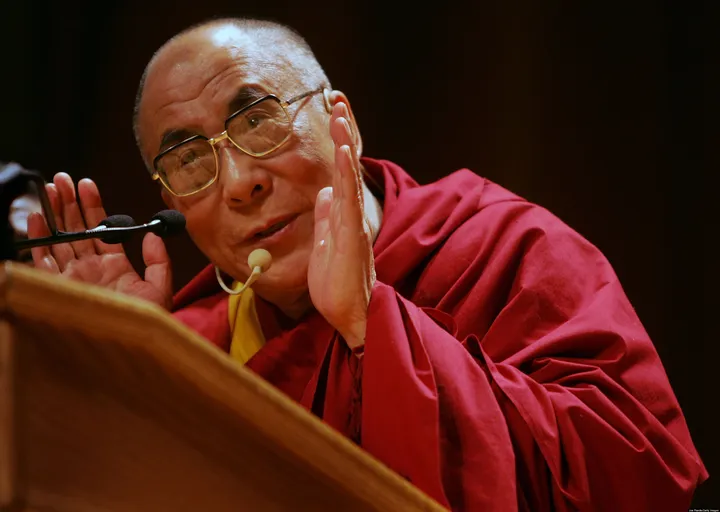
Once considered esoteric by most Westerners, Buddhism and psychoanalysis have come to infiltrate much of contemporary culture. His Holiness the Dalai Lama has become a universal symbol of peace and good will. Buddhist meditation centers abound in most urban centers, and increasingly the scientific community has given credence to the ameliorative impact of meditation on many psychological struggles, including depression and anxiety.
The same is true for psychoanalysis. What was once a stigmatized option for the mentally ill and affluent, therapy -- at least in most urban settings -- is today almost a rite of passage. It's the rare New Yorker who has made it through the various travails of contemporary life -- finishing one's formal education, finding a partner, making a living -- without seeking some form of psychoanalytic support. Add to these pervasive struggles the distressing issue of terrorism, the rise of childhood diseases including autism and leukemia and the onslaught of stimulation from advances in technology, and you have a population increasingly eager for help in finding psychological and spiritual wellness.
What has changed in recent years, and captured the attention of both Buddhist teachers and psychoanalysts, is the fascinating relationship between these divergent traditions. Today, there are growing numbers of people looking for therapists who respect their need for meditation and spiritual support. So too, there are scores of long-term (even second generation) meditators who have come to realize that spiritual practice does not always eliminate the psychological problems they hoped it would. In this way, these two radically different approaches to wellness have begun to intersect with new levels of respect and curiosity.
As a caveat to this growing conversation, scholars of both traditions have been quick to point out that the differences between these two healing realms are extensive. Buddhism arose some 2,500 years ago in India. Its founder, Siddhartha Gautama, was a young man of great wealth who grew up in cloistered privilege. It was through his introduction, at the age of 29, to the suffering world of sickness, aging and death that he was inspired to explore how we might relate to our basic vulnerability and still remain happy. In his 84,000 ensuing teachings, he emphasized that despite the pain we would invariably endure, happiness was our most basic birthright.
Psychoanalysis, in contrast, first developed in Europe just over 100 years ago. Sigmund Freud, its founder and steadfast protector, lead a radically different life from the young Siddhartha. At an early age, Freud knew the pain of loneliness and struggle and went on to suffer the traumas of anti-semitism, two world wars and the loss of a child. It is not surprising that his approach to healing would posit a basic conflict inherent to the human condition. Freud believed that much like the warring world that raged around him, within our own psyches was another kind of battlefield of raging instincts that constantly seek expression. His was a more pessimistic view: that the best we can do is find ways to sublimate our sexual and aggressive urges and settle for "common unhappiness." Yet, he brought to light the impact of the unconscious, and the ways in which we can live with less suffering and more integrity if we accept the truth of what is in our unconscious.
The interest in how Buddha Shakyamuni's approach to wellness might converge with Freud's, began more than 60 years ago. In the 1950s, psychoanalysts including Karen Horney and Eric Fromm wrote about their growing interest in Zen Buddhism, and its more hopeful vision for how people might come to genuinely enjoy their lives, despite the pain of loss and the power of desire. In the intervening years, many more therapists and Buddhist teachers joined in this conversation, exploring the tools of each path, and seeking creative ways to bring them together.
Such theorists point out that each tradition has something unique to offer and limitations to overcome. Psychoanalysis has been extremely useful in helping people understand how their earliest experience of relationship influences their sense of self and their approach to interpersonal relationships. It has respected the importance of early childhood and the particular ways in which each individual will respond to his or her caretakers. The downside of this self-centric process, say its critics, is the solipsism that can result from too many years of parsing personal struggles.
Theorists interested in how Buddhism and psychotherapy might work together, have suggested that this very solipsism is powerfully challenged in Buddhist practice. Buddhism takes a more universal view of our human struggles, suggesting that all of us, regardless of our caretakers or personal traumas, can be helped by remembering that everything changes, including our most entrenched struggles and vexing relationships. It's simply the nature of reality. So too, we depend upon each other for everything -- our food, education, healthcare, companionship. According to Buddhist thought, none of us can get through this life, or achieve abiding happiness, alone. So it makes sense to treat each other with genuine care, knowing that we share the same wish to be happy and free from suffering.
Today, these two paradigms are mixing minds and ideas through an expanding population of Westerners who want to understand the influence of their own personal history, while not getting too caught up in it. In this way, Buddhism and psychoanalysis have begun to cultivate a true partnership that seems to be ushering in wellness on a new scale.
Sogyal Rinpoche: How Buddhist Meditation Unlocks Our Natural Wisdom and Compassion
Zen Buddhism and Psychoanalysis by Erich Fromm | LibraryThing
Wisdom Publications :: Mixing Minds : The Power of Relationship in ...
Dr. Pilar Jennings • Mixing Minds
Mixing Minds 12/10/2010 - exquistemind | Internet Radio | Blog ...
Mixing Minds - Book Launch & Signing | Tibet House US Programs
Mixing Minds: The Power of Relationship in Psychoanalysis and ...
Blogtrotter: Pilar Jennings' "Mixing Minds: The Power of ...
So while Buddhism is very useful in practical therapy for topics of mindfulness, it is not so useful in areas like CBT or classical psychoanalysis if the patient does not buy into the illusion of “I,” which was central to the Buddha’s teaching.
http://appliedbuddhism.com/2010/12/10/the-buddhist-freud/
http://www.cavershamproductions.com/general/100-years-a-timeline.html
However they have not thought,through what happens next, to the planet or themselves .
Obviously the planet will continue on without them, and heaven and hell will now continue on with them. But to where?
This is the news release of Tibetan service of Radio Free Asia of December 24, 2010.
On December 24, 2010, the Prime Minister of Tibetan GovernmentÂÂ-in-Exile had a public meeting in Delhi attended by some Tibetan Parliament members,… representaÂÂtives of each province of Tibet, local Tibetans living in Delhi including a representaÂÂtive of Dalai Lama’s office in Delhi.
“Inside and outside of Tibet Shugden followers are opponents of his Holiness Dalai Lama. They are trying to divide Tibetan community and make it against Dalai Lama, so, for example, here, in exile in India, we almost completely won and demolished Shugden followers who used to be very strong in Delhi, but not any more because we, Tibetan people, acted bravely and without hesitation against Shugden followers. But some of the roots are still left, and the Shugden followers on the way stop by in Delhi and carry out some activitiesÂÂ. Now, without fear and hesitationÂÂ, we, Tibetans, must fight and destroy Shugden followers. I am urging you to act against hesitation and fear, but of course, I will not blame you if you fear – they will fight back fearlessly and may beat some of us or kill, but if you fear and do nothing that means Shugden followers are winning. Even though you may die or face beating you must fight – it I very important”ÂÂ.
Building on Freud, Melanie Klein showed how we distort our perception of the world in order to cope with its disappointment and frustration. The concept of the delusional self, and the need for self-realization to overcome these delusions, and the development of mindfulness, are all themes that run through both Western Psychology and Buddhism.
There are many areas of overlap between Eastern and Western Psychology, and there are also some differences. However, many modern day psychological viewpoints can be framed within the foundations of thought laid down 2,500 years ago in India. Modern man, and those who came before, all experienced the same pains of anxiety, depression, and other common mental health problems. It is not surprising then that both the modern and ancient concepts of these ills, and the therapies to deal with them, are remarkably similar to each other.
fanned!
Buddhist psychology can be viewed as one of the first, systematic attempt at cultivating a state of mental wellbeing. The Buddha often engaged in the practice of listening to the mental and/or spiritual condition his adherents would describe, and then prescribing a therapy to help them resolve their conflicts. The Sutra on the Four Establishments of Mindfulness (MN10), is a compendia of these remedies and form the basis of much Buddhist practice.
The Abhidhamma, a fourth century C.E. text representing the original teachings of the Buddha is considered to be the world’s first text on therapeutic psychology. The Buddha himself said that his teachings were whatever led to the end of suffering. As such, Buddhism can and should be viewed first as a therapy, even before looking at it as a philosophy or a religion.
The foundation of Buddhist Psychology lies in direct experience. Much has been written in Buddhist texts on the manner and method in which perception is distorted by delusion. In Buddhism, clear perception is known as vidya, and delusion is avidya. In an enlightened state, our minds are clear and unconditioned by struggles with pain and suffering (dukkha). Vidya frees us from avidya, and opens our minds to clear perception. The conditioning of our mental states is driven by vidya and avidya. This is central to understanding Buddhist Psychology.
faved, since a fan!
Yes, but while Western medicene has concentrated on defining unhealthy states of mind, the west has been unclear what a whole, enlightened human being would look like.
On the other hand, the East has traditionally been unclear about what causes mental illness, but Buddhism is clear about what a healthy, whole human mind looks like (The example of the Buddha) and gives a detailed path to get there. Buddhism also affims a complete, unconflicted, mental state is available to all.
Not to underline it too much, but both have approached the problem of human happiness from opposite directions. Perfect for a troubled mind would be adepts from both traditions, don't you think?
(I know that's how i got my funky on. ;)
The first speaks to your statement which I agree with very much 'Perfect for the troubled mind would be adepts from both traditions'
The Monk and the PhilosopheÂr [a conversatiÂon] Jean-FrancÂois Revel, Matthieu Ricard
And the second, rather recent, is extremely clear and on point, and good for those seeking as well as those with many years practice. It is a very well done sum. Wu Shu direct.
What Makes You not A Buddhist, by Dzongsar Jamyang Khyentse – Shambhala
See you around in funkytown.
Nego
book called
mixing minds
best book
I can see in the West how Freudianism was necessary to advance people's concept of the self--but it is no exaggeration to say that comparing it to Buddhism is like comparing a child's big wheel to a 1200 Harley-Davidson. To say they are remotely comparable is absurd.
fanned!
This is the news release of Tibetan service of Radio Free Asia of December 24, 2010.
On December 24, 2010, the Prime Minister of Tibetan GovernmentÂ-in-Exile had a public meeting in Delhi attended by some Tibetan Parliament members,… representaÂtives of each province of Tibet, local Tibetans living in Delhi including a representaÂtive of Dalai Lama’s office in Delhi.
“Inside and outside of Tibet Shugden followers are opponents of his Holiness Dalai Lama. They are trying to divide Tibetan community and make it against Dalai Lama, so, for example, here, in exile in India, we almost completely won and demolished Shugden followers who used to be very strong in Delhi, but not any more because we, Tibetan people, acted bravely and without hesitation against Shugden followers. But some of the roots are still left, and the Shugden followers on the way stop by in Delhi and carry out some activitiesÂ. Now, without fear and hesitationÂ, we, Tibetans, must fight and destroy Shugden followers. I am urging you to act against hesitation and fear, but of course, I will not blame you if you fear – they will fight back fearlessly and may beat some of us or kill, but if you fear and do nothing that means Shugden followers are winning. Even though you may die or face beating you must fight – it I very important”Â.
For those, however, who know something about this controversy, here's a link to counterbalance your distorted views:
http://thedorjeshugdengroup.wordpress.com/
Namo Amida Bu!
Namaste!
faved, since a fan!