
iPhone app iPad app Android phone app Android tablet app More

Featuring fresh takes and real-time analysis from HuffPost's signature lineup of contributors
Qanta Ahmed, MD

GET UPDATES FROM Qanta Ahmed, MD

Collateral Damage: The Hidden Costs of the Ariel Boycott

Posted: 10/06/10 11:11 AM ET

This summer as a Templeton-Cambridge Fellow in Journalism I was engaged in multidisciplinary seminars focusing on science and religion moderated by speakers from all over the world, of every religious persuasion. One of the most memorable speakers this year was Noah Efron, of Bar Ilan University in Tel Aviv who came to speak to us about Science and Judaism. Learning from him was a luxury and sadly one which is increasingly challenged: more and more institutions would like to bar academics like Noah from pursuits like this fellowship because of his Israeli nationality and affiliation. Noah himself wrote about the issues of cultural boycott eloquently in Ha'aretz recently.
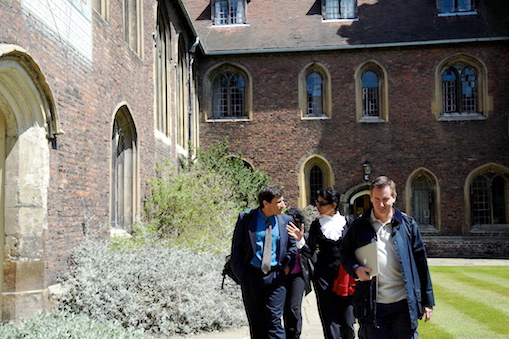

2010-10-03-CambridgeJune10DSC_4383Version2.jpg

In conversation with Noah Efron at Queens College, Cambridge England earlier this summer during the 2010 Templeton-Cambridge Fellowship in Journalism


In an increasingly polarized world, anti-Israeli boycott as a means to influence political climate is urged more and more often. The cultural boycott of Ariel seeks to penalize spaces which should remain sacrosanct, and devoid of political positioning. Prime Minister Netanyahu recognizes these risks well:

"The State of Israel is under an attack of delegitimization by elements in the international community. This attack includes attempts to enact economic, academic and cultural boycotts. The last thing we need at this time is to be under such an attack - I mean this attempt at a boycott - from within."


Cultural and academic boycotts carry their own special devastation taking causalities on all sides of ideological divides. As a Muslim physician enriched by American Jewish and Israeli colleagues I feel especially strongly that channels of collaboration and engagement must always remain open. Such dialogue is especially important at times of heightened tension.

Yet I only became aware of mounting calls to boycott Israel within my field recently. A fellow Muslim colleague wanted to know my thoughts on a very strongly worded call (published in The Lancet) for the medical academe to cease all interactions with Israeli investigators and Israeli projects.

The authors, British academics, had published the medical sequaelae of events in Gaza in the aftermath of Operation Cast Lead. In conclusion, my British peers called for trade and academic boycott against Israel. This astonishing statement was met without chagrin. My own letter of objection also went unpublished, not only in The Lancet but also in two of the premiere US medical journals where I subsequently re-lodged my protest. Perhaps my objections were deemed worthless. Perhaps the journals did not wish to engage in an uncomfortable discussion. Perhaps, I privately worried, these views were shared.

Had there been other such precedents for such an outrageous call? I searched the NIH Library of Medicine expecting to find dusty accounts of academic boycott impacting a bygone South Africa, not because I equate Israel with Apartheid, but because I grew up in England aware of the trade boycotts against South Africa at the time. Trawling through the medical literature, I stumbled across reference after reference on academic boycott against Israel. Apparently a vigorous debate had been unfolding for some time. When I began quizzing my US physician colleagues, I found they were as surprised as I. This controversial discussion had been going on under our radar. Soon I encountered papers calling for academic boycott against China, finally a series calling for boycott against Saudi Arabia.

Had a Saudi boycott actually transpired, my career would have been significantly limited. Because of my excellent American mentors and their training, I could share some of the finest aspects of an American medical education and in return be informed by their unique and extraordinary medical expertise. Intellectual capital remains America's best export, priceless in the post 9-11 era. That's something even MasterCard cannot buy.

Israel and its physicians, scientists and artists are no different. We need their intellectual capital just as much. The Senate at the University of Johannesburg understands this, voting to defend their right to engage with Ben Gurion University this week, despite mounting pressures to cancel their academic collaborations. The extraordinary successes Israelis have demonstrated through a nearly peerless intellectual aegis is something all of us must learn from, particularly within the surrounding region. David Brooks expressed this best earlier this year writing about the The Tel Aviv Cluster. Boycotts, like the one proposed by The Lancet seek to put a stop to exactly such valuable exchanges.

I am learning that the acquisition and dissemination of knowledge, very much in the spirit of tikkun olam is a quintessentially Jewish pursuit. My friend Alex explained to me recently that central to being a good, believing Jew is a deep sense of responsibility to serve others, including non-Jews like me. This is very similar to the value placed on knowledge within Islam, in fact, which must be shared to serve others. Ironically, this appetite and ability for knowledge has been very much to the world's benefit, despite pervasive hostility to God's firstborn.

But what has this to do with a theater in a West Bank settlement?

An internal cultural boycott focused on Jewish Settlements in the West Bank muddies the water in favor of those eager to condemn Israel and less willing to apply careful thought. To my mind, this instance of boycott adds to Israeli societal polarization at a time when national unity could never be more critical. Wondering what the Jewish view might be, I asked my thoughtful friend for his opinion. As so often, Richard's response surprised me.

It shows that Israel is a free country where people can express what they think. The same can't be said about the Palestinians; there haven't been any Palestinian peace rallies against suicide bombings or for the release of Gilad Shalit. There are Israelis who think settlements are a bad idea and have no reason to be afraid to express their views.


He didn't sound remotely upset with Israeli Jews for their protests. For sure, the freedom to express boycott does indicate an unfettered, confident populace. I could never imagine a boycott in Saudi Arabia, or Pakistan where lawyers protesting the removal of Chief Justice Iftikhar Muhammad Chaudry are briskly muzzled by the military and sent packing while justice is yet again dismantled. Israelis and their press are some of the most vociferous critiques of their government's policies, so Richard's observations made sense. But quickly, he reminded me of the importance of a distinction between this kind of boycott - of Israelis against other Israelis- from the boycotts writers in The Lancet appealed for. He continued...

....not to be confused with the overall boycott of Israeli professors or (Israeli) products because of the settlements, which is in fact antisemitism and not a Mid-East policy issue...


While Richard is correct - the Israelis objecting to Ariel's theater are not anti-Semites -I fear an increasingly hostile anti-Israeli world is much less likely to make this distinction. Instead, activity of this nature (while a function of a healthy citizen politik) lends fuel to the fire of anti-Israel sentiment and ultimately risks inviting ever greater pressure for Israel's isolation.

Paradoxically, precisely such pressures ultimately seek to silence some of the very same Israelis who are themselves calling for the boycott of Ariel, voices like that of Amos Oz, one of my favorite writers. Daniel Barenboim's signature to the petition supporting the Ariel Boycott saddened me particularly. Eventually, he himself may find his organization and their remarkable efforts the subject of boycott by narrow-minded individuals -emboldened by this climate tolerant of boycott - who either do not believe Israelis and Palestinians can collaborate, or believe (because of their vehemently anti-Israeli stance) Barenboim's do-gooding must be strangled in its infancy

Boycott is a blunt instrument. Boycotts focus on arresting the most valuable yet vulnerable freedoms: freedom of thought. Like a cluster bomb, boycotts are not particularly surgical in its strike, instead reeking extensive collateral damage. At an individual level, boycott strangulates one career. At a national level, boycott penalizes a critically important and growing sector integral to effective counter terrorism and national security: citizen diplomacy. Normally encompassing acts of service by one nation to another (the US rebuilding of maternity hospitals in Afghanistan or the pro bono relief work of the IDF in Haiti for example) diplomacy across divides can also accomplished by individual acts of public service. Israel, like the United States, has long been a setting for cross-cultural academic collaboration, whether in medical training programs, organ donor programs, collaborative research or cultural endeavors.

Whether we work in blood-stained operating theaters or in star-studded performance theaters it is exactly these apolitical opportunities which empower entire societies. Should the global medical academe move to exclude any nationality from international dialogue, including an Israeli national, my profession will penalize exactly those sectors of society best placed to provide hopeful counterpoints to mainstream assumptions.

The same holds true for artists. Silencing academics or artists through the misplaced moralizing of boycotts is a mistake of grave proportion . While Israelis understand an internal boycott to be an expression of impassioned democracy, enemies of Israel see this as yet another opportunity for her delegitimization.

Medicine, science and the arts must remain unbounded, free within pristine cathedrals, even in the context of disputed territories. Protecting these precious spaces is a shared responsibility which stretches across borders, religions and politics.. As physicians we have long relinquished autonomy in the field of science and medicine to the oleaginous interests of industry. We have learned from this. Let us not make the same mistake in relation to politics.

I support all Israeli scientists, physicians and artists and their academic efforts without restriction, and those who collaborate with them, because I am enriched by such collaboration both to my benefit and that of my practice of medicine. If I had been denied these opportunities, my views as a Muslim woman and my abilities as a physician might have been quite different. For others to be denied the same cannot go unchallenged. That applies to the Jewish settlers of Ariel too. Let politicians determine boundaries. Let artists and academics instead advance the limits of intellectual freedom not restrict them. Disputes over settlements can be battled without scuppering some of the best platforms for public discourse in an increasingly fractious world.Whether chairs of medicine, or studio bosses, whether musical impresarios or scientific investigators, whether theater directors or opera managers, all of us need to raise serious objection to any cultural or academic boycott both within Israel and external to Israel.

Boycott is often a sanctimonious expression of moral judgment and always an imperfect one. But before passing flawed judgment, a careful examination of the moral cost of such judgment would be wise. Let us not seek to magnify already enormous losses. We can ill afford them. Like it or not, we all need a vibrant and globally engaged Israel, much more than you may think.


Follow Qanta Ahmed, MD on Twitter: www.twitter.com/MissDiagnosis


  • Comments
  • 35
  • Pending Comments
  • 0
  • View FAQ
Comments are closed for this entry
View All
Favorites
Bloggers
Recency  | 
Popularity
photo
MelissaGoldman
One moment in time--RIP Whitney
06:16 PM on 10/10/2010
I am just now reading thing and am not sure what to say. I am rarely speechless but this is one of those times.
As a hardcore Zionist and supporter of Israel and as someone completely opposed to the boycotts, I can only say that you are an interesting person, Quanta Ahmed and I wish there were more people on your side how thought like you. If that were the case, we'd have had peace by now.
I am still relatively young (just turned 30) and yet I have already become very hardened in my stance mainly because of the extreme hatred and anti-Semitism coming from the other side which I believe has hardened people like myself but if there were more on the other side like Quanta Ahmed, this would not be the case and there'd be no tolerance for the likes of Lieberman.
Lieberman came to power and his ideas are embraced solely because of what has been happening since Oslo.
photo
HUFFPOST BLOGGER
Qanta Ahmed
Author, In the Land of Invisible Women, Physician,
09:19 PM on 10/13/2010
Thank you MelissaGoldman. I would quote to you from one of Israel's finest writers: Amos Oz - 'On the Dangers of Being a Fanatic'. Being too attached to ANY position makes it hard to see all perspectives which is always limiting. Thank you for maintaining an open mind. I doubt my views are solitary among 1.67 Billion. I am not informed enough to comment on Lieberman, Perhaps you wish to explain further...
12:09 AM on 10/10/2010
You must use a sense of scale as a guide in such decisions. The occupation and settlements cause misery, loss, death, statelessness, and despair for literally millions of innocent people, and are growing yearly.

The only reasonable non violent approach that has a prayer of working is civil disobedience and aggressive boycotts and embargoes, such as those that were applied so successfully against South Africa. Whatever short term pain or loss they cause is more than acceptable in the long run when you consider the devastation that the growing settlements cause for all parties involved.

Anything having anything to do with the settlements should be boycotted, isolated, and rejected by any person with a functioning conscience.
photo
HUFFPOST BLOGGER
Qanta Ahmed
Author, In the Land of Invisible Women, Physician,
09:24 PM on 10/13/2010
Excellent point Justtellthetruth. A sense of proportion is critical which is why it always strikes me how Israel is often judged quite differently from other 'western' democractic states. Further the unprecedented cannabalism of the leadership of the disputed terrirtories is breathtakingly manipulative at the expense of their own 'electorate' and unfortunately leaves little option but escalating force when facing generations of indviduals more eager to die and through death murder than to preserve life, even the life of their children. How can one begin to approach shared moral ground when the opponet has departed from every semblance of universally accepted moral principles; foremost the preservation of life - the single most fundamental belief in Islam, a right so important it exceeds even the rights of God- and the acceptance of enemy non combatants as legitiate targets- women, children, disabled, elderly, orphans, non soldiers- also a fundamental violation of Islamic principles of warfare. Think of that as if you were an Israeli General and you begin to see why retaliation is often so emphatic and unfortunately devastating.
12:03 AM on 10/07/2010
I do not agree with your post and feel you have engaged in a false equivalency between a people being colonized and their occupier/colonizer. I mean basically you are saying the Palestinians can't respond violently or non-violently at least in anyway that would make the occupation painful for the occupier. That makes no logical sense. I also would state it is easy for you to say such a thing when you did not grow up in the endless futility that is Palestine watching people come in from Brooklyn and telling you that they have a right to your land. It seems cruel to me to demand the Palestinians just sit there and take that and that no one outside of Palestine offer any sort of help to end it. That all being said, I respect you for at least answering the comments to your posts. You seem actively interested in a conversation.
photo
HUFFPOST BLOGGER
Qanta Ahmed
Author, In the Land of Invisible Women, Physician,
12:11 AM on 10/07/2010
Quite the contrary. I do not advocate violence in principle. Removing cultural and academic interaction through boycott begins to leave little other option. I agree the Palestinians are an utterly orphaned people, orphaned by their leaderships and the wider Muslim world, no matter how uncomfortable that makes each of us as Muslims feel. As a result out of this despondency is born bottomless violent futility which is not fodder for anything other than senseless generational violence. This does not mean I do not recognize the violence wrought by Israel military operations, That cannot be denied.
photo
HUFFPOST BLOGGER
Qanta Ahmed
Author, In the Land of Invisible Women, Physician,
12:28 AM on 10/07/2010
Also my perspective may indeed be very different. While I did not grow up in occupied or disputed territory watching 'people from Brooklyn' arrive and demand a right to my land, I did grow up in a family where both grandparents were dispossessed because of the Partition, another product of British Rule. Both my grandparents revoked all rights to property land and livelihoods they had in India simply because they were Muslim and moved to the new land of Pakistan, in my father's case with no assets, no home and no shelter. We did indeed migrate. It was a forced migration. And our family suffered, but survived. There is a beautiful passage I have read recently in Islamic scriptures that guides Muslims to leave lands where they feel they live under duress and seek sustenance in any other corner of Gods vast world. That is of course not ideal and not possible without regional and international cooperation. I do believe coexistence is possible and is already occurring in Israel and the West Bank. But there are other alternatives. Again if only the Muslim world could cooperate.
12:32 AM on 10/07/2010
It is not just military operations, but the everyday violence and injustice of the occupation. The separate settler roads, the unpunished and rampant settler violence, the absolute total restrictions on Palestinian development meant to make life unbearable, and the theft of the very water underneath the land and sold back to the Palestinians at outrageous prices. Though after reading your point about knowledge dissemination and interaction I feel similarly that a boycott may be very harmful in that regard, I don't see any other choice. Israelis are very removed from what their government and the settlers do to the Palestinians and so have no reason to push their government to end the occupation. It seems to me this is a way that the rest of the world is making Israel proper begin to finally feel a cost to this occupation. How else would you achieve this in a non-violent way if not with a boycott?
photo
HUFFPOST BLOGGER
Qanta Ahmed
Author, In the Land of Invisible Women, Physician,
12:37 AM on 10/07/2010
I am interested for sure in the conversation. But less so in my own voice than in that of others' particularly given their more direct experience, My experience of academic exchange however is very intense and prolonged over two decades. So that is my expertise in this discussion. I have seen first hand the good academic interaction can achieve and the divides it can bridge
01:06 AM on 10/07/2010
Sorry if we're not communicating in a more conversational fashion. There seems to be a problem posting comments right now. I'm not even sure you're going to get this.
photo
HUFFPOST BLOGGER
Qanta Ahmed
Author, In the Land of Invisible Women, Physician,
10:19 PM on 10/06/2010
Thank you for your detailed observations. We agree to disagree but your careful response gave me pause. I actually do not believe academic or cultural boycott to be as benign as you portray. It is just as devastating as trade or economic boycott. The impact of arresting intellectual exchange and development can set a nation back decades, particularly so in this knowledge-era that we live in. This would be especially detrimental to a nation as technologically and biotechnologically advanced as Israel. Such impacts would have a run off effect on the disputed territories to, which Israel supports through medical services and other channels.
09:46 PM on 10/06/2010
As someone who's works in the arts, and has family who work in academia I can sympathize to some degree with the position of this article, but can't help but remember how the boycotts of South Africa did in fact play a role in ending the Apartheid regime. Do I think Israel is comparable to South Africa's Apartheid regime? No I don't, but they move disturbingly that direction more and more and I do wonder what other means do we have to confront such things? You don't like boycotts? Fine, tell me how we can work to change what we disagree with in any other nation's policies that don't involve such boycotts.
photo
HUFFPOST BLOGGER
Qanta Ahmed
Author, In the Land of Invisible Women, Physician,
10:29 PM on 10/06/2010
I think the first step is faciliating a unified leadership for the Palestinians, a leadership which is empowered and secure enough to eliminate extremist terrorism which effectively not only holds Israel 'hostage' to a position of needing to use extreme force and security to control but also holds the Palestinians they represent themselves also at the mercy and futility of these endless measures of escalation. The way this will happen is by engaging the Muslim world in constructive paths, patterns and dialogues rather than a stance of not communicating with Israel. Building cultural and academic programs with Israelis and Palestinians together will actually faciliate this kind of dialogue. The medical literature is replete with accounts of the harsh sequalae of academic boycott on South African physicians which are worth reading. As some one who has been free to engage on a spectrum from Saudis to Israelis I really am very much opposed to isolating any academic or cultural body.
photo
HUFFPOST SUPER USER
JibberJabberwocky
06:14 PM on 10/07/2010
Thank you for the response, but I can't help but notice that in response to a question about what other steps could be taken by third parties to impact the actions of the Israeli government, your response only discussed changes that the Palestinains could make and changes others should try to make to the Palestinain leadership.

Let me then remind you of the call of the question: In regard to the behavior of the Israeli government, "tell me how we can work to change what we disagree with in any other nation's policies that don't involve such boycotts."

Thanks in advance.
photo
HUFFPOST SUPER USER
JibberJabberwocky
03:04 PM on 10/06/2010
I disagree.

One of the reasons wny academic and cultural boycotts can be so effective is because:
(1) Unlike economic boycotts, they are less likely to cause actual, physical harm (such as could be created by an embargo of basic necessities), they cause phychological pressure to create change;
(2) Due to the impact on cultural and academic leaders, it is more likely to both force those leaders to consider the real costs of their government's action, and put pressure on that structure to change behavior, due to the access such leaders have to political leaders; and,
(3) NOT boycotting provides the opposite effect on the populace, in that they may become more hardened to change if they see no reprocussions on their lives.

More troubling for me, however, was your premise that such a boycott could never be legitimate: "I feel especially strongly that channels of collaboration and engagement must always remain open."

I find it hard to believe that you would have opposed a boycott of Pol Pot's regime... or even a boycott of Germany after the invasion of Poland. Certainly it is unlikely that a Jewish performer would have returned alive from a performance in Berlin, and I'm sure you must recognize that in extreme cases such a boycott is not only appropriate, but necessary, even life saving.
photo
HUFFPOST BLOGGER
Qanta Ahmed
Author, In the Land of Invisible Women, Physician,
10:20 PM on 10/06/2010
Further, academic and cultural boycotts do focus impact on the most engaged, influential and often liberal-minded individuals, as you rightly say, made so liberal because of the need to engage across spheres, disciplines, national and religious identities. It can brutally cut off those very individuals who may be key change-makers in society, as you too identify, and in fact lead them into despair or perhaps even hardening of certain attitudes, a loss of hope and an irreversible turn for a new, less liberal direction. The captive populace which in Israel’s case would include both the Israelis Jews and the Israeli Arabs and also the Palestinian residents of Gaza and the West Bank collectively suffer doubly: both from the external boycotts and the loss of the more intellectually gifted members of their society who are normally in a position to enhance and develop societies to higher levels of potential, achievement, and diversity. This is doubly punitive.
photo
HUFFPOST SUPER USER
JibberJabberwocky
06:30 PM on 10/07/2010
I agree with your analysis to a degree, but I think it makes too many assuptions about the role of those leaders in the societies before such a boycott. False assumptions.

Your comments assumes those intellectual and cultural leaders are a counterweight to objectionable govenmental or societal action, yet in reality, those individuals are often part of the power structure itself, and intimately involved in promulgating, and sometime conceiving of the governmental behavior that is the actual problem.

In those situations continued cultural and scientific colaboration in the face of the societal issues in effect rewards those behaviors, or at a minimum leaves them no reprocussions for the leaders, and therefore they have no impitus to change beyond the critisism of their international colleges -- if even that is allowed.

When the person being impacted by the boycott is already on the side of the issue advocated by the boycotters, yes, it is an untoward burden, but one which I would expect those individuals to understand is necessary for the greater good. On the other hand, those portion of the people affected who have a different opinion are precisely the ones whose cost-benefit analysis would not be affected without the impact of the boycott.
photo
HUFFPOST BLOGGER
Qanta Ahmed
Author, In the Land of Invisible Women, Physician,
10:20 PM on 10/06/2010
Finally, intellectuals are often the voices for their communities where not everyone gets to travel outside their societies but intellectuals must, to attend conferences or present research. Penalizing them through enforced travel bans or refusal of entry to academic circles effectively eliminates one of the final channels of communication through which to influence and coax and nurture positive changes or support as these same people struggle internally for their needs with their own leaderships.
01:48 PM on 10/06/2010
Again an excellent article, Qanta Ahmed, thank you!
photo
HUFFPOST BLOGGER
Qanta Ahmed
Author, In the Land of Invisible Women, Physician,
11:00 PM on 10/06/2010
Thank you. Do share your views on the issues.