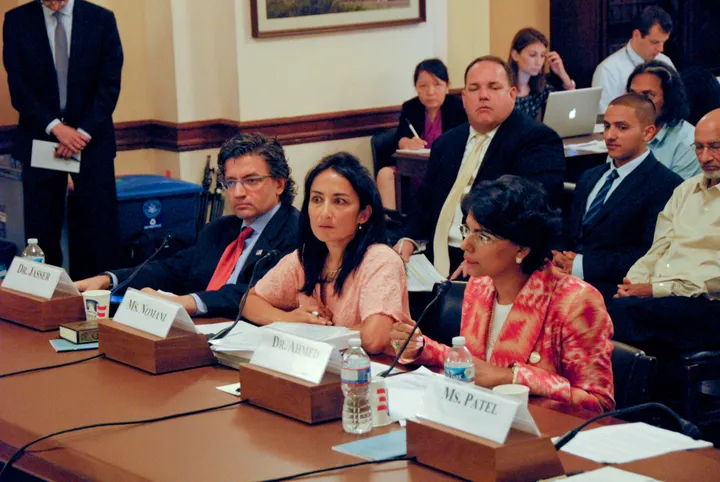
There were many reasons why, when called to do so, I testified in the investigative hearings held by the House Committee on Homeland Security examining radicalization within the Muslim American community.
I testified because, as an anti-Islamist Muslim, I believe exposing a wrong is the bare minimum of my faith. I testified because I have seen the full spectrum of radicalization: from silent approval, to overt sympathies for Islamist ideologies, to the end point of suicidal violence among Pakistani child militants. But most of all, I testified because of my patients here in New York.
At Winthrop University Hospital in Mineola, I am part of a team that attends the World Trade Center First Responder patient population of Nassau County. Long Island is home to 6,000 of the nation's 40,000 first responders, many of whom feel long forgotten by America. Each year, Winthrop cares for 2,500 of these Americans, relieved of the financial burden of their health costs by the James Zadroga bill, spearheaded by Congressman Peter King, R-N.Y., who is also chairman of the Homeland Security Committee.
Rescuers by profession, my patients are members of the NYPD, the FBI, the FDNY, the New York Federal Crime Bureau and other law enforcement agencies. Some are retired, others still work and many are now disabled because of their service to our nation. Sadly, these Americans have granted me painful insights into the indiscriminate burden of radical Islamist acts, insights to which few will ever be privy.
I thought often about these men and women when I visited Pakistan this spring to see "Sabaoon," a school in the Northwest Frontier town of Malakand. There, working with a highly skilled mental health team, Dr. Feriha Peracha deprograms Pakistani child Taliban operatives by rebuilding their psyches.
One boy stands out in my memory in particular. Dressed in a brand new cricket strip, sporting Pakistan's bottle-green "Boom Boom" jersey popular nationwide and glowing from the match he had just played with other Sabaoon students, he looked much as my own brothers did at his age -- active, animated and well looked after.
Later, I learned he was hoping to join a cricket academy to pursue his passion. But within moments, the illusion of confidence fell away as this 18-year-old boy described to me his seduction into, and near annihilation by, the Pakistani Taliban. Speaking to me in Urdu, the account was unnervingly intimate.
He was 15 when it began, the eldest of five, and the son of a father who supported the family with his meager earnings at a small government post. He lived in a four-roomed mud-walled house with his siblings and parents. Gradually lured by an older Pakistani boy with tales of a purer, "more noble" Islam during his long walks to his village school, the boy soon ran away to join the Taliban, dreaming of a higher divine mission.
A Taliban scout told him that the group had purified Pakistan of drugs and alcohol and was leading the country toward a "purer" and "true" Islam. That message appealed to him. Convinced he was serving Islam, the boy found himself immediately relocated from concealed site to concealed site, sometimes spending nights in the open air in Pakistan's harsh but beautiful Swat valley, other times being sequestered in squalid hostels and other such markaz (centers). He never spent more than one night in each locale. This situation made it nearly impossible for his family to find him, and stopped him from making new friends who might influence him away from the Taliban.
He participated in minor missions at first, and then major ones. But it wasn't until he expressed homesickness one Eid holiday and a desire to see his mother that his career as a leader among Taliban was redirected into becoming a suicide operative. The boy was too much of a risk should he break away and become an informer.
He talked about his tarbiyyat, or religious training, in detail. I imagined rote memorization of the Quran. Instead, he learned the correct use of a handgun, the deployment of a grenade and the successful detonation of a suicide jacket. He even had training in rocket launchers, AK47s and LMGs (light machine guns). As I sat opposite him, he carefully demonstrated this knowledge to me, miming the relevant gestures to me, a novice when it comes to weapons. He explained the strategy behind his training: that when approaching his final target, he may be confronted by a police officer and would have to fend him off with his pistol. Law enforcement thus dispatched, he knew to throw the grenade, kept at arm's length in his shalwar (trouser) pocket, into a packed crowd, and, as he watched the crowd flee from the grenade, he would then run into the same panicked masses as he detonated his suicide jacket, achieving maximum carnage.
Finally, he described his ultimate surrender moments from detonation in a local Shiite mosque. As he entered and assessed the surroundings of Muslim men in prayer, he recognized these people. His targets "were Muslim too," he said. He suddenly feared for his own spiritual salvation. His voice lowered as he explained the relief he felt when he turned himself in to the lone, unwary police officer nearby and revealed his weapons. He endured a vicious beating to the heart with the butt of the policeman's rifle and then months of detention by Pakistan's secret police, the ISI.
Though he had given himself up some years earlier, seduced by the Islamist narrative at the age of 15, I discovered he had already wrought extraordinary destruction.
He had participated in a previous attack that killed five Pakistani Frontier Corpsmen and had helped kidnap 11 others in a raid on a military camp. The Taliban took the hostages. He had been part of a separate raid in which more than 100 people from a local tribal court were executed.
Americans Susceptible
The King investigative hearings on radical Islam showed how the same narratives that drove the young Pakistani to violence are alive in the United States today, thriving amid similarly vulnerable, disconnected and indoctrinated youth. Such Islamist radicalization is ongoing in our civilian, military and prison community, as repeated findings from the investigative hearings have uncovered.
Unfortunately, where there should be uproar and carefully targeted actions in response to these critically important findings, we remain mired in political correctness by refusing to identify our enemies' driving ideology.
Islamists distract the discussion from the root of the problem by focusing our attention on what they call "Islamophobia," arguing that the world is using a broad brush to describe Muslims.
Attorney General Eric Holder demonstrated this pandering in his May 2010 testimony before the House Judiciary Committee, when he attempted to discuss failed Times Square bomber Faisal Shahzad's potential motives, while avoiding the term "radical Islam." Holder's agonizing dance around the issue demonstrates just how difficult it has become to talk about the ideology fueling so many terror plots, now that the highest levels of government have banned any discussion of the role of radical religious interpretation. While political correctness may be cloyingly comfortable, reassuring even, it can prove all too deadly, as testimonies in these investigative hearings on radical Islam have shown.
In one of the House radicalization hearings, retired Marine Corps veteran Daris Long testified how political correctness masked Islamist extremism. His son, Army Pvt. William Long, was killed in an Islamist terrorist attack on his recruiting station in Little Rock, Ark., yet the military refused to name it as such, and the shooter was tried in state court rather than on federal terrorism charges.
"The blatant masking and disregard of the facts not only endanger American citizens of non-Muslim faith but also those of Muslim heritage who do not adhere to the extremist beliefs demonstrated by a militant and political form of jihad," Long said.
Melvin Bledsoe testified to the "brainwashing" of his son -- a Muslim convert -- who murdered Pvt. Long and injured another in what I, as a Muslim, call an act of terror.
"This was a Jihadi attack on infidel forces," Carlos Bledsoe, the shooter, wrote in a letter to the judge in his case.
As the politically correct rail against the sound intelligence identifying plots in evolution (and the necessary counter-measures also deemed politically incorrect), they collude with the violent and non-violent Islamists in their foil as Muslims. Masquerading as the "peaceful" translators and "owners" of Islam, Islamists exploit political correctness and, by brandishing the charge of Islamophobia, deter vital scrutiny.
Most recently, pseudo-advocacy groups purportedly representing mainstream American Muslims lobbied the Obama administration to "sanitize" intelligence language used within the FBI to purge references to Islam. This approach only limits debate, scrutiny and examination of Islamist ideologies, both violent and nonviolent.
Our leadership has bowed to such pressures. The 2010 Quadrennial Homeland Security Review never mentions "Islamist" or "Islamic terrorism" in 108 pages. This is in keeping with President Obama's vision, which, according to then Homeland Security Assistant Secretary for Policy David Heyman, "made it clear as we are looking at counterterrorism that our principal focus is al Qaeda and global violent extremism, and that is the terminology and language that has been articulated" by President Obama and his advisers.
In contrast, Pakistan, a nation fighting the highest prevalence of Islamist radicalization, has no such qualms. In fact, the deprogramming at Sabaoon specifically addresses religious scholarship as an area of counter extremism -- identifying and dismantling disordered beliefs and replacing them with healthy, nonviolent Islamic ideals.
This goal cannot be accomplished by shying away from religiously charged language.
Political correctness is a serious obstacle in articulating the Islamist threat here in the United States. Refusing to accurately name it will not make the threat go away. Simplifying complex ideas distilling political Islamism and Islam into one sensitive taboo, rather than building clarity, inflames sentiments and drives polarity.
In this climate, Muslims like me -- those who accept Islam yet revile Islamists -- are rendered voiceless. I am not alone in my practice of Islam, an Islam that values and cherishes other faiths as equally legitimate and, indeed, reminds the Muslim that to each believer is sent his own Law and his own Way, whether a follower of Jesus, Moses, Siddartha or others. As a Muslim, my Islam reminds me, that according to our Maker we cannot place judgment on the belief systems of fellow People of the Book. They must only judge themselves by their own laws and ways and not by the Quran.
My Islam particularly condemns the rampant exercise of violence on the non combatant civilians which includes all nonmilitary personnel, all children, women, elderly and disabled and further identifies no war as ever Holy, only just or unjust. We also understand that jihad has far greater meaning as an internal struggle for self improvement and relief of personal and community suffering than frank warfare for political or military gain. By these standards which Islam gives me, I as a Muslim can repudiate radical Islamism (which relies on the condemnation of all non Muslim elements and all Muslims who dare to balk at their extreme ideology) without wavering in my belief in Islam or failing in my duty as a Muslim.
The government's adherence to political correctness doesn't make room for this distinction because it avoids any reference to radical Islamism.
By avoiding nuance, we fuel simplification. By banning U.S. law enforcement agencies from using the word "Islamist" and other charged language that correctly identifies a manufactured fictional Islam as the origins for Islamist ideology, we have compelled our agencies to kowtow to political correctness. Even their Saudi counterterrorism colleagues, in the cradle of Islam, refer to Islamist terrorists as "Jihadists." This term implicitly identifies their ideological roots within Islam, albeit a distortion of the faith. While discourse in America is hampered by such "propriety," the Saudis, calling a spade a spade, don't stand on such futile ceremony.
Blindfolded by political correctness, we remain vulnerable. Counter warfare on ideological battlefields begins with widening the debate, both on Capitol Hill in congressional committee hearing rooms and on the nation's opinion pages which are increasingly reluctant to host this debate. Without doubt, these investigative hearings are the first public foray examining the divide between Islam and Islamism in contemporary America and as Muslims naming this divide we embrace an Islamic duty. As the Prophet Mohammed (SAW) once said:
"Whoever sees a wrong and is able to put it right with his hand, let him do so; if he can't, then with his tongue, if he can't, then with his heart. That is the bare minimum of faith."
It's that simple for a Muslim. Because I see a wrong, and because I am Muslim, combating Islamism asks me for the bare minimum of my faith, as it does for all Muslims in America if their actions are to match their words as believers in Islam.

Muslims Combating Islamism
This column was originally published as a special to the Investigative Project on Terrorism. Qanta Ahmed is a physician and author of 'In the Land of Invisible Women.'