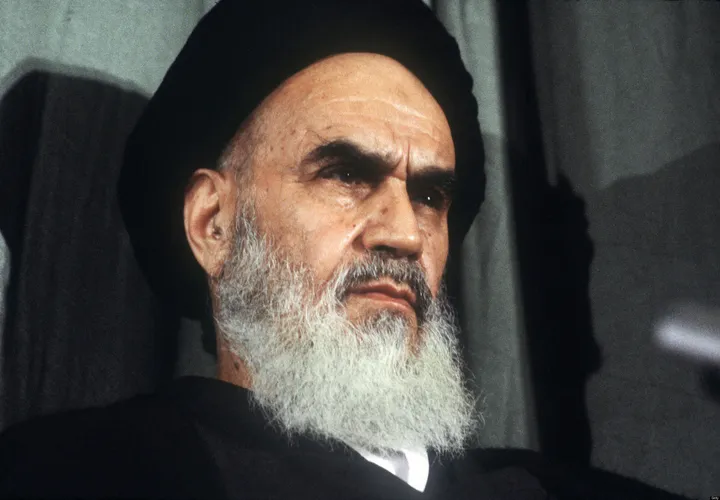
Millions turned out to publicly mourn the passing, 21 years ago, of Ayatolla Khomeini, who led the revolution that overthrew the despotic Shah of Iran and replaced him with a totalitarian Islamic theocracy. Worth the trade? I hardly think so. But that is not the most important question today. Certainly not as speeches given by the current leaders at the memorial ceremonies excoriated the United States, rebuked as heretics any who challenged the current regime, and fantasized about the end of Israel.
The real questions today are not about the past. They need to be about the present and how understanding it better can help us build a better future. How do we get past the options of banging the drums of inevitable war with Iran, as some seem to love doing, or of pretending that today's Iran shouldn't scare pretty much anyone able to read this post, as the way to avoid admitting how tough the situation is?
We start by asking better questions about the meaning of those millions who took to the streets to mourn Ayatollah Khomeini. If they are there because they idolize him and believe that today's Iran honors his legacy, then things are far worse than many want to admit.
If the average Iranian believes that the totalitarian theocracy of 21st-century Iran is the best way forward for their nation, then those of us who oppose theocracy and/or totalitarianism need to speak out much more forcefully about the problem of Iran. It does not matter that this has traditionally been an issue for conservatives and/or Republicans. In fact, many of the human rights abuses and church-state (or mosque-state) issues in Iran are the bread and butter of liberal advocacy groups in the US. So why not speak out when it comes to Iran? The answer cannot be that it's "their" issue.
On the other hand, if the millions who turned out for the memorials did so because they were coerced by the government, then things may be more promising than we often imagine. It may be that people are not so happy with the status quo. It may be that more people than many imagine are still looking for a new way forward. And if that is the case, then offering something other than stark choices between American culture and Islamic totalitarian culture is incredibly important.
I know that like so much of what goes on in the Middle East, and especially in light of this past week's events off the coast of Gaza, we tend to see what we already believe rather than ask how new events present new opportunities and invite us to see the world in new ways. I also know that if we want things to improve, whatever our definition of that word is, we need to do more than use current events to confirm past conclusions.
As Albert Einstein remarked, "No problem could ever be solved at the level of consciousness which created it." Nowhere more than in our thinking about the Middle East should that insight be more forward in our minds.
Follow Brad Hirschfield on Twitter: www.twitter.com/bradhirschfield
Monica Duffy Toft: Understanding Rationality in Religious Violence
Religiously-inspired actors are rational, but like nationalists, their rationality is different. Therefore, we need not avoid theorizing about religious actors because their rationality differs from our common understandings.
Nations like Iran will never progress until they remove religion and religious leaders from gov.
The US will follow the Muslim lead if religion gets a hold in this country, that is why intelligent people should never vote for religious conservatives.
Qdog
Why do you suppose that is?
Could it be that women there aren't treated as poorly as you have been led to believe?
Need I add that 100% of Jewish states were headed by women. :-)
Actually no particular region lives up to that standard very well. Campbell was an accidental PM (never elected) and may be the single most dramatically repudiated leader of a democratic country in history. Bhutto was the daughter of a male politician in a society where family ties rule. So is Megawati. Women rulers who rose to their high office on the strength of their own qualities include Margaret Thatcher and Golda Meir, neither of whom I would imagine would get your vote.
May Iranians have a secular and true democratic government SOON!
;;
Smile.
Happy.
Yay...
;;
Not rioting and falling into the grave would be a good start.
There are many Muslims who feel that this theocracy has led millions of people away from religion in Iran. I gather that Iran's pre-Islamic poets are more genuinely adored than the Ayatollahs of today.
The police and prison guards who imprison, beat, torture, and rape their prisoners hide behind their religion and if I were a devout Muslim, I'd have great resentment towards them for this.
Secularism is the only path to separation of church and state. And it doesn't matter who is arguing for it. They are all equal under the structure they promote.
From reading your post here, am I to gather that you are under the impression that Saddam Hussein should have been left in power? That his atrocities against the people of Iraq were okay because he was a "counterbalance" against Iran? Wow, that sounds indefensible and incredibly short-sighted to me.
If you want an honest answer- should Hussein have been left in power- I say yes. The Iraqis would have eventually taken matters into their own hands- his sons would never have been able to hold onto power- too spoiled and not intelligent enough.
All the best
Knute
TR Knudtson
Robert Baer, in his book The Devil We Know, suggests that the current Iranian leadership could care less about more apologies. They have moved on and are more concerned with spreading their influence and control throughout the Middle East. Understanding and humility are the last things that we need to embrace when dealing with a totalitarian theocracy.
Iran follows in this "grand tradition" by overthrowing the Shah and getting theocratic trash oppressing them even more but this time instead of for the aggrandizement of one man (the Shah) the mullahs claim to be doing it for Sky Daddy...pathetic
That's what makes the U.S. special.
We overthrew England and got......George Washington.
Let's hope for a more open and tolerant society in their future.